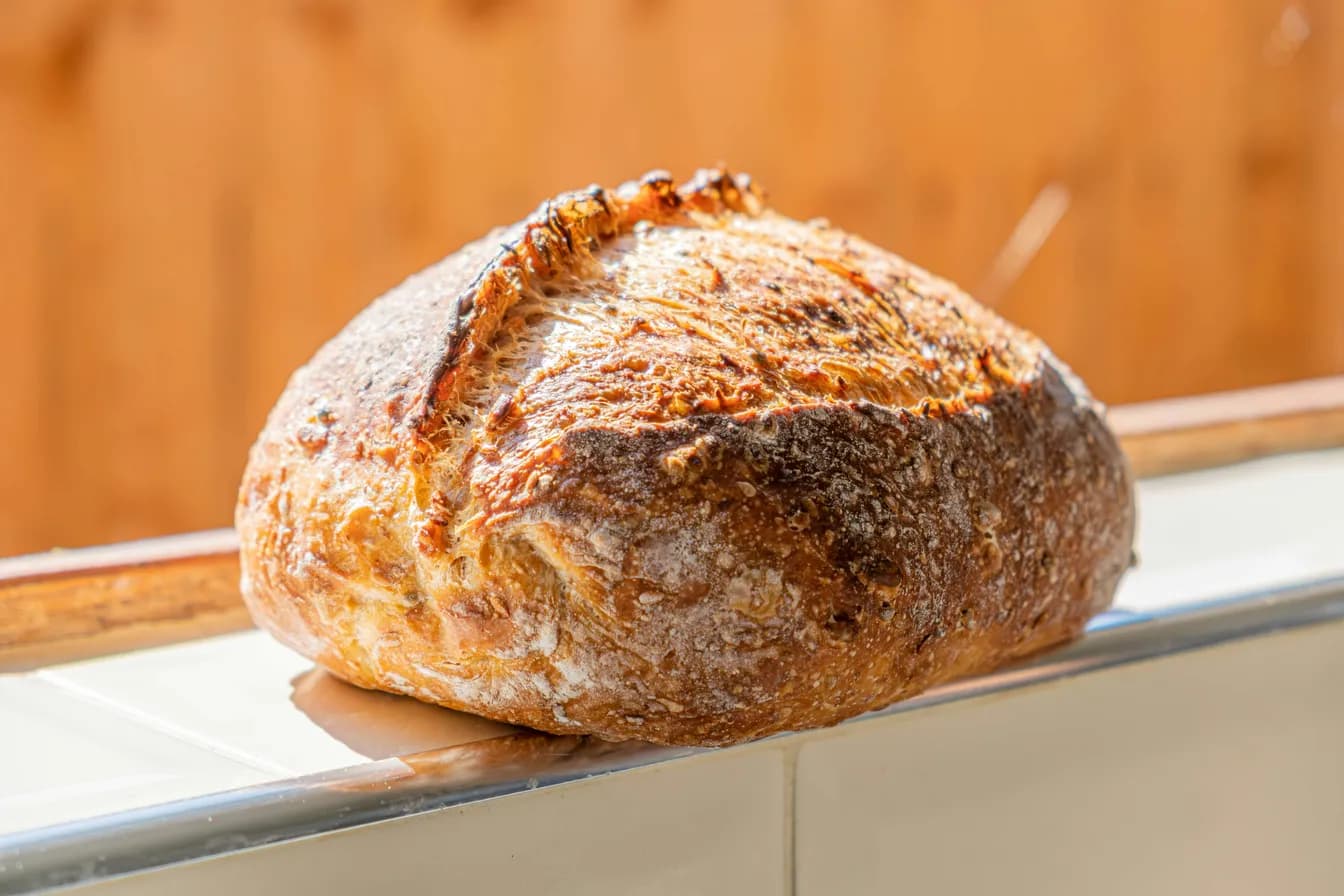
No-Knead Dutch Oven Bread
Twelve hours of time replace ten minutes of kneading, and the Dutch oven replaces the steam oven.
- Preparation
- 10 min
- Cook/bake time
- 45 min
- Total
- 14 hr 25 min
- Difficulty
- Easy
- Calories
- 145 kcal
- Servings
- 12 slices
- Prep
- 10 min
- Cooking & baking
- 45 min
- Resting
- 13 hr 30 min
Only 55 min of that is hands-on – the rest takes care of itself.
Twelve hours of time replace ten minutes of kneading, and the Dutch oven replaces the steam oven. Four ingredients, five minutes of work, a loaf with a crackling crust and an open crumb. The simplest serious bread recipe there is.
Why this works
Kneading aligns gluten strands, but time does that too, all by itself. In a very wet dough, the protein molecules are mobile enough to arrange themselves into a network over twelve hours; this is called autolysis. That is why the 75 percent hydration here is not showing off, but the condition for the recipe to work without kneading. The Dutch oven solves the second problem: A crackling crust needs steam in the first few minutes, because a moist surface remains stretchable longer and the bread can continue to rise. A domestic oven does not hold steam, but a closed cast-iron pot does, because the water from the dough itself evaporates there and stays inside. Take the lid off as soon as the shape is set, and the crust browns dry.
Step-by-step instructions
- 1
Stir together, do not knead
Mix the flour, salt and yeast dry and pour in the water. Stir with a spoon until no dry flour is visible. This takes less than two minutes and the dough looks unfinished and sticky. That is exactly how it should be.
- 2
Let rise for twelve hours
Cover the bowl and let the dough stand at room temperature for twelve hours. It should double in size and be covered with bubbles on the surface. During this time, the gluten network arranges itself, which is the work you save yourself.
- 3
Fold and shape
Tip the dough onto a well-floured surface and fold it four times from the outside to the center, without kneading. Turn it over so that the seam is at the bottom, and pull it into a tight ball with your hands. It is very soft, so work quickly and with plenty of flour on your hands.
- 4
One and a half hours of proofing
Place the ball seam-side up in a floured cloth in a bowl and let it rise for ninety minutes. Preheat the oven in the last half hour with the empty pot and lid to 240 °C. The pot must be thoroughly heated.
- 5
Bake: 30 minutes with lid, 15 without
Carefully tip the dough into the hot pot, score it deeply once and cover it. Bake for thirty minutes with the lid on, then remove the lid and bake for another fifteen minutes until the crust is deep golden brown. Let cool completely on a wire rack before you cut it. If cut hot, the crumb will become gummy.
Our best tips
- The pot must preheat with the oven for at least thirty minutes. A cold pot costs oven spring, and the bread remains flat.
- Do not cut hot. Inside, the starch continues to cook as it cools. Anyone who cuts after ten minutes gets a gummy crumb and cannot undo it.
- The score is not a decoration. It gives the bread a controlled breaking point, otherwise it tears somewhere on the side.
Tasty variations
With sourdough instead of yeast
Replace the yeast with 100 g of active sourdough starter and reduce the amount of water to 325 ml. The rising time increases to 14 to 18 hours, but the bread becomes more aromatic and stays fresh two days longer.
Walnut rye
Replace 150 g of the wheat flour with rye flour Type 1150 and work in 100 g of coarsely chopped walnuts when folding. The dough becomes slightly stickier and the crumb denser, but it is the better bread for cheese.
What is left over?
In two days the loaf will be hard. That is not a problem – it is the start of three more dishes.
Nutrition facts
| Calories | 145 kcal |
|---|---|
| Protein | 5 g |
| Carbohydrates | 30 g |
| – of which sugar | 0 g |
| Fat | 1 g |
| Fiber | 2 g |
Where the 145 kcal come from
per serving
These lines have no quantity (“to taste”) or no table value, so they are missing from the total.
Calculated from the ingredients – how we do it
We add up reference values for every ingredient and divide by the number of servings. These assumptions are baked in:
- Reference values per 100 g – for the raw ingredient, exactly as listed.
- Tinned goods count at drained weight, bone-in meat at purchase weight: you eat about 70 per cent of a chicken thigh and leave the rest.
- Water evaporates as you cook. The energy stays in the pot, the weight does not – so the figure is per serving, not per 100 g of finished dish.
- Anything listed without a quantity – “salt and pepper” – is not counted.
A guide value, not a lab measurement: no two onions weigh the same, and fat content varies from pack to pack.
Frequently asked questions
I do not have a cast-iron pot, does it still work?
Any ovenproof pot with a lid works, including stainless steel or ceramic, as long as it can withstand 240 degrees. The lid handle must not be made of plastic. Without a pot, you bake on a hot tray with a bowl of water in the oven. The crust will then be thinner, but the bread will succeed.
My bread stayed flat. Why is that?
Mostly due to overproofing: After twelve hours at a summery 26 degrees, the dough is already past its peak and collapses when shaped. In summer, eight to ten hours are enough. Second cause: a pot that was not preheated.
How do I store the bread?
Cut side down on a board, not in plastic, where the crust softens within hours. This way it keeps for three to four days. After that, it is not old bread, but the ingredient for croutons, bread dumplings and French toast.
Comments & ratings(0)
Sign in to rate and comment on this recipe.
You might also like
 Bread & Rolls
Gluten-Free Bread
Without gluten the structure is missing. Psyllium husks rebuild it, and the dough is intentionally liquid.
 Basic Recipes
Sourdough Starter
Flour and water, seven days, feeding once a day, that is all it takes.
 Low Carb
Cauliflower Rice
A rice substitute made from cauliflower with a tenth of the carbohydrates, dry roasted instead of steamed, otherwise it turns to mush.