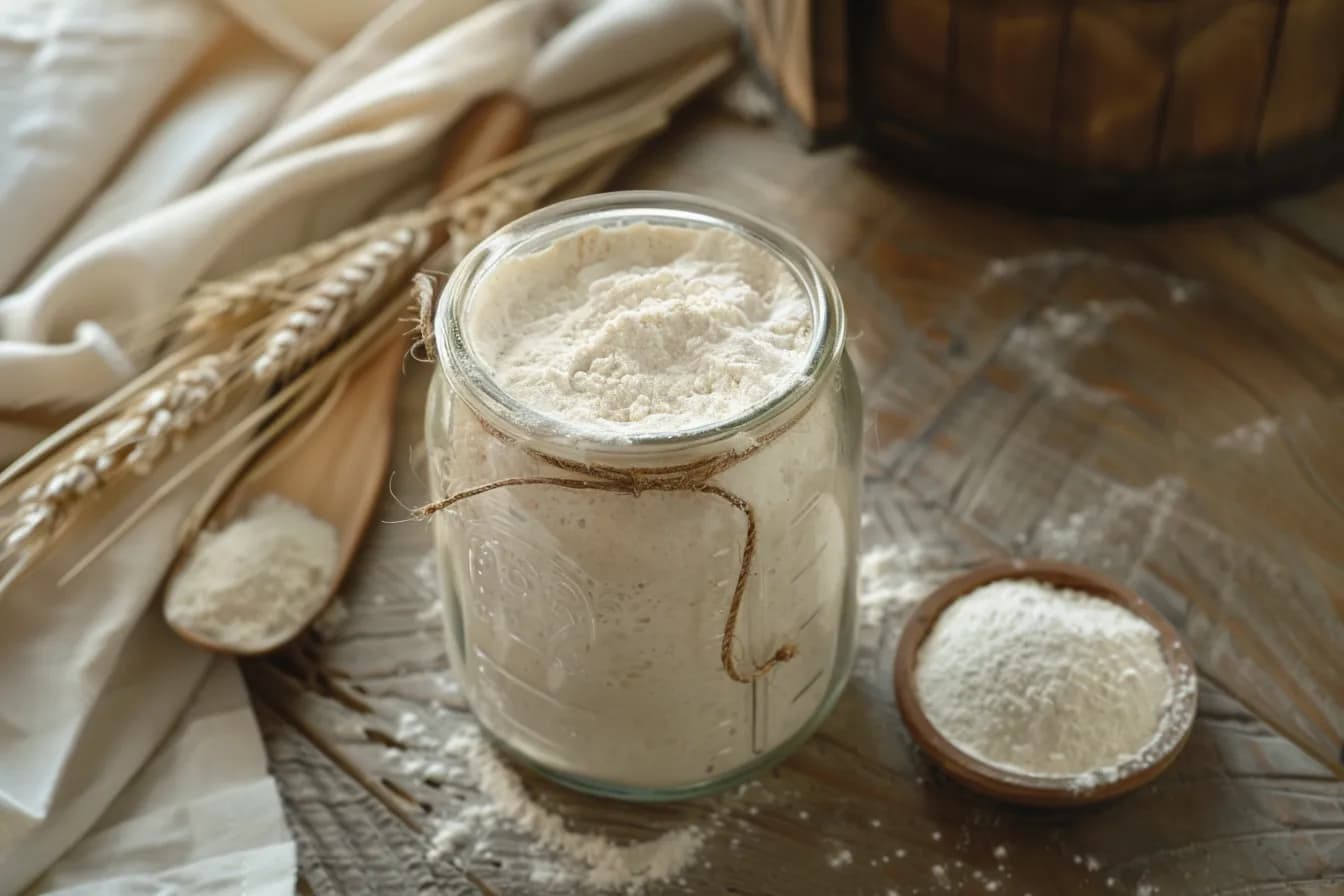
Sourdough Starter
Flour and water, seven days, feeding once a day, that is all it takes.
- Preparation
- 25 min
- Cook/bake time
- –
- Total
- 168 hr 25 min
- Difficulty
- Medium
- Calories
- 33 kcal
- Servings
- 10 servings
- Prep
- 25 min
- Resting
- 168 hr
Only 25 min of that is hands-on – the rest takes care of itself.
Flour and water, seven days, feeding once a day, that is all it takes. A sourdough starter is a culture of wild yeasts and lactic acid bacteria that are already present in the flour. You do not breed them, you just give them the conditions under which they outcompete the rest.
Why this works
Yeasts and bacteria sit on every grain, including lactic acid bacteria and various spoilage germs. In the first few days, the wrong ones are in the majority, which is why a young starter often smells unpleasant. Daily feeding reverses the ratio. The lactic acid bacteria lower the pH value below 4, and hardly any other germ can tolerate this acidic environment, so the culture protects itself. Whole grain rye flour is the best starter because its bran brings the most microorganisms and the most enzymes. And the temperature determines the taste. At 26 to 28 degrees, mild lactic acid bacteria predominate, significantly below that, acetic acid producers prevail and the dough becomes sharp and sour.
Step-by-step instructions
- 1
Day 1: starting
Mix the flour and water in a jar to form a thick paste and cover it loosely so that air can get in but nothing falls in. Place it in a warm spot at 26 to 28 degrees, such as on top of the fridge or in the oven with the light turned on.
- 2
Day 2 and 3: first movement
Stir in 50 g of flour and 50 ml of water every day. The starter will now form bubbles and may smell strange, like cheesy feet, acetone, or wet cardboard. This is normal and will pass, as the wrong bacteria are still fighting here.
- 3
Day 4 and 5: the quiet phase
Often nothing seems to happen for two days now. Keep feeding anyway. In this phase, the ratio tips. The lactic acid bacteria lower the pH value, and the early troublemakers disappear.
- 4
Day 6 and 7: reliable rise
Now the starter should visibly double within four to six hours after feeding and smell pleasantly sour like yogurt and apple. This is the sign that it is ready, not the date.
- 5
Storage
From now on, the starter lives in the fridge and is fed once a week. Take half away, stir in 50 g of flour and 50 ml of water. Before baking, you take it out twelve hours beforehand and feed it twice so that it reaches operating temperature.
Our best tips
- Use whole grain rye flour to start, even if you want to bake wheat bread later. Its bran brings the most microorganisms and the starter gets going two days earlier.
- 26 to 28 degrees are the difference between mild and sharp. If kept too cool, acetic acid producers prevail, and you can taste that later in the bread.
- Chlorinated tap water can slow down the culture. Let the water stand open for an hour, then the chlorine will have escaped.
Tasty variations
Wheat sourdough (Lievito madre)
After day 7, switch to wheat flour Type 550 and feed with less water over a week (50 g flour, 25 ml water). This results in a firm, mild starter for Panettone and Italian breads.
Drying for emergencies
Spread some starter thinly on baking paper, let it dry and crumble it. It will keep for years in a jar and can be revived with lukewarm water within two days, which is your insurance against a forgotten vacation.
What is left over?
In two days the loaf will be hard. That is not a problem – it is the start of three more dishes.
Nutrition facts
| Calories | 33 kcal |
|---|---|
| Protein | 1 g |
| Carbohydrates | 7 g |
| – of which sugar | 0 g |
| Fat | 0 g |
| Fiber | 2 g |
Where the 33 kcal come from
per serving
Calculated from the ingredients – how we do it
We add up reference values for every ingredient and divide by the number of servings. These assumptions are baked in:
- Reference values per 100 g – for the raw ingredient, exactly as listed.
- Tinned goods count at drained weight, bone-in meat at purchase weight: you eat about 70 per cent of a chicken thigh and leave the rest.
- Water evaporates as you cook. The energy stays in the pot, the weight does not – so the figure is per serving, not per 100 g of finished dish.
- Anything listed without a quantity – “salt and pepper” – is not counted.
A guide value, not a lab measurement: no two onions weigh the same, and fat content varies from pack to pack.
Frequently asked questions
My starter smells like acetone, is it broken?
No, it is hungry. The smell occurs when the yeasts have used up their sugar. Feed it two to three times at intervals of twelve hours, then it will normalize. It is only truly spoiled if there is pink, orange or furry mold, which belongs in the trash, along with the jar.
Do I really have to throw away half every day?
Not in the first week, where you only feed, otherwise you will have hardly any culture after seven days. Later in the fridge, yes. Without removing some, the amount grows exponentially. The removed part is not waste, it goes into pancakes, waffles and crackers.
How do I know it is ready to bake?
By the doubling test. After feeding, it must visibly double in four to six hours and be evenly permeated when cut open. A spoonful of it must float in water. If it smells sour and fruity instead of pungent, it is ripe.
Comments & ratings(0)
Sign in to rate and comment on this recipe.
You might also like
 Bread & Rolls
No-Knead Dutch Oven Bread
Twelve hours of time replace ten minutes of kneading, and the Dutch oven replaces the steam oven.
 Bread & Rolls
Gluten-Free Bread
Without gluten the structure is missing. Psyllium husks rebuild it, and the dough is intentionally liquid.
 Bread & Rolls
Oktoberfest Pretzels
Bavarian lye pretzels with a thick belly and thin arms, soft on the inside, mahogany brown and salty on the outside.