Oktoberfest Pretzels
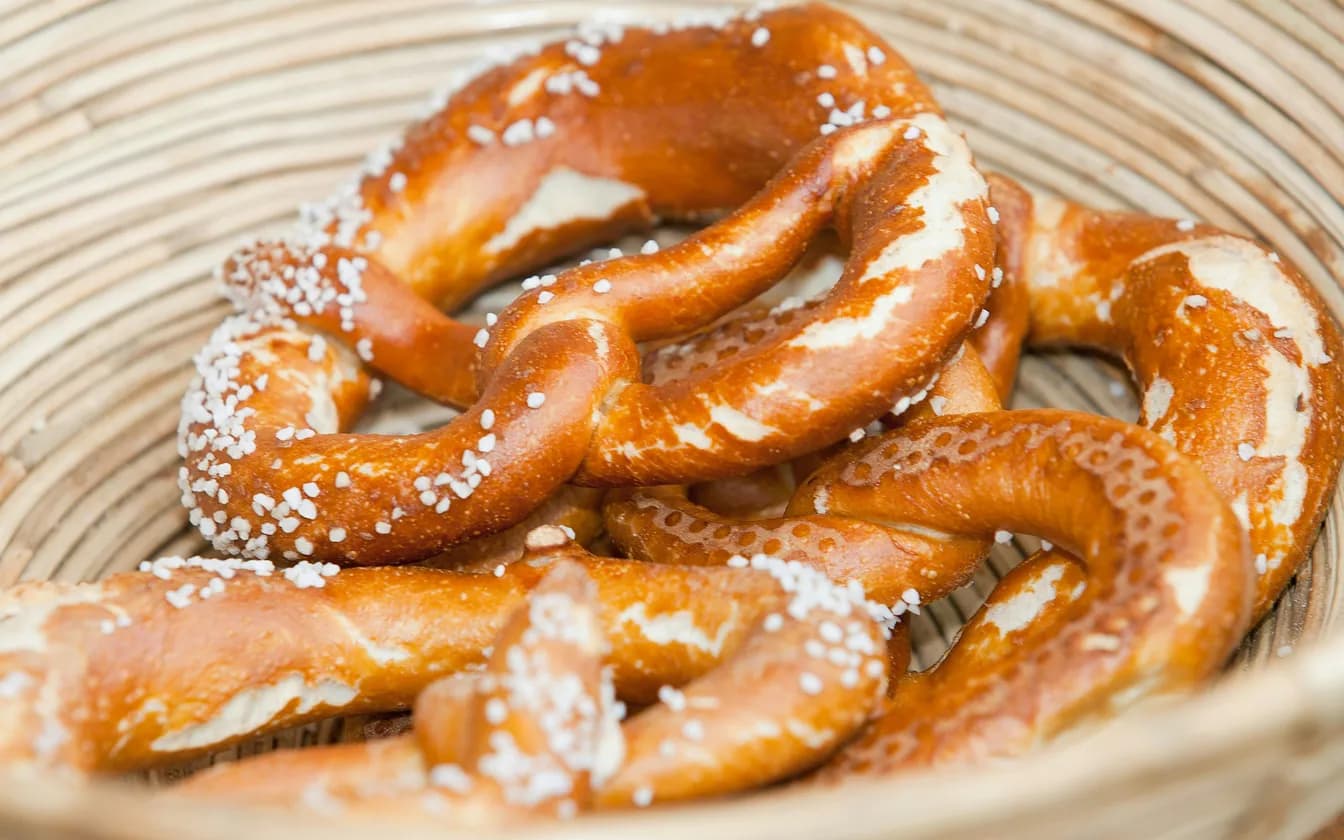
Bavarian lye pretzels with a thick belly and thin arms, soft on the inside, mahogany brown and salty on the outside.
- Preparation
- 45 min
- Cook/bake time
- 18 min
- Total
- 13 hr 33 min
- Difficulty
- Advanced
- Calories
- 249 kcal
- Servings
- 8 pieces
- Prep
- 45 min
- Cooking & baking
- 18 min
- Resting
- 12 hr 30 min
Only 1 hr 3 min of that is hands-on – the rest takes care of itself.
Bavarian lye pretzels with a thick belly and thin arms, soft on the inside, mahogany brown and salty on the outside. The color and typical flavor do not come from baking, but from the lye bath: sodium hydroxide makes the surface highly alkaline, and only this triggers the reaction in the oven that makes a pretzel a pretzel. With baking soda alone, it becomes a pretzel-shaped roll.
Why this works
The Maillard reaction, which browns bread, runs faster the more alkaline the surface is. A four percent sodium hydroxide solution raises the pH of the dough skin to about 13, and as a result, the pretzel browns to a deep mahogany color at 220 degrees in just a few minutes, while the inside remains soft and light. This contrast is the whole trick. Baking soda dissolved in water only reaches a pH of about 8.5 and therefore never achieves the same color, let alone the typical lye flavor. The refrigerator step beforehand serves a different purpose: overnight, the surface dries slightly and forms a skin to which the lye adheres instead of soaking into the dough. Without this step, the pretzel will be soapy on the inside.
Step-by-step instructions
- 1
Knead the dough
Knead the flour, cold water, salt, yeast, sugar, and softened butter into a firm, smooth dough for at least ten minutes. Pretzel dough is significantly firmer than bread dough and feels stubborn when kneading. This is correct, because only a firm dough will hold the thin arms later.
- 2
Let rise briefly and shape
Let the dough rest covered for thirty minutes, then divide it into eight pieces and roll each into a strand about 50 cm long, thick in the middle and tapering thin at the ends. Exactly this uneven thickness later results in the soft belly and the crispy arms. Lay the strand into a U shape, twist the ends around each other twice, and fold them down onto the belly.
- 3
Overnight in the refrigerator
Place the pretzels on a baking sheet lined with parchment paper and put them **uncovered** in the refrigerator for twelve hours. The surface must dry out and feel tacky to the touch. This is what the lye will adhere to later instead of soaking into the dough. It does not work if covered.
- 4
Lye bath with gloves
Put on rubber gloves and safety goggles and **always dissolve the sodium hydroxide into the water**, never the other way around. Use a bowl made of plastic, glass, or stainless steel. Aluminum is attacked by lye. Dip each pretzel for thirty seconds, lift it out with a slotted spoon, and place it back on the baking sheet.
- 5
Score, salt, bake
Score the thick belly lengthwise once with a sharp blade and sprinkle coarse salt over it. Bake the pretzels at 220 °C top/bottom heat for 16 to 18 minutes until they are deep mahogany brown. They will get darker than seems right when watching. The color is the flavor.
Our best tips
- Food-grade sodium hydroxide is available in pharmacies and baking supply stores. Gloves and safety goggles are not a recommendation, but mandatory: lye burns skin and eyes. Leftovers can be neutralized with plenty of water and a splash of vinegar before disposal.
- No aluminum baking sheets and no aluminum foil. Sodium hydroxide dissolves aluminum, forming hydrogen gas. Parchment paper on an enamel or stainless steel baking sheet is correct.
- Pretzels taste best on the day they are baked, ideally within the first three hours. After that, freezing is more worthwhile than storing: baked from the freezer at 180 °C for five minutes, they are almost fresh again.
Tasty variations
With baking soda instead of lye
Bake 150 g of baking soda on a baking sheet for one hour at 150 °C. This creates the more alkaline sodium carbonate. Add 60 g of this to 1 l of boiling water and let the pretzels steep in it for one minute. Comes closer to the original than raw baking soda, but does not reach the real lye.
Lye sticks and rolls
The same dough, just shaped differently: 15 cm long sticks or round rolls. Shaping is much easier than twisting pretzels, while the bath and baking time remain the same.
Nutrition facts
| Calories | 249 kcal |
|---|---|
| Protein | 7 g |
| Carbohydrates | 45 g |
| – of which sugar | 1 g |
| Fat | 4 g |
| Fiber | 3 g |
Where the 249 kcal come from
per serving
Calculated from the ingredients – how we do it
We add up reference values for every ingredient and divide by the number of servings. These assumptions are baked in:
- Reference values per 100 g – for the raw ingredient, exactly as listed.
- Tinned goods count at drained weight, bone-in meat at purchase weight: you eat about 70 per cent of a chicken thigh and leave the rest.
- Water evaporates as you cook. The energy stays in the pot, the weight does not – so the figure is per serving, not per 100 g of finished dish.
- Anything listed without a quantity – “salt and pepper” – is not counted.
A guide value, not a lab measurement: no two onions weigh the same, and fat content varies from pack to pack.
Frequently asked questions
How many calories does a pretzel have?
About 250 kcal per piece of around 100 grams. This puts it roughly on par with two slices of bread. The pretzel is considered high in calories mainly because rarely is only one eaten.
Can it be done without sodium hydroxide?
It can, but it won't be a pretzel. Baking soda in water reaches around pH 8.5, sodium hydroxide about pH 13, and only there does the browning reaction occur in such a way that the typical color and lye flavor develop. Baked baking soda comes closest.
Is the lye still dangerous after baking?
No. During baking, the sodium hydroxide reacts completely with the carbon dioxide in the air and the components of the dough. Only handling the solution beforehand is dangerous.
Why do the pretzels have to go in the refrigerator overnight?
So that the surface dries out. On a moist dough skin, the lye soaks in and makes the pretzel soapy on the inside. On a dried skin, it stays on the outside where it belongs.
Why doesn't my pretzel belly split open?
Either the cut was too shallow or the dough was too soft. The cut can easily be half a centimeter deep, and the dough is one of the firmest of all. At 50 percent water content, it is significantly drier than bread dough.
Comments & ratings(0)
Sign in to rate and comment on this recipe.
You might also like
 Basic Recipes
Yeast Dough
A sweet basic dough for braided bread, rolls, and doughnuts, and the answer to the question of why it sometimes fails to rise.
 Basic Recipes
Sourdough Starter
Flour and water, seven days, feeding once a day, that is all it takes.
 Basic Recipes
Homemade Pizza Dough (24-Hour Cold Fermentation)
Mix it tonight, bake it tomorrow: time does the work, not you.