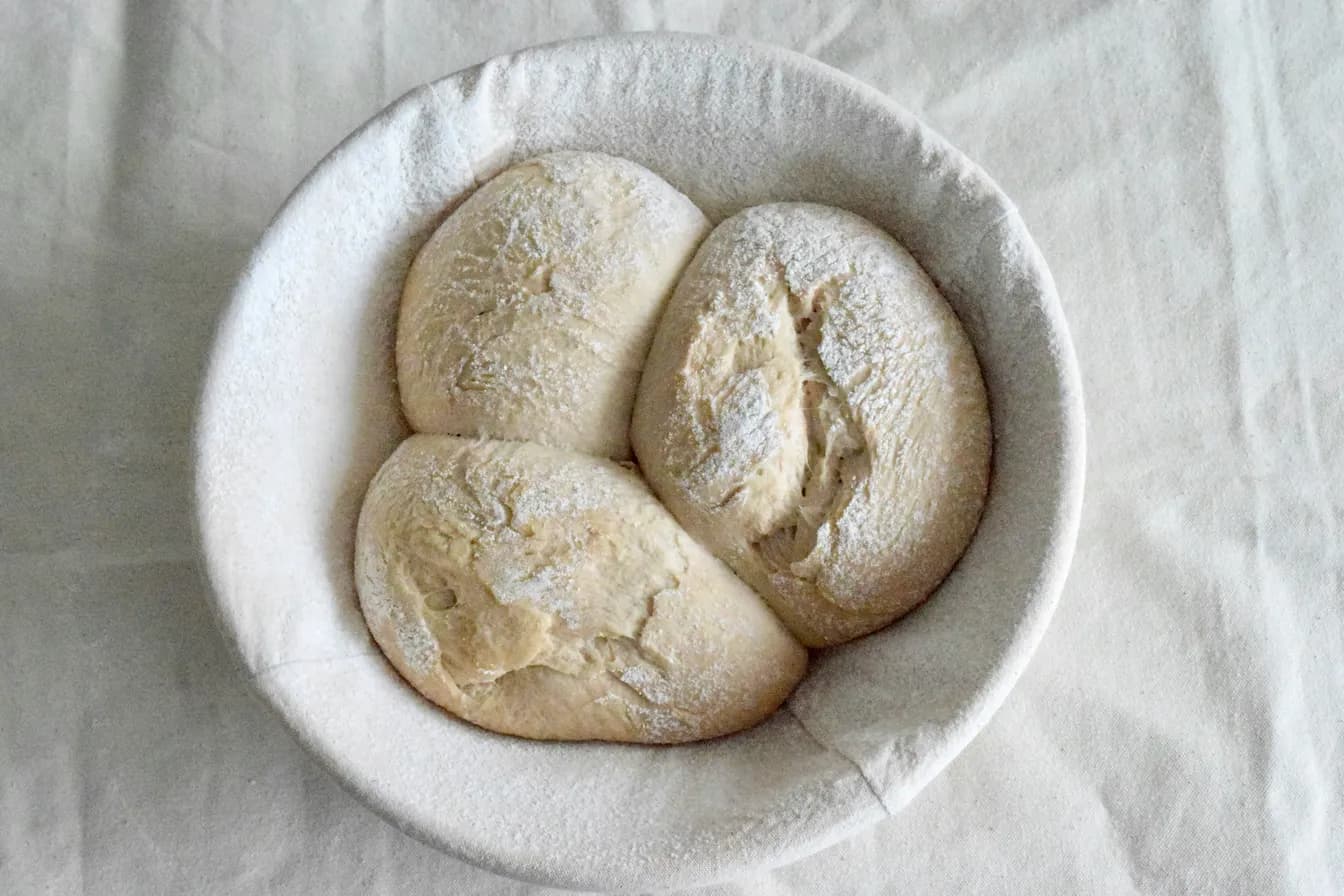
Yeast Dough
A sweet basic dough for braided bread, rolls, and doughnuts, and the answer to the question of why it sometimes fails to rise.
- Preparation
- 25 min
- Cook/bake time
- –
- Total
- 1 hr 55 min
- Difficulty
- Medium
- Calories
- 243 kcal
- Servings
- 12 pieces
- Prep
- 25 min
- Resting
- 1 hr 30 min
Only 25 min of that is hands-on – the rest takes care of itself.
A sweet basic dough for braided bread, rolls, and doughnuts, and the answer to the question of why it sometimes fails to rise. In nine out of ten cases, the liquid was too hot. Yeast dies at 45 degrees, and milk that feels warm is often already there. Lukewarm means body temperature, not warm.
Why this works
Yeast is a fungus, and like any organism, it has an optimal temperature. At 30 to 35 degrees it works fastest, and from 45 degrees it dies. This is exactly where most yeast doughs fail, because milk that feels distinctly warm to the hand is often already over 45 degrees, meaning the yeast is dead before the dough is even kneaded. The second point is the kneading itself. During kneading, the gluten proteins align and cross-link to form an elastic framework that traps the gas bubbles from the yeast. Without this framework, the carbon dioxide escapes and the dough does not rise, even if the yeast is working. Sugar and fat additionally slow down both processes. Sugar osmotically draws water from the yeast, and fat settles between the gluten strands. This is why a sweet yeast dough rises more slowly than a bread dough, and it is why the butter is only added once the framework is already established.
Step-by-step instructions
- 1
Temper the liquid
Heat the milk to a maximum of 40 degrees. It should feel neutral on the inside of your wrist, not warm. Stir the yeast into it. Anyone who works too hot here has already lost the dough without realizing it, because the mistake only becomes apparent an hour later.
- 2
Knead without butter
Add the flour, sugar, egg, salt, and lemon zest and knead for eight minutes into a smooth dough. The butter is left out at first. Fat interferes with gluten cross-linking, and the framework should be established before it is softened with it.
- 3
Incorporate the butter
Add the softened butter in pieces and knead for another five minutes. The dough will fall apart in between and come back together, which is normal. It is ready when it is shiny, pulls away from the edge of the bowl, and can be stretched thin without tearing.
- 4
Let rise until doubled
Cover the dough and place it in a warm, draft-free spot until it has doubled in size. At 24 degrees this takes about 60 minutes, and at 18 degrees it takes almost twice as long. Go by volume, not by the clock. The finger test: a dent that springs back slowly means it is ready.
- 5
Shape and second proof
Press the dough together once, shape it according to the recipe, and let it rise for another 30 minutes. This second, shorter proof after shaping is the difference between a fluffy and a dense pastry. Anyone who puts it straight into the oven gets neither.
Our best tips
- The liquid is the most common source of error. Above 45 degrees the yeast is dead, and you only notice it when nothing has happened after an hour.
- Do not put salt directly on the yeast. It draws water from it and slows it down, so it belongs with the flour, not in the milk.
- The dough can be proofed overnight in the refrigerator. It rises slowly there and develops significantly more flavor. Let it acclimatize for an hour the next morning.
Tasty variations
Savory yeast dough
Reduce the sugar to 20 g and replace the milk with water. This is the base for pizza rolls, onion tart, and pretzel pastries.
Overnight proofing
Reduce the amount of yeast to 7 g of fresh yeast and place the dough in the refrigerator for twelve hours. It is significantly more aromatic because the yeast has more time for byproducts.
Nutrition facts
| Calories | 243 kcal |
|---|---|
| Protein | 6 g |
| Carbohydrates | 38 g |
| – of which sugar | 8 g |
| Fat | 7 g |
| Fiber | 2 g |
Where the 243 kcal come from
per serving
Calculated from the ingredients – how we do it
We add up reference values for every ingredient and divide by the number of servings. These assumptions are baked in:
- Reference values per 100 g – for the raw ingredient, exactly as listed.
- Tinned goods count at drained weight, bone-in meat at purchase weight: you eat about 70 per cent of a chicken thigh and leave the rest.
- Water evaporates as you cook. The energy stays in the pot, the weight does not – so the figure is per serving, not per 100 g of finished dish.
- Anything listed without a quantity – “salt and pepper” – is not counted.
A guide value, not a lab measurement: no two onions weigh the same, and fat content varies from pack to pack.
Frequently asked questions
Why is my yeast dough not rising?
In most cases, the liquid was too hot. Yeast dies at 45 degrees. Other reasons include expired yeast, salt directly on the yeast, or a location that is too cold. At 18 degrees, the same dough takes almost twice as long.
How many calories are in one piece?
Around 245 kcal per piece if you make twelve pieces from the entire dough. What it becomes decides the rest. A braided yeast bread stays in this range, while a filled doughnut is significantly higher.
Fresh yeast or dry yeast?
Both work. A 42 g cube of fresh yeast corresponds to about 14 g of dry yeast. Fresh yeast must be dissolved in liquid, while dry yeast can be added directly to the flour. Otherwise, there is no difference in the result.
Can I freeze yeast dough?
Yes, ideally after the first rise and shaping. It keeps for three months frozen. Thaw it overnight in the refrigerator and then do the second proof at room temperature.
Comments & ratings(0)
Sign in to rate and comment on this recipe.
You might also like
 Bread & Rolls
Oktoberfest Pretzels
Bavarian lye pretzels with a thick belly and thin arms, soft on the inside, mahogany brown and salty on the outside.
 Basic Recipes
Shortcrust Pastry
1-2-3 dough for tarts, cookies, and covered cakes, along with the rule of why it must not be kneaded.
 Basic Recipes
Sourdough Starter
Flour and water, seven days, feeding once a day, that is all it takes.