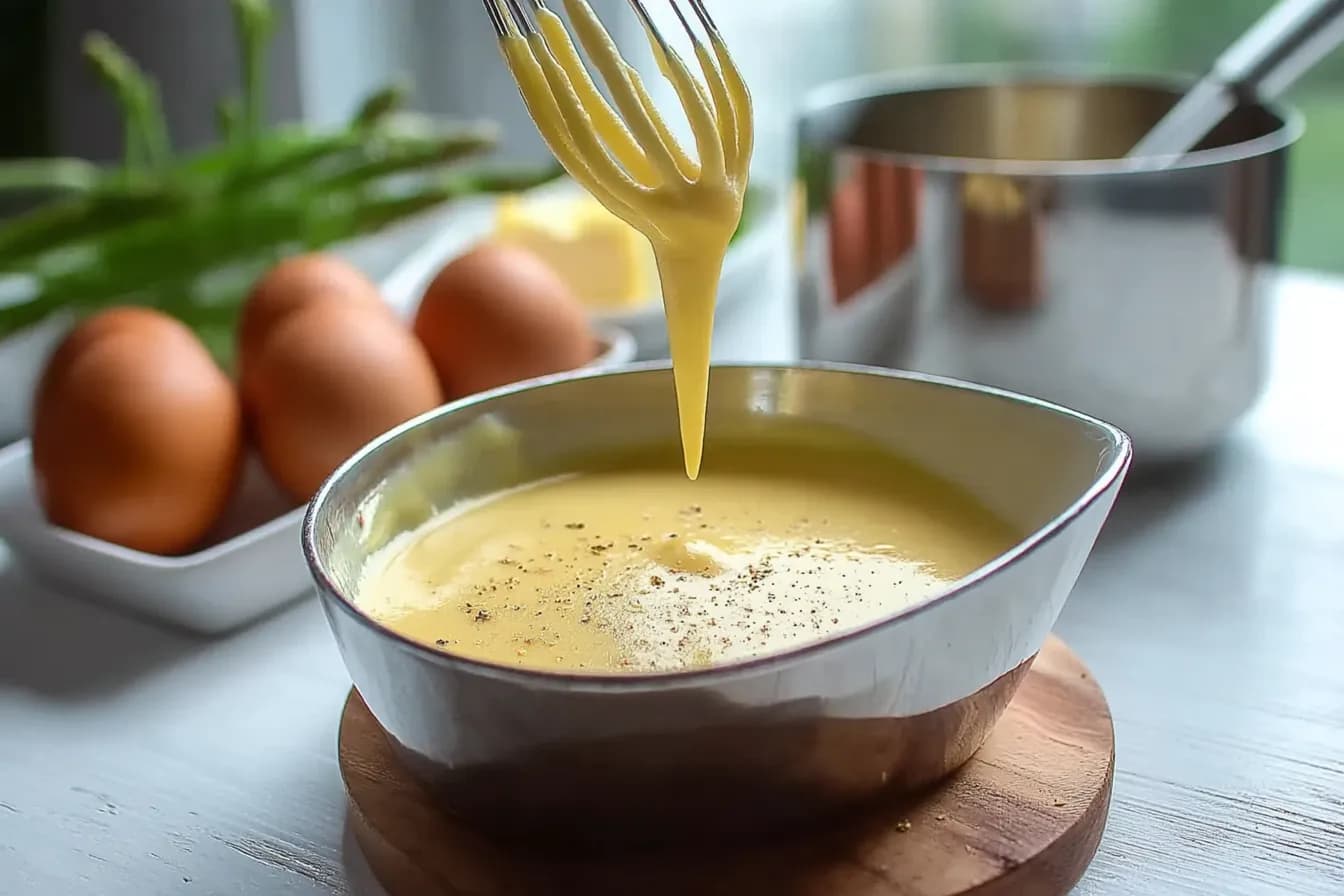
Hollandaise Sauce
A whipped butter and egg yolk emulsion ready in eight minutes, along with the rule on exactly what temperature makes it curdle.
- Preparation
- 10 min
- Cook/bake time
- 20 min
- Total
- 30 min
- Difficulty
- Medium
- Calories
- 434 kcal
- Servings
- 4
- Prep
- 10 min
- Cooking & baking
- 20 min
A whipped butter and egg yolk emulsion ready in eight minutes, along with the rule on exactly what temperature makes it curdle. Hollandaise is considered difficult but is simply sensitive to temperature. Above 70 degrees Celsius, the egg yolk scrambles, and below that, nothing terrible happens. Anyone who keeps a thermometer nearby will get it right the first time.
Why this works
Hollandaise is an emulsion of butterfat in an aqueous phase, and the lecithin in the egg yolk acts as the emulsifier holding both together. The critical point is the temperature. Egg yolk proteins begin to denature at around 65 degrees Celsius and become solid at 70 degrees, at which point you have scrambled eggs in butter instead of a sauce. At the same time, the emulsion needs heat because cold butter cannot be dispersed into droplets. The window therefore lies between 60 and 68 degrees, which is exactly why it is prepared over a water bath. Water cannot get hotter than 100 degrees, and the bowl above it reliably stays below that during a gentle simmer. The reduction of vinegar and white wine is not merely for flavor. Its acidity lowers the pH value, and in an acidic environment, the egg yolk proteins only denature at a higher temperature. It therefore makes the sauce measurably more stable.
Step-by-step instructions
- 1
Clarify the butter
Melt the butter slowly and let it stand briefly. Skim off the white foam and carefully pour off the clear butter so that the milky sediment remains behind. This water and protein in the sediment are the most common reason a hollandaise splits later on. Let it cool to about 60 degrees Celsius.
- 2
Boil down the reduction
Boil down the white wine, vinegar, shallot, and peppercorns until about two tablespoons remain, and pour the liquid through a sieve. The acidity in it is not just a flavor detail. It shifts the coagulation point of the egg yolk upward and gives you several degrees of additional leeway.
- 3
Whip the egg yolks
Whisk the egg yolks and reduction in a bowl and place it over a water bath that is only gently simmering and does not touch the bowl. Whip continuously until the mixture is light, thick, and frothy, and the whisk leaves trails. This happens at 65 degrees Celsius.
- 4
Pour in the butter
Remove the bowl from the water bath and pour in the clarified butter, first drop by drop, then in a thin stream while you continue to whip. Adding butter too quickly overwhelms the emulsifier and the sauce separates. This is the same mechanism as with mayonnaise.
- 5
Season to taste
Season to taste with lemon juice, salt, and cayenne pepper. If the sauce is too thick, stir in a tablespoon of warm water. Hollandaise keeps lukewarm for about an hour in a thermos flask. In the refrigerator, it solidifies and cannot be saved.
Our best tips
- If the sauce has curdled, it is not lost. Put a fresh egg yolk in a clean bowl and whip the curdled mixture into it drop by drop. This almost always works.
- The butter must not be hot when it is added to the egg yolk. About 60 degrees Celsius is right. Boiling hot butter cooks the egg yolk immediately, no matter how fast you stir.
- Hollandaise is a sauce for the moment. It cannot be prepared in advance and cannot be reheated, so it is the final step before serving.
Tasty variations
Béarnaise sauce
Add tarragon and chervil to the reduction and omit the lemon juice. The classic sauce for steak uses the same technique with a different herb.
Quick blender hollandaise
Whip the egg yolks and reduction in a tall beaker with an immersion blender and slowly pour in the 70-degree butter. Ready in two minutes and significantly less prone to failure.
What is left over?
This recipe only uses the yolks. The whites keep for three days in the fridge and freeze well – nobody has to throw them out.
Nutrition facts
| Calories | 434 kcal |
|---|---|
| Protein | 3 g |
| Carbohydrates | 2 g |
| – of which sugar | 1 g |
| Fat | 45 g |
| Fiber | 0 g |
Where the 434 kcal come from
per serving
Calculated from the ingredients – how we do it
We add up reference values for every ingredient and divide by the number of servings. These assumptions are baked in:
- Reference values per 100 g – for the raw ingredient, exactly as listed.
- Tinned goods count at drained weight, bone-in meat at purchase weight: you eat about 70 per cent of a chicken thigh and leave the rest.
- Water evaporates as you cook. The energy stays in the pot, the weight does not – so the figure is per serving, not per 100 g of finished dish.
- Anything listed without a quantity – “salt and pepper” – is not counted.
A guide value, not a lab measurement: no two onions weigh the same, and fat content varies from pack to pack.
Frequently asked questions
How many calories does hollandaise sauce have?
Around 435 kcal per serving for four servings. The sauce consists practically only of butter and egg yolk. The 45 g of fat per serving are what make it, and they cannot be optimized away.
At what temperature does hollandaise curdle?
From about 70 degrees Celsius. Egg yolk proteins begin to denature at 65 degrees and are solid at 70. The working window is between 60 and 68 degrees, which is why it is done over a water bath and never directly on the stove.
My sauce has curdled, what now?
Put a fresh egg yolk in a clean bowl and whip in the curdled sauce drop by drop. The new emulsifier rebuilds the emulsion. Only if the egg yolk is visibly scrambled is the attempt no longer worthwhile.
Can I prepare it in advance?
No. In the refrigerator, the butter solidifies and the emulsion breaks when heated. Kept lukewarm in a thermos flask, it lasts about an hour, which is the only delay that works.
Comments & ratings(0)
Sign in to rate and comment on this recipe.
You might also like
 Salads
Basic Vinaigrette Recipe – the 3:1 Formula
Three parts oil, one part acid, one spoonful of emulsifier, and then you choose which.
 Basic Recipes
Béchamel Sauce Basic Recipe
Butter, flour, milk, equal parts fat and flour, and the milk in three batches.
 Basic Recipes
How to Make Mayonnaise
One egg yolk binds a quarter liter of oil, provided it is added drop by drop and everything is at the same temperature.