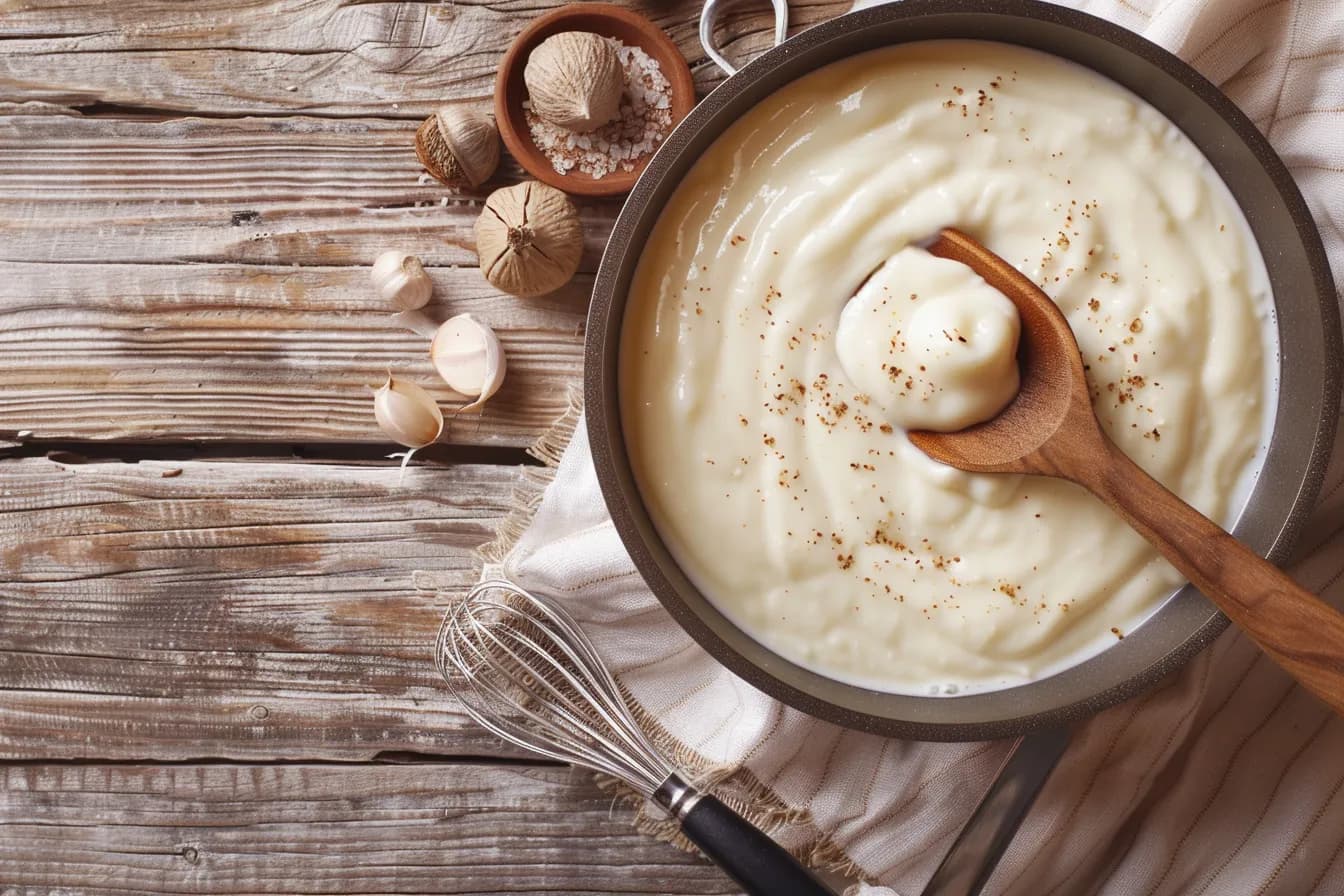
Béchamel Sauce Basic Recipe
Butter, flour, milk, equal parts fat and flour, and the milk in three batches.
- Preparation
- 5 min
- Cook/bake time
- 17 min
- Total
- 22 min
- Difficulty
- Medium
- Calories
- 157 kcal
- Servings
- 6 servings
- Prep
- 5 min
- Cooking & baking
- 17 min
Butter, flour, milk, equal parts fat and flour, and the milk in three batches. The mother of all white sauces, the foundation for lasagna, casseroles, Croque Monsieur, and gratins. Once you make it without lumps, you will never need a store-bought sauce again.
Why this works
Lumps form because flour in water immediately gelatinizes on the outside and traps the dry center. The butter prevents exactly this: it coats each starch granule individually so that the milk reaches them all at the same time. That is why fat and flour are used in equal parts, less butter and the coating is incomplete. Foaming the roux for two minutes serves a second purpose: it removes the raw taste from the flour without it taking on color, which would make the sauce gray. And the milk is added in three batches instead of all at once because a small amount of liquid can be stirred in without lumps, and the next batch then flows into an already finished emulsion. Starch only reaches its full binding power at about 95 degrees, which is why the sauce must come to a boil once.
Step-by-step instructions
- 1
Prepare the roux
Melt the butter over medium heat until it foams but does not brown. Sprinkle the flour in all at once and whisk it in, creating a smooth, sandy paste.
- 2
Let foam for two minutes
Let the mixture foam for two minutes while stirring, without it taking on color. It will then smell like pastry instead of raw flour. If it turns brown, the sauce will later be gray and bind poorly, as browning destroys some of the starch.
- 3
Milk in three batches
Pour in a third of the milk and stir vigorously until the mixture is smooth and thick. Only then add the second third, then the last. This is exactly where everything is decided: if poured all at once, the whisk can no longer catch up with the lumps. Room temperature milk makes it even easier.
- 4
Boil and season
Let the sauce come to a boil once and then simmer for five minutes over low heat, stirring constantly from the bottom. Starch only binds completely at about 95 degrees, without this boiling, the sauce remains thin and tastes floury. Season to taste with salt, nutmeg, and white pepper.
Our best tips
- Always weigh fat and flour in equal parts. 50 to 50 results in a sauce that coats, 60 to 40 one that lumps.
- Milk at room temperature and in three batches. Cold milk all at once is the most reliable way to lumps that no whisk can dissolve.
- Still got lumps? Pass it once through a fine sieve, and no one will notice. An immersion blender also works, but makes the sauce stringy.
Tasty variations
Mornay Sauce
Stir 80 g of grated Gruyère and a teaspoon of Dijon mustard into the finished sauce removed from the heat. The cheese sauce for gratins and Croque Monsieur, cheese never belongs in the boiling sauce, otherwise it becomes stringy.
Without milk
Replace butter with olive oil and milk with vegetable broth. Results in a velouté, slightly thinner, significantly more savory, and the base for fricassee and ragout fin.
Nutrition facts
| Calories | 157 kcal |
|---|---|
| Protein | 4 g |
| Carbohydrates | 11 g |
| – of which sugar | 5 g |
| Fat | 11 g |
| Fiber | 0 g |
Where the 157 kcal come from
per serving
Calculated from the ingredients – how we do it
We add up reference values for every ingredient and divide by the number of servings. These assumptions are baked in:
- Reference values per 100 g – for the raw ingredient, exactly as listed.
- Tinned goods count at drained weight, bone-in meat at purchase weight: you eat about 70 per cent of a chicken thigh and leave the rest.
- Water evaporates as you cook. The energy stays in the pot, the weight does not – so the figure is per serving, not per 100 g of finished dish.
- Anything listed without a quantity – “salt and pepper” – is not counted.
A guide value, not a lab measurement: no two onions weigh the same, and fat content varies from pack to pack.
What can go wrong
The points where this recipe most often goes sideways – and what to do about it.
- The sauce has lumps
- The milk was added to the roux too quickly or too cold. A whisk and a splash of milk usually save what has clumped; otherwise, pass it through a fine sieve. Next time, add the milk in three batches and stir each one in completely first.
- It tastes like flour
- The roux was cooked too briefly. Butter and flour need one to two minutes of stirring before the milk is added, the smell changes from raw to nutty, and that is the signal.
- The sauce has become too thick
- It continues to bind as it cools. Simply stir in warm milk, spoonful by spoonful, until the consistency is right. Conversely, a sauce that is too thin becomes firmer through further simmering, not through more flour.
Frequently asked questions
My sauce has become too thick, what should I do?
Stir in warm milk by the spoonful until the consistency is right. Cold liquid causes the starch to solidify abruptly and the sauce becomes grainy. Conversely, if it is too thin, it becomes firmer through further simmering, not through more flour.
Why does it taste like flour?
It has not cooked long enough. After boiling, the sauce needs five minutes over low heat so that the starch gelatinizes completely and the raw taste disappears. The two minutes of foaming at the beginning are the second part of the same answer.
Can I prepare Béchamel in advance?
Yes, up to three days in the refrigerator. It becomes as firm as pudding, when reheating, whisk it with a splash of milk. Freezing does not work: the starch separates from the water when thawing and the sauce becomes grainy.
Comments & ratings(0)
Sign in to rate and comment on this recipe.
You might also like
 Salads
Basic Vinaigrette Recipe – the 3:1 Formula
Three parts oil, one part acid, one spoonful of emulsifier, and then you choose which.
 Basic Recipes
Vegan Aquafaba Mayonnaise
The water from the chickpea can replaces the egg yolk, and it emulsifies just as reliably.
 Low Carb
Cauliflower Rice
A rice substitute made from cauliflower with a tenth of the carbohydrates, dry roasted instead of steamed, otherwise it turns to mush.