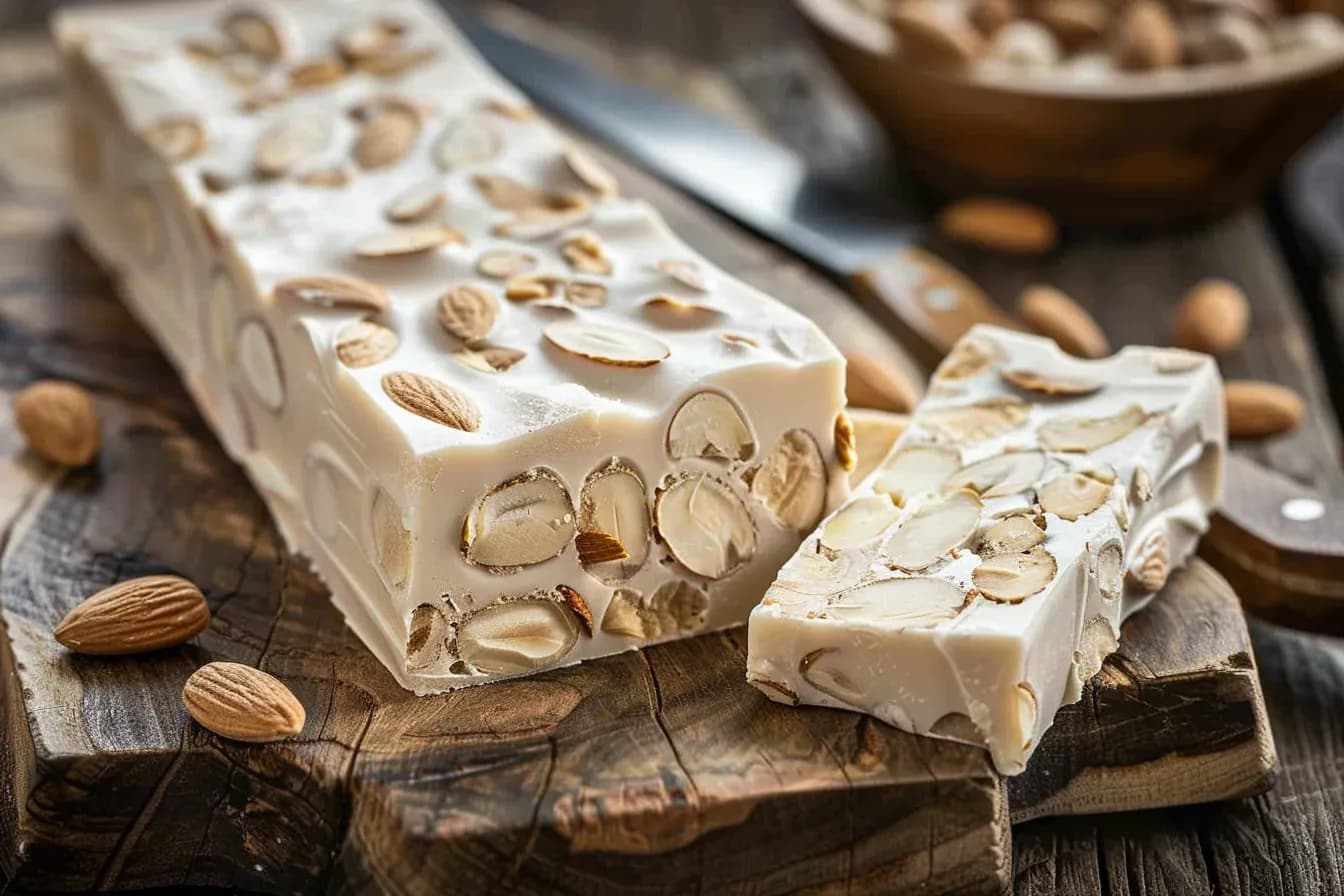
Turrón
Spanish Christmas nougat made of almonds and honey, either rock hard or buttery soft, with nothing in between.
- Preparation
- 25 min
- Cook/bake time
- 30 min
- Total
- 24 hr 55 min
- Difficulty
- Advanced
- Calories
- 241 kcal
- Servings
- 16 pieces
- Prep
- 25 min
- Cooking & baking
- 30 min
- Resting
- 24 hr
Only 55 min of that is hands-on – the rest takes care of itself.
Spanish Christmas nougat made of almonds and honey, either rock hard or buttery soft, with nothing in between. The hard Turrón de Alicante is an almond slab in an egg white and honey mixture, while the soft Turrón de Jijona is ground from the same ingredients. This recipe makes the hard version, which is a staple on any Spanish Christmas table.
Why this works
Turrón is essentially sugar work, and the final temperature of the syrup alone determines how hard the result will be. At 140 degrees, so little water remains in the syrup that it solidifies into a glassy state upon cooling instead of remaining chewy. This is the hard crack stage, and just five degrees below that already yields a sticky mass that never sets. The whipped egg white has a purely structural task here. Its proteins form a network of fine air bubbles that holds the hot syrup while it crystallizes, preventing it from pooling into a solid slab of sugar. The roasted almonds are the third part of the structure, as they interrupt the sugar matrix and make it breakable rather than splintering.
Step-by-step instructions
- 1
Roast the almonds
Roast the almonds at 160 °C for about twelve minutes until they are fragrant and light brown inside. Let them cool completely afterwards. Warm almonds would later dissolve the sugar mass again, and unroasted ones taste flat. Roasting is the biggest flavor gain in the whole recipe.
- 2
Boil down honey and sugar
Slowly heat the honey and sugar in a heavy pot to 140 degrees, stirring constantly. Use a thermometer, because the water glass test is too imprecise here. Below 135 degrees, the turrón will never get hard, and above 150 degrees it tastes burnt. This takes about fifteen minutes.
- 3
Whip into the egg whites
Whip the egg whites with the salt until very stiff. Then pour the hot syrup in a thin, steady stream along the edge of the bowl while the mixer continues to run. Never pour it right into the middle, as the syrup would cook the egg white in spots and form lumps. Continue beating until the mixture is chewy and glossy, about ten minutes.
- 4
Fold in almonds and shape
Fold in the cooled almonds and lemon zest with a spatula. The mixture is now very stiff and requires strength. Fill it into a loaf pan lined with parchment paper, press it down firmly with the back of a wet spoon, and weigh it down with a second board.
- 5
Let rest for 24 hours
Let the turrón rest at room temperature for at least one day, preferably two. During this time, the sugar crystallizes completely, and only then can it be sliced instead of crumbling. To portion, briefly hold a heavy knife under hot water.
Our best tips
- A sugar thermometer is not optional for this recipe. The difference between soft and hard turrón lies in a range of ten degrees, and that cannot be hit with the naked eye.
- Turrón does not turn out well on a humid day. The sugar mass attracts humidity and then remains sticky. A dry winter day is the right time, and that is no coincidence for a Christmas pastry.
- In Spain, a wafer is placed between the turrón and the mold. It prevents sticking and is eaten along with it. Alternatively, parchment paper works, which is peeled off before serving.
Tasty variations
Turrón de Jijona (soft)
Roughly break the finished, hardened turrón and grind it in a food processor until the almond oil is released and a spreadable paste forms. Press into the mold again and let rest for a day.
With pistachios
Replace half of the almonds with shelled pistachios. This colors the slab greenish and is quite common in Alicante, even if not the classic form.
What is left over?
This recipe only uses the whites. There are better places for the yolks than the bin.
Nutrition facts
| Calories | 241 kcal |
|---|---|
| Protein | 6 g |
| Carbohydrates | 30 g |
| – of which sugar | 26 g |
| Fat | 13 g |
| Fiber | 3 g |
Where the 241 kcal come from
per serving
Calculated from the ingredients – how we do it
We add up reference values for every ingredient and divide by the number of servings. These assumptions are baked in:
- Reference values per 100 g – for the raw ingredient, exactly as listed.
- Tinned goods count at drained weight, bone-in meat at purchase weight: you eat about 70 per cent of a chicken thigh and leave the rest.
- Water evaporates as you cook. The energy stays in the pot, the weight does not – so the figure is per serving, not per 100 g of finished dish.
- Anything listed without a quantity – “salt and pepper” – is not counted.
A guide value, not a lab measurement: no two onions weigh the same, and fat content varies from pack to pack.
Frequently asked questions
How many calories does a piece of turrón have?
About 240 kcal per piece for sixteen pieces. With almonds and honey as the only notable ingredients, this is to be expected. In return, the portions are traditionally small, with a piece being a bar of two centimeters.
Why is my turrón not getting hard?
The syrup did not reach a high enough temperature. Below 135 degrees, too much water remains in it, and the mass does not solidify into a glassy state but remains chewy. A second possible reason is high humidity, which the sugar absorbs again.
How long does turrón keep?
Packaged airtight and kept cool, about a month. The enemy is humidity, not spoilage. In an open tin it becomes sticky within days, but wrapped in cling film it stays hard.
Can I make it without egg?
Not in this form. The egg white network holds the syrup while it crystallizes. Aquafaba works well for cold foams, but not reliably with 140 degree hot syrup.
Comments & ratings(0)
Sign in to rate and comment on this recipe.
You might also like
 Cakes & Pastries
Panettone
The Milanese Christmas cake: tall, airy, tearable into shreds, and the result of two days of patience.
 Cakes & Pastries
Mince Pies
Small British Christmas tarts with a dried fruit filling, meat-free for two hundred years despite the name.
 Cakes & Pastries
Cut-Out Cookies with Royal Icing
Cut-out cookies with sharp edges and colorful royal icing, the American Christmas classic.