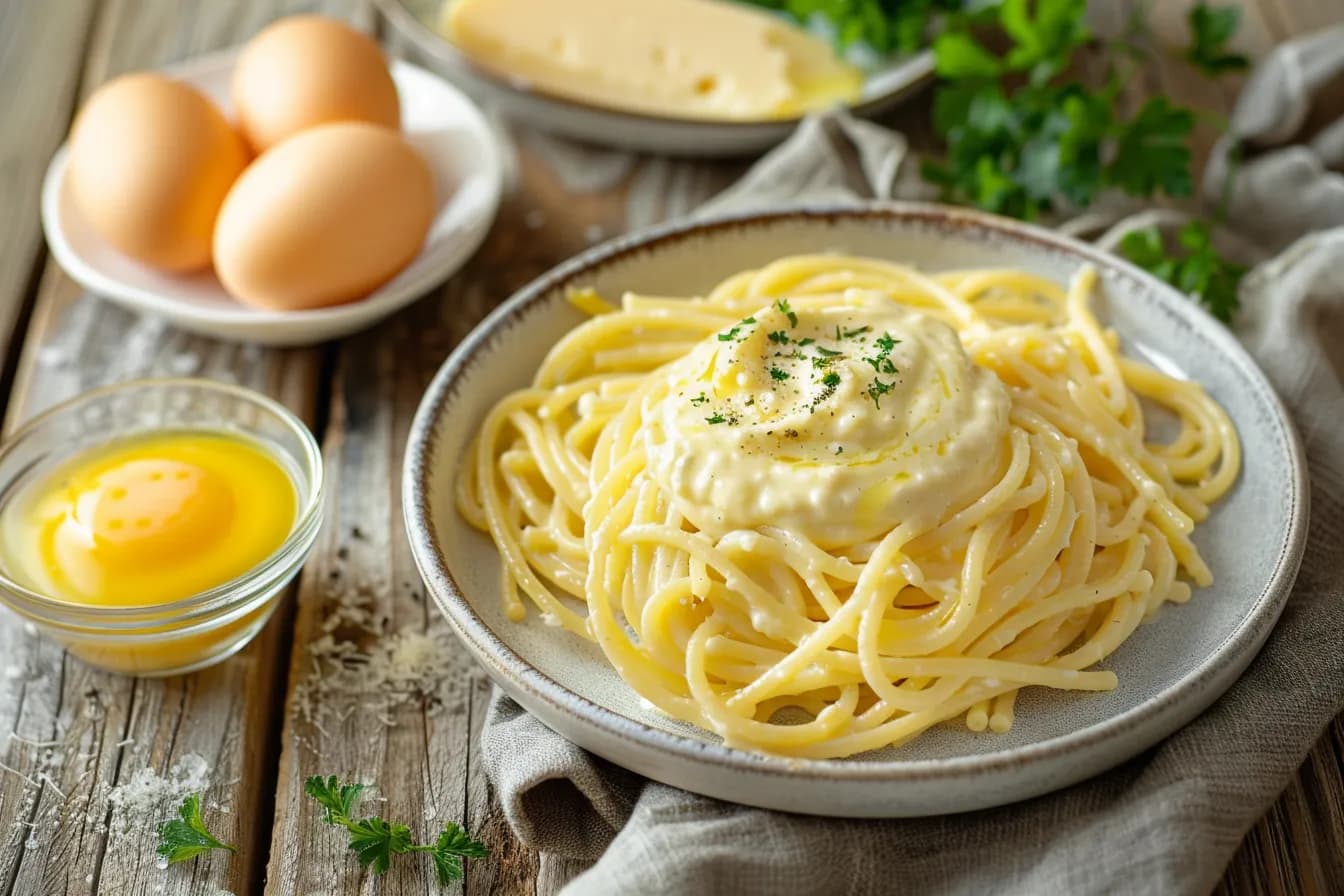
Leftover Egg Yolks 3 Ways
Aioli, pasta, or custard, egg yolks are the more valuable leftover, and they only last two days.
- Preparation
- 15 min
- Cook/bake time
- 25 min
- Total
- 40 min
- Difficulty
- Medium
- Calories
- 1149 kcal
- Servings
- 4
- Prep
- 15 min
- Cooking & baking
- 25 min
Aioli, pasta, or custard, egg yolks are the more valuable leftover, and they only last two days. After making meringue, whipped egg whites, or an egg white omelet, you are left with egg yolks, and they are more delicate than egg whites. They dry out on the surface and do not freeze well. These three methods use them up quickly and rewardingly.
Why this works
An egg yolk is a natural emulsion of water, fat, and protein, held together by lecithin, a molecule with a water-loving end and a fat-loving end. This is why a single egg yolk can bind a quarter liter of oil, and it is the key to mayonnaise, aioli, and hollandaise sauce. Its second property is its coagulation temperature. Egg yolks set between 65 and 70 degrees, which is significantly earlier than egg whites and much earlier than most people expect. This is exactly why the pan for a carbonara is taken off the heat before the egg yolk is added. The residual heat of the pasta is enough to bind it into a sauce, whereas the hot pan would turn it into scrambled eggs within seconds.
Step-by-step instructions
- 1
Way 1: Build the aioli
Whisk the egg yolks, garlic, lemon juice, and salt in a tall container. Add the oil drop by drop at first and whisk continuously. The first fifty milliliters decide everything. As soon as the mixture is visibly lighter and thicker, you can continue pouring in a thin stream.
- 2
Way 2: Bind the pasta off the heat
Boil the spaghetti and reserve a cup of pasta water. Whisk the egg yolks, Pecorino, and plenty of pepper in a bowl. Add the drained pasta and stir immediately, adding hot pasta water by the spoonful until a creamy sauce forms. Do all of this outside the pan, as egg yolks set at 65 degrees.
- 3
Way 3: Cook the custard to the rose stage
Heat the milk and vanilla, whisk the egg yolks with sugar, and slowly pour in the hot milk while stirring. Return to the pot and stir over low heat until the custard coats the back of a spoon, which is around 82 degrees. A finger drawn through it must leave a clear path. Pour through a sieve immediately.
- 4
Store the remaining egg yolks
Whatever is left goes into a jar covered with a thin layer of water. This prevents the skin that otherwise forms within hours. They will keep for two days in the fridge, and you should carefully pour off the water before using them.
Our best tips
- Egg yolks set at 65 to 70 degrees, much earlier than egg whites. That is why any sauce bound with egg yolks is taken off the heat before the egg yolk is added.
- Room temperature is mandatory for emulsions. Cold egg yolks and room temperature oil have different viscosities and will not combine.
- Store leftover egg yolks under water. A thin layer of water in the jar prevents a skin from forming. Without it, they will be tough the next day.
Tasty variations
Aioli with saffron
Let a pinch of saffron steep in a tablespoon of warm water and add it with the lemon juice. This yields rouille, the classic accompaniment to fish soup, and colors the aioli a deep golden yellow.
Crème anglaise for ice cream
Freeze the cooled custard in an ice cream maker or mix it with whipped cream using the no-churn method. This is the classic base for any vanilla ice cream.
What is left over?
This recipe only uses the yolks. The whites keep for three days in the fridge and freeze well – nobody has to throw them out.
Nutrition facts
| Calories | 1149 kcal |
|---|---|
| Protein | 26 g |
| Carbohydrates | 74 g |
| – of which sugar | 28 g |
| Fat | 83 g |
| Fiber | 2 g |
Where the 1,149 kcal come from
per serving
Calculated from the ingredients – how we do it
We add up reference values for every ingredient and divide by the number of servings. These assumptions are baked in:
- Reference values per 100 g – for the raw ingredient, exactly as listed.
- Tinned goods count at drained weight, bone-in meat at purchase weight: you eat about 70 per cent of a chicken thigh and leave the rest.
- Water evaporates as you cook. The energy stays in the pot, the weight does not – so the figure is per serving, not per 100 g of finished dish.
- Anything listed without a quantity – “salt and pepper” – is not counted.
A guide value, not a lab measurement: no two onions weigh the same, and fat content varies from pack to pack.
Frequently asked questions
Can I freeze egg yolks?
Only with a trick, otherwise they become gel-like and can no longer be whisked. This is called gelation and it is irreversible. Whisked with a pinch of salt or half a teaspoon of sugar per four egg yolks, they remain usable. Note on the container which of the two is inside.
How long do leftover egg yolks keep in the fridge?
Two days, significantly shorter than egg whites. They dry out on the surface and form a tough skin, so cover them with a thin layer of water. If they still smell neutral after more than two days, they are usually still good. When in doubt, throw them away, as they are a raw product.
Why did my egg yolks scramble in the pasta?
The pan or the bowl was too hot. Cacio e uova and carbonara are never bound on the stove. The residual heat of the drained pasta is completely sufficient. If it does happen, the only remedy is another egg yolk and more pasta water, stirred in cold.
Comments & ratings(0)
Sign in to rate and comment on this recipe.
You might also like
 Leftover Cooking
Leftover Egg Whites 3 Ways
Meringue, financiers or an omelet, depending on how many egg whites are in the jar.
 Basic Recipes
Make your own pesto, from whatever you have
Greens, fat, nuts, salt: pesto does not need basil, it just needs four roles filled.
 Basic Recipes
Carrot Top Pesto
The greens that get cut off at the store are edible, and they make a more robust pesto than basil.