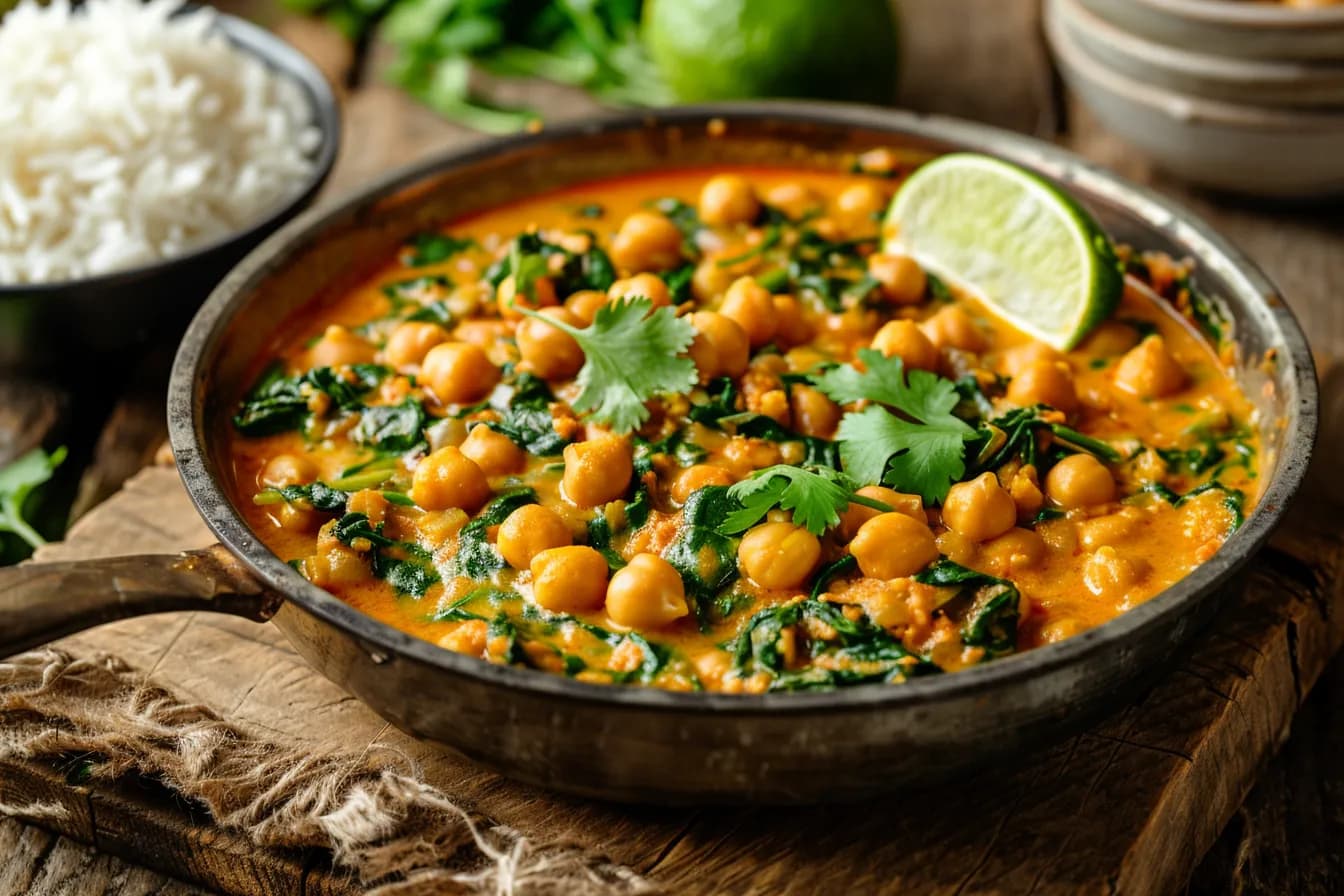
Make Your Own Curry: The Curry Matrix
Base, liquid, add-ins, heat: Four decisions separate a Thai curry from an Indian one.
- Preparation
- 20 min
- Cook/bake time
- 30 min
- Total
- 50 min
- Difficulty
- Easy
- Calories
- 671 kcal
- Servings
- 4
- Prep
- 20 min
- Cooking & baking
- 30 min
Base, liquid, add-ins, heat: Four decisions separate a Thai curry from an Indian one. Curry isn't a dish, it's a method: unlocking flavors in fat, stretching them with liquid, and cooking the add-ins in it. Once you understand the matrix, you can cook six countries out of one pan.
Why this works
The step where almost all curries fail is frying the spices. The flavor compounds in cumin, coriander, and turmeric are fat-soluble, not water-soluble. If you throw them into the liquid, most of the flavor stays trapped in the powder, and the curry tastes dusty instead of fragrant. That's why they go into hot fat for half a minute before anything liquid is added. The second point is the order of acid and add-ins. Tomatoes and limes are acidic, and acid significantly slows down the softening of legumes and potatoes because it stabilizes the pectins in the cell walls. Therefore, the add-ins cook first, and the acid comes at the end.
Build your own
Pick one option per row. Ingredients, steps, cook mode and shopping list adapt instantly.
Your pick: Indian · Coconut Milk · Chickpeas & Spinach · Lime & Cilantro
Sign in to save your combinations. Sign in
Step-by-step instructions
- 1
Unlock the flavor base in fat
This is the step that decides everything. Spices and aromatics go into hot fat before anything liquid is added. Their flavor compounds are fat-soluble. Thrown into water, they stay stuck in the powder, and the curry tastes dusty.
- 2
Sauté the onion base
Fry the onions in oil for eight minutes until they are golden brown and distinctly sweet. This is the longest and most important stage, and under-browned onions are the most common reason for a flat curry. Ginger and garlic are added only after that, as they only need a minute. Then stir in the spices and toast for thirty seconds until fragrant.
- 3
Pour in the liquid
Pour in the liquid and scrape the browned bits from the bottom, as that's where most of the flavor sits. From now on, the rule is to simmer, not boil. Vigorous boiling separates coconut milk and makes yogurt curdle.
- 4
Pour in the coconut milk
Pour in the coconut milk and let it simmer uncovered, but never boil vigorously. Above 90 °C, the coconut fat separates from the liquid and floats on top as an oil film. A gentle bubbling at the edges is just right.
- 5
Cook the add-ins
Add the add-ins and let them finish cooking in the liquid instead of separately. They will absorb exactly the flavors you just unlocked. A separately cooked chicken will just end up being chicken with sauce on the side.
- 6
Cook the chickpeas and spinach
Add the drained chickpeas and let them simmer for ten minutes so they absorb the flavors. The spinach goes in during the last two minutes. It needs nothing but heat and wilts immediately.
- 7
Season and add freshness on top
Take the pan off the heat and season: salt first, then sugar, and finally acid. Do it in this order, because sugar changes how much salt you perceive, and acid changes both. Fresh herbs only go on top after the pan is off the stove, otherwise their flavors cook away in seconds.
Our best tips
- Really brown the onions for eight minutes. Under-browned onions are the most common reason for a curry that tastes like spices instead of curry.
- Never boil coconut milk vigorously. Above 90 degrees, the fat separates and floats on top as an oil film. A gentle bubbling at the edges is enough.
- Acid belongs at the end. It lifts everything, but it also keeps potatoes and legumes hard. Adding a lime too early costs ten minutes of cooking time.
Tasty variations
Dal for the week
Indian base, tomato, red lentils, lime, and cilantro. Costs under three euros for four portions, keeps for four days, and gets better on the second day, as the starch from the lentils continues to thicken overnight.
Thai curry in 25 minutes
Thai base, coconut milk, chickpeas and spinach, lime, and cilantro. The fastest combination in the matrix, because neither onions need to be browned nor potatoes cooked.
Nutrition facts
| Calories | 671 kcal |
|---|---|
| Protein | 16 g |
| Carbohydrates | 41.2 g |
| – of which sugar | 11 g |
| Fat | 48.9 g |
| Fiber | 11.2 g |
Where the 671 kcal come from
per serving
Calculated from the ingredients – how we do it
We add up reference values for every ingredient and divide by the number of servings. These assumptions are baked in:
- Reference values per 100 g – for the raw ingredient, exactly as listed.
- Tinned goods count at drained weight, bone-in meat at purchase weight: you eat about 70 per cent of a chicken thigh and leave the rest.
- Water evaporates as you cook. The energy stays in the pot, the weight does not – so the figure is per serving, not per 100 g of finished dish.
- Anything listed without a quantity – “salt and pepper” – is not counted.
- For build-your-own recipes the figure applies to the default choice. A different combination shifts it, sometimes considerably.
A guide value, not a lab measurement: no two onions weigh the same, and fat content varies from pack to pack.
Frequently asked questions
Which combination do the nutritional values apply to?
For the standard selection: Indian base, coconut milk, chickpeas and spinach, lime, and cilantro. With tomato instead of coconut milk, about 150 kilocalories per portion are dropped, and with chicken, protein and fat are added.
Why did my coconut milk curdle?
It boiled instead of simmered. Above 90 degrees, the coconut fat separates from the water phase and settles as an oil film on top. It's not spoiled and can be stirred in, but the creamy texture won't come back. Turn down the heat before it bubbles.
Is curry powder enough instead of individual spices?
For the Indian base, yes. Then take three teaspoons and toast them in fat the exact same way. For the Thai base, no. Curry paste contains fresh aromatics like lemongrass, galangal, and shrimp paste, which a dry powder cannot replace.
Comments & ratings(0)
Sign in to rate and comment on this recipe.
You might also like
 Dinner
How to Make a Casserole: The Modular Guide
Starch, vegetables, binder, cheese: the four layers that make up every casserole, individually selectable.
 Soups & Stews
Any-Vegetable Soup
One kilo of vegetables, one onion, one liter of broth: the rest is just deciding how creamy and how spicy you want it.
 Basic Recipes
Roasted Vegetables: Time & Temperature for Everything
Sixteen types of vegetables, each with a time and a temperature, so everything is ready at the same time.