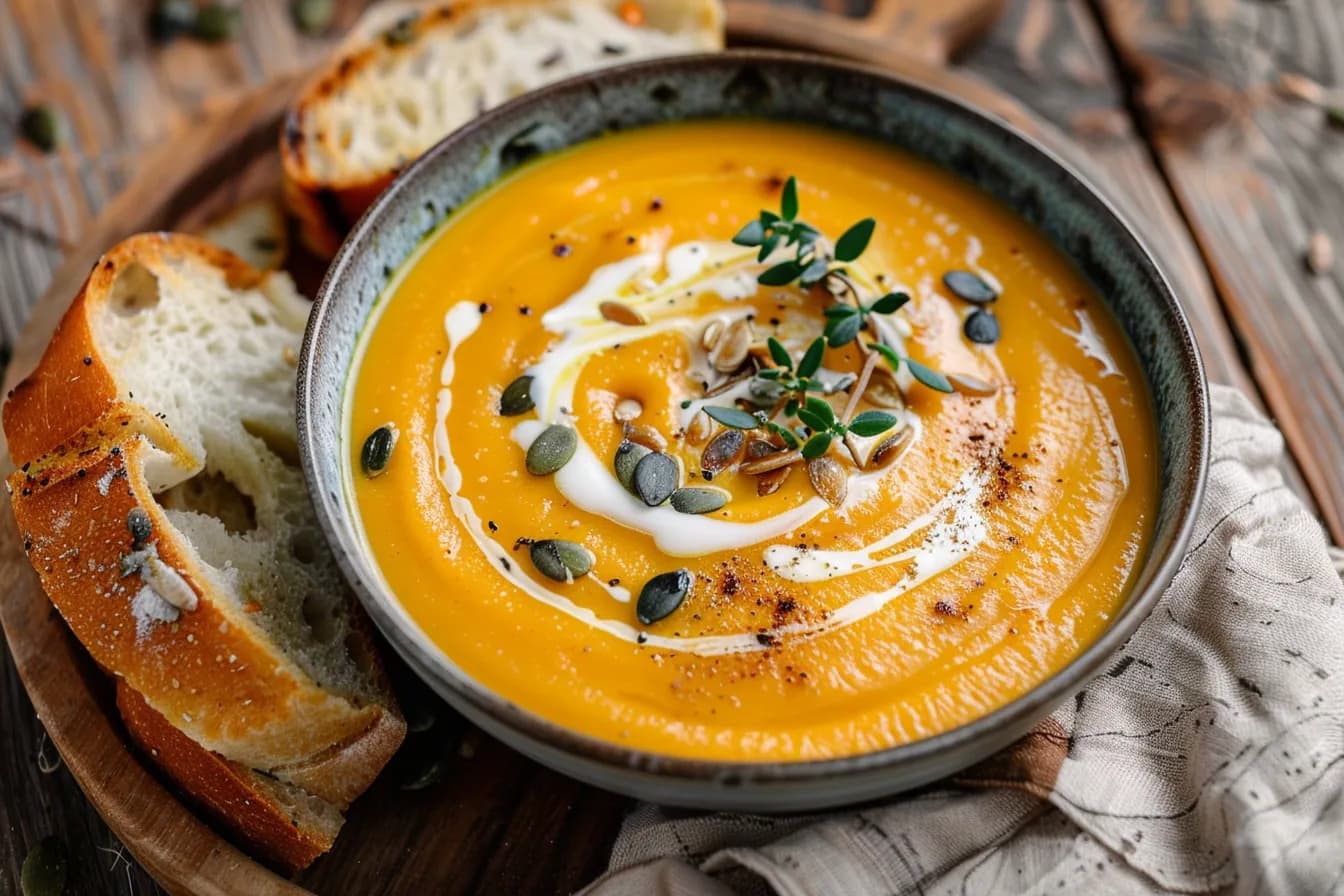
Any-Vegetable Soup
One kilo of vegetables, one onion, one liter of broth: the rest is just deciding how creamy and how spicy you want it.
- Preparation
- 15 min
- Cook/bake time
- 35 min
- Total
- 50 min
- Difficulty
- Easy
- Calories
- 359 kcal
- Servings
- 4
- Prep
- 15 min
- Cooking & baking
- 35 min
One kilo of vegetables, one onion, one liter of broth: the rest is just deciding how creamy and how spicy you want it. Almost any vegetable makes a good creamy soup if you use the same method: sauté, cook, purée, and finish. Pick the vegetables that need to be used up, and the soup builds itself from there.
Why this works
A cream soup does not get its creaminess from cream, but from puréed starch and plant fibers. The cream only rounds it out. That is why every variation includes something starchy: a potato, a handful of lentils, or the vegetable itself. The second lever is sautéing. The onion and vegetables first go into fat for five minutes, and two things happen at the same time. Cell walls break down so they purée better later, and sugar caramelizes slightly, bringing a depth that no additional seasoning can replace. The amount of liquid is also deliberately kept low. You can thin out a soup that is too thick in five seconds, but a soup that is too thin must be reduced, losing flavor in the process.
Build your own
Pick one option per row. Ingredients, steps, cook mode and shopping list adapt instantly.
Your pick: Pumpkin · Classic · Cream · Croutons
Sign in to save your combinations. Sign in
Step-by-step instructions
- 1
Sauté the onions
Sauté the diced onions in oil for five minutes until translucent, and add the garlic in the last minute. Translucent means clear, not brown. Browned onions would remain visible as specks in a light cream soup and dominate the flavor.
- 2
Sauté the vegetables
Add the vegetables and let them cook for five minutes, stirring occasionally. This is the step that is most often skipped and most clearly tasted. Here, cell walls break down and some of the sugar caramelizes, giving the soup a depth that no additional seasoning can replace.
- 3
Barely cover with broth
Pour in just enough broth so that the vegetables are barely covered. It is better to use too little than too much. Simmer gently for twenty minutes until everything can be easily pierced with the tip of a knife. A soup that is too thick can be thinned in five seconds, while one that is too thin costs twenty minutes of reducing and flavor.
- 4
Purée
Remove hard aromatics like bay leaf and lemongrass, and purée the soup with an immersion blender for a really long time, for two full minutes. The difference between puréed and velvety is exactly these two minutes, and nobody takes the time for them.
- 5
Finish and season
Stir in the creamy component over low heat and do not let the soup boil again. Season to taste with salt and a splash of lemon. The acidity is the step that almost everyone leaves out, and it turns a well-rounded soup into a vibrant one.
- 6
Fry the croutons
Fry the bread cubes in oil over medium heat for five minutes, stirring, until they are golden brown all over and audibly hard. Only salt them afterwards. Salt draws moisture to the surface and would otherwise soften them again.
Our best tips
- Keep the liquid sparse. You can thin a soup that is too thick in five seconds, but a soup that is too thin costs twenty minutes of reducing, and flavor is lost in the process.
- Purée for two full minutes, not twenty seconds. This is exactly the difference between a puréed soup and a velvety one.
- Always add a splash of acidity at the end. Lemon or a spoonful of vinegar turns a well-rounded vegetable soup into one you will want to cook again.
Tasty variations
Pumpkin Soup with Coconut
Hokkaido, Asian seasoning, coconut milk, and toasted seeds. This is the combination that works every year in October, and the Hokkaido does not need to be peeled.
Roasted Tomato Soup
Tomato and bell pepper, classic seasoning, cream, and croutons. Factor in thirty extra minutes of roasting time. They make all the difference between this soup and one from a can.
Nutrition facts
| Calories | 359 kcal |
|---|---|
| Protein | 6.8 g |
| Carbohydrates | 28.7 g |
| – of which sugar | 11.4 g |
| Fat | 23.2 g |
| Fiber | 5.1 g |
Where the 359 kcal come from
per serving
Calculated from the ingredients – how we do it
We add up reference values for every ingredient and divide by the number of servings. These assumptions are baked in:
- Reference values per 100 g – for the raw ingredient, exactly as listed.
- Tinned goods count at drained weight, bone-in meat at purchase weight: you eat about 70 per cent of a chicken thigh and leave the rest.
- Water evaporates as you cook. The energy stays in the pot, the weight does not – so the figure is per serving, not per 100 g of finished dish.
- Anything listed without a quantity – “salt and pepper” – is not counted.
- For build-your-own recipes the figure applies to the default choice. A different combination shifts it, sometimes considerably.
A guide value, not a lab measurement: no two onions weigh the same, and fat content varies from pack to pack.
Frequently asked questions
Which combination do the nutritional values apply to?
For the standard selection: pumpkin, classic seasoning, cream, and croutons. Without a creamy component, they are about 90 kilocalories lower per serving, and slightly higher with cashew cream.
Can I mix the vegetables?
Yes, and that often makes the best soup. Use about one kilo in total and just make sure there is something starchy included. One potato is enough. It is what thickens the soup, not the cream.
Why did my soup stay grainy?
It was puréed too briefly or you used a fibrous vegetable. Carrots and celery need significantly longer under the immersion blender than pumpkin. If it comes down to it, a fine sieve helps. Pass it through once, and the soup is velvety. Lemongrass and bay leaf must be removed beforehand.
Comments & ratings(0)
Sign in to rate and comment on this recipe.
You might also like
 Basic Recipes
Vegetable Scrap Broth
The freezer bag next to the ice compartment collects scraps until it is full, and then the broth costs nothing.
 Dinner
How to Make a Casserole: The Modular Guide
Starch, vegetables, binder, cheese: the four layers that make up every casserole, individually selectable.
 Dinner
Make Your Own Curry: The Curry Matrix
Base, liquid, add-ins, heat: Four decisions separate a Thai curry from an Indian one.