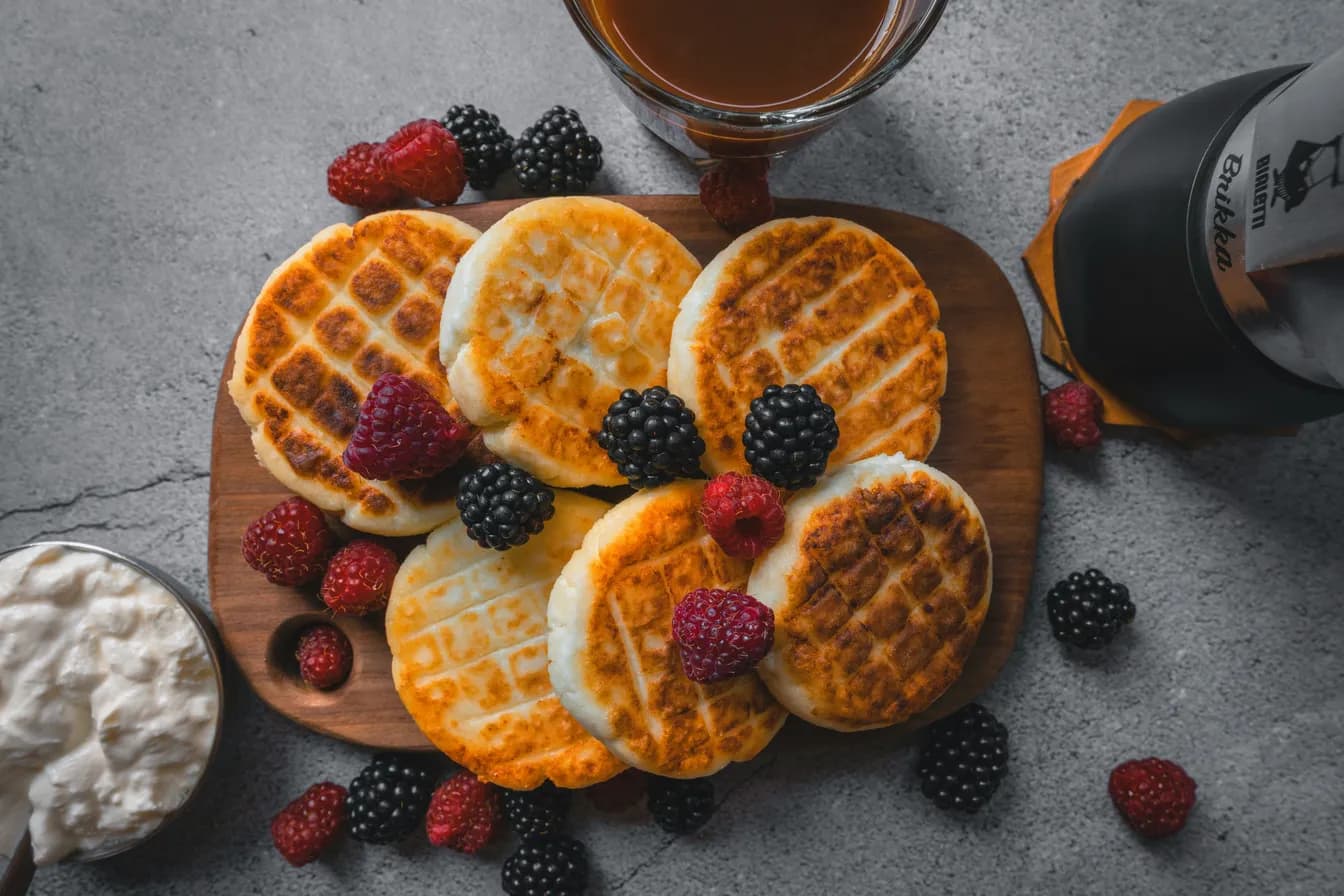
Syrniki
Russian quark pancakes that are golden brown on the outside and almost pudding-like on the inside. The secret is that the quark must be dry.
- Preparation
- 20 min
- Cook/bake time
- 15 min
- Total
- 1 hr 35 min
- Difficulty
- Easy
- Calories
- 366 kcal
- Servings
- 4
- Prep
- 20 min
- Cooking & baking
- 15 min
- Resting
- 1 hr
Only 35 min of that is hands-on – the rest takes care of itself.
Russian quark pancakes that are golden brown on the outside and almost pudding-like on the inside. The secret is that the quark must be dry. Wet quark always demands more flour, and with every spoonful of flour, syrniki become firmer and drier. A well-drained quark hardly needs any flour at all, which makes all the difference.
Why this works
Syrniki stand or fall on the water content of the quark, and the connection is direct. The wetter the quark, the more flour is needed to bind it, and the more gluten is formed during mixing. Gluten makes the pancakes tough and dry, which is exactly the opposite of what is intended. A well-drained quark, on the other hand, binds almost by itself because its casein sets when heated and holds the mixture together. That is why the hour in the sieve is not an optional step, but the essential one. The second point is the heat. At a medium temperature, the surface browns while the core is only heated enough for the casein to set cream-like instead of becoming firm. High heat would leave them dark on the outside and raw on the inside, while low heat would make them firm and dry throughout.
Step-by-step instructions
- 1
Drain the quark
Place the quark in a sieve lined with cheesecloth and let it drain for one hour, or longer if the quark is very wet. This step determines everything else. Wet quark requires more flour, and more flour makes syrniki tough.
- 2
Mix the batter
Mix the quark, egg, sugar, vanilla, and salt. Fold in just enough flour so that the mixture is barely shapeable. With well-drained quark, three tablespoons are enough. Do not mix longer than necessary.
- 3
Shape
With floured hands, shape flat pancakes about six centimeters in diameter and two centimeters high, and toss them lightly in flour. Thickness is important. Flat syrniki cook all the way through and lose their creamy center.
- 4
Fry over medium heat
Fry the pancakes in butter over medium heat for 3 to 4 minutes per side until golden brown. Do not use higher heat. Over high heat, they would be dark on the outside and raw on the inside, and over too low heat, they would be firm throughout. Let them drain briefly on paper towels.
- 5
Serve
Serve with sour cream and jam. In Russia, they are also often served with smetana and honey. Syrniki are a breakfast dish and are eaten warm. When cold, they lose their creamy center.
Our best tips
- Dry quark is the prerequisite. If you do not let it drain, you have to compensate with flour and get tough pancakes instead of creamy ones.
- Two centimeters high. Flatly shaped syrniki cook completely through, and the pudding-like center is exactly what makes them special.
- Medium heat and butter, not oil. Butter browns the surface more beautifully and brings the nutty flavor that goes well with quark.
Tasty variations
With raisins
Fold in 80 g of raisins, previously soaked in warm water for ten minutes. This is the most common variation in Russia.
In the oven
Bake at 190 °C for about 20 minutes, turning once. Significantly lower in fat, but lacks the crispy crust from the pan.
Nutrition facts
| Calories | 366 kcal |
|---|---|
| Protein | 20 g |
| Carbohydrates | 29 g |
| – of which sugar | 24 g |
| Fat | 19 g |
| Fiber | 0 g |
Where the 366 kcal come from
per serving
Calculated from the ingredients – how we do it
We add up reference values for every ingredient and divide by the number of servings. These assumptions are baked in:
- Reference values per 100 g – for the raw ingredient, exactly as listed.
- Tinned goods count at drained weight, bone-in meat at purchase weight: you eat about 70 per cent of a chicken thigh and leave the rest.
- Water evaporates as you cook. The energy stays in the pot, the weight does not – so the figure is per serving, not per 100 g of finished dish.
- Anything listed without a quantity – “salt and pepper” – is not counted.
A guide value, not a lab measurement: no two onions weigh the same, and fat content varies from pack to pack.
Frequently asked questions
Why do my syrniki get tough?
Too much flour, and that is almost always due to quark that is too wet. Drained in a sieve for an hour, the quark hardly needs any flour to bind, and the less flour, the more tender the result.
How many calories do syrniki have?
Around 365 kcal per serving with sour cream and jam. The pancakes alone are around 240 kcal, and they are extremely high in protein with around 20 g of protein per serving.
Which quark is the right one?
In Russia, tvorog is used, which is a dry, crumbly quark. Here, low-fat quark comes closest, but it must drain well. Quark with 20% fat also works and tastes richer.
Can I prepare them in advance?
Yes, once fried, they keep for two days in the refrigerator and can be frozen. Reheated in the pan or in the oven, they become crispy again, but in the microwave, they stay soft.
Comments & ratings(0)
Sign in to rate and comment on this recipe.
You might also like
 Cakes & Pastries
Roscón de Reyes
Spanish Epiphany wreath made of yeast dough with orange blossom water, the scent that defines January 6th in Spain.
 Desserts
Rice Pudding
Creamy rice pudding that does not burn, and the explanation of why sugar only belongs at the end.
 Desserts
Torrijas
Spanish Easter toast in milk and wine, the French toast of Andalusia, and significantly better than its German relative.