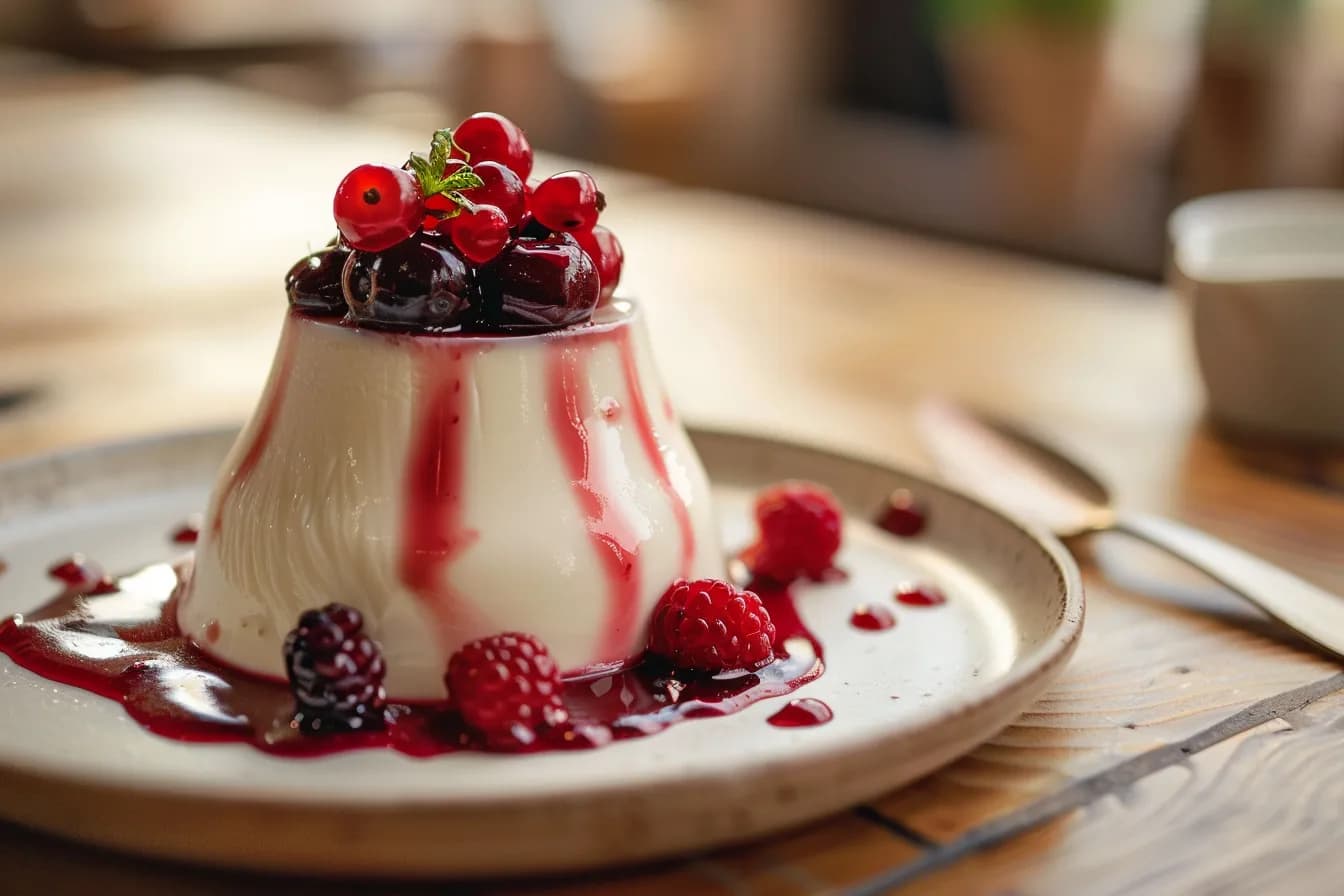
Panna Cotta
Delicately wobbly cream with vanilla, turned out and served with berry sauce.
- Preparation
- 15 min
- Cook/bake time
- 15 min
- Total
- 5 hr 30 min
- Difficulty
- Medium
- Calories
- 431 kcal
- Servings
- 6
- Prep
- 15 min
- Cooking & baking
- 15 min
- Resting
- 5 hr
Only 30 min of that is hands-on – the rest takes care of itself.
Delicately wobbly cream with vanilla, turned out and served with berry sauce. The amount of gelatin is the whole craft here: too much results in jello, too little a puddle. With the right ratio, the panna cotta just barely stands and still melts on the tongue.
Why this works
Gelatin forms a three-dimensional network that holds the liquid in its meshes. How firm the result becomes depends solely on the concentration. Around one percent gelatin, four sheets to 750 milliliters, results in a network that just holds and immediately breaks down again at body heat in the mouth. At double the amount, the network remains stable even at 37 °C, and that is exactly the difference between panna cotta and jello.
Step-by-step instructions
- 1
Soak the gelatin
Place the gelatin sheets individually in plenty of cold water and let them swell for five minutes until they are soft and pliable. They must be completely covered and must not stick together, otherwise they will swell unevenly and will not dissolve completely later.
- 2
Flavor the cream
Scrape the seeds from the vanilla bean and place them in a pot with the pod, cream, milk, sugar and the pinch of salt. Heat everything while stirring until the sugar is dissolved and the mixture is steaming slightly, but under no circumstances boiling. Let it steep covered for ten minutes.
- 3
Dissolve the gelatin
Remove the pot from the heat and remove the vanilla bean. Squeeze the gelatin well and stir it into the hot, but not boiling cream until it has completely dissolved. Gelatin loses its binding power at over 80 °C, so the mixture must never bubble.
- 4
Fill into molds
Pour the mixture through a fine sieve into six molds rinsed with cold water. Rinsing with cold water makes turning out much easier later because a thin film of water forms between the cream and the wall. Let them cool and then refrigerate for at least five hours.
- 5
Sauce and turning out
Boil the berries with sugar and lemon juice for five minutes and let the sauce cool. To turn out, dip the molds in hot water for three seconds, run a knife along the edge and turn them out onto plates. Pour the berry sauce over them and serve immediately.
Our best tips
- Four sheets of gelatin to 750 ml of liquid is the ratio for a panna cotta that just barely stands.
- The cream must not boil after stirring in the gelatin, otherwise it will not set.
- Rinse molds with cold water instead of greasing them. Fat leaves a visible film on the surface.
Tasty variations
Coffee panna cotta
Replace 100 ml of the milk with strong espresso, caramel sauce goes well with this.
Vegan
Replace cream with coconut milk and use 1.5 teaspoons of agar-agar instead of gelatin, this must boil for two minutes.
Nutrition facts
| Calories | 431 kcal |
|---|---|
| Protein | 5 g |
| Carbohydrates | 29 g |
| – of which sugar | 28 g |
| Fat | 33 g |
| Fiber | 2 g |
Where the 431 kcal come from
per serving
Calculated from the ingredients – how we do it
We add up reference values for every ingredient and divide by the number of servings. These assumptions are baked in:
- Reference values per 100 g – for the raw ingredient, exactly as listed.
- Tinned goods count at drained weight, bone-in meat at purchase weight: you eat about 70 per cent of a chicken thigh and leave the rest.
- Water evaporates as you cook. The energy stays in the pot, the weight does not – so the figure is per serving, not per 100 g of finished dish.
- Anything listed without a quantity – “salt and pepper” – is not counted.
A guide value, not a lab measurement: no two onions weigh the same, and fat content varies from pack to pack.
What can go wrong
The points where this recipe most often goes sideways – and what to do about it.
- The panna cotta is not setting
- The gelatin has not set. Two common reasons are that it went into a boiling mixture, it loses its power from about 80 °C, or the mixture stood for too short a time. The cream should only be warm after dissolving, and it needs at least four hours in the refrigerator, preferably overnight.
- It cannot be turned out of the mold
- Dip the mold in hot water for three to five seconds, then run a thin knife along the edge. Too long in the water, and the edge melts away.
Frequently asked questions
My panna cotta is not setting, why?
Either the liquid was too hot when stirring in or the gelatin was not completely dissolved. Neither can be saved afterwards.
Can I serve them in glasses?
Yes, then you only need three sheets of gelatin because it does not have to stand. The result is even creamier.
How long does it keep?
Three days in the refrigerator, covered. Freezing does not work, the gelatin structure becomes watery when thawed.
Comments & ratings(0)
Sign in to rate and comment on this recipe.
You might also like
 Cakes & Pastries
Zucchini Brownies
A whole zucchini in the batter, and nobody notices it: instead, they stay moist for three days.
 Desserts
Peach Crumble with Oat Streusel
One kilo of peaches, one baking dish, forty minutes, and streusel that still crunches the next day.
 Desserts
Homemade Protein Ice Cream
Creamy ice cream with 20 grams of protein per serving, made without an ice cream maker using Skyr, banana, and protein powder.