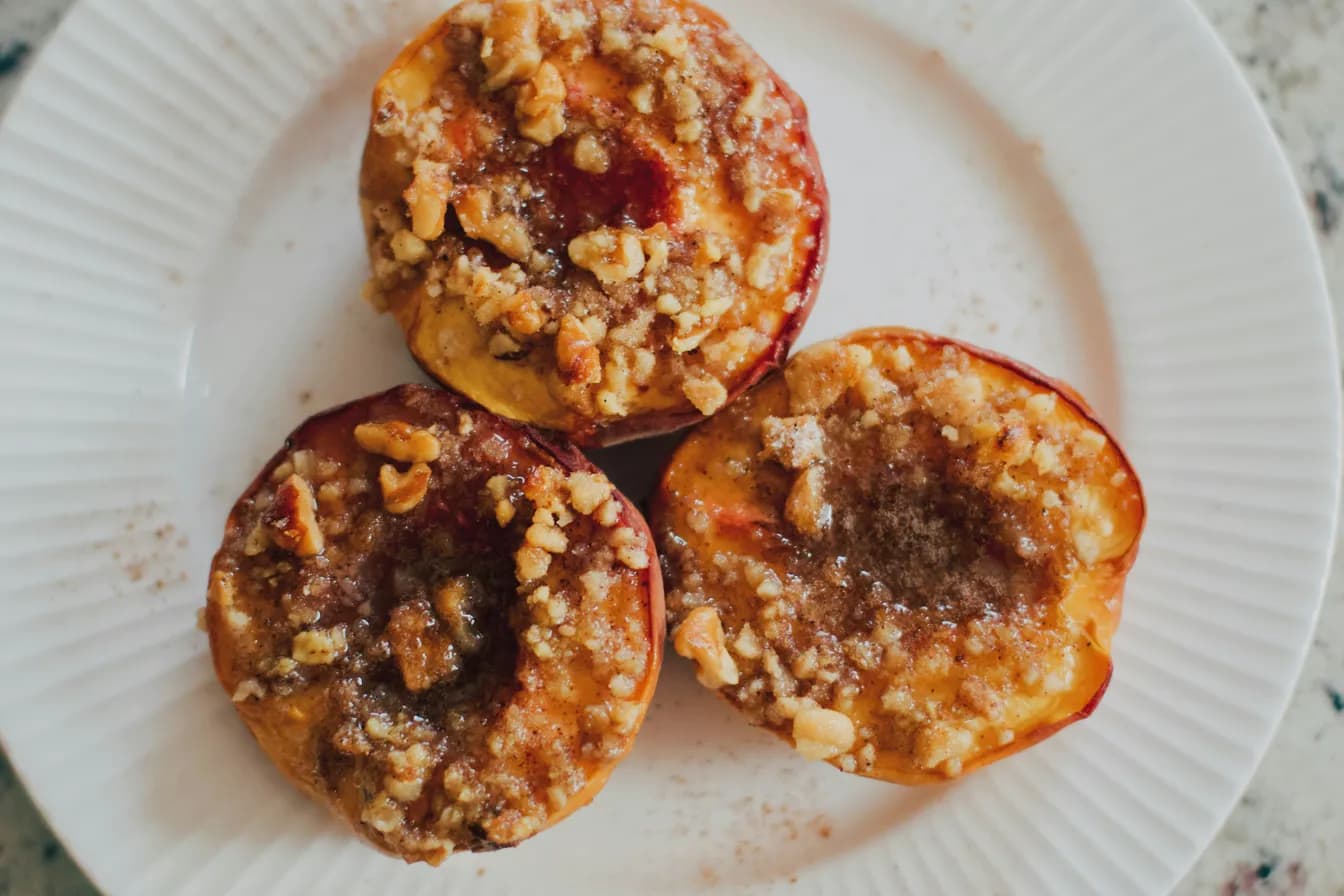
Peach Crumble with Oat Streusel
One kilo of peaches, one baking dish, forty minutes, and streusel that still crunches the next day.
- Preparation
- 20 min
- Cook/bake time
- 40 min
- Total
- 1 hr 15 min
- Difficulty
- Easy
- Calories
- 449 kcal
- Servings
- 6 servings
- Prep
- 20 min
- Cooking & baking
- 40 min
- Resting
- 15 min
Only 1 hr of that is hands-on – the rest takes care of itself.
One kilo of peaches, one baking dish, forty minutes, and streusel that still crunches the next day. The difference from a soggy crumble is two spoons of cornstarch in the fruit and cold butter in the topping. The cornstarch binds the juices before they soak upwards, while the cold butter creates crumbs instead of a solid sheet of dough. The rolled oats are the reason this is called a crisp in America.
Why this works
A crumble almost always fails in the same spot: the topping gets soggy underneath. The fruit juice is to blame, as peaches consist of about 89 percent water and release a large portion of it in the heat. This juice boils up, rises between the crumbs, and softens them from below. Two tablespoons of cornstarch solve this problem. It gelatinizes at around 75 °C and turns the thin juice into a syrup that stays at the bottom instead of migrating upwards. However, this binding only becomes completely firm as it cools down, which is why the fifteen-minute resting time is not just for show. The second point is the temperature of the butter. Cold cubes only melt in the oven, and wherever a piece of butter sat, a small cavity remains. It is exactly these cavities that make the streusel tender. Warm butter, on the other hand, immediately combines with the flour to form a solid layer of dough. And finally, the oats, which give this pastry its name in America. Rolled oats absorb significantly less water than flour during baking and toast instead. They stay crispy where pure flour streusel turns soft, which is why a crumble with oats is called a crisp.
Step-by-step instructions
- 1
Slice the peaches and mix with cornstarch
Preheat the oven to 190 °C top and bottom heat. Halve the peaches, pit them, and cut them into wedges about 1 cm thick. They are not peeled, as the skin breaks down during baking and holds the wedges in shape until then. Mix them with brown sugar, cornstarch, lemon juice, vanilla, and cinnamon, and spread everything in an ovenproof dish measuring about 20 by 25 cm. The type of dish does not matter, whether it is a baking dish, tart pan, or cast-iron skillet. The only important thing is that the fruit lies flat, about four centimeters high. In a tall, narrow dish, there is too little streusel for a lot of fruit, and the bottom half never cooks through properly. The cornstarch must touch every wedge, otherwise it will only bind the juices in patches.
- 2
Rub the streusel together with cold butter
Mix the flour, rolled oats, sugar, cinnamon, and salt. Add the cold butter cubes and rub everything together with your fingertips until coarse crumbs of various sizes form, ranging from the size of peas to hazelnuts. Do not knead and do not let it get warm. As soon as the butter smears, the crumbs turn into a dough, and it will bake as a solid sheet instead of streusel.
- 3
Sprinkle loosely, do not press down
Sprinkle the crumbs evenly over the fruit and let them lie as they fall. Pressing them down is the most common unnecessary step. Between loosely sprinkled crumbs, there is air through which the steam from the fruit can escape. If pressed down, the steam gets trapped underneath and softens the exact layer that is supposed to become crispy.
- 4
Bake for 40 minutes with a baking sheet underneath
Slide a baking sheet under the dish, as the juice boils up at the edges and would otherwise spill onto the oven floor. Bake the crumble for 40 to 45 minutes until the streusel is golden brown and the juice bubbles thickly and darkly at the edges. If it still bubbles thin and clear, the cornstarch is not cooked through. In that case, bake for another five minutes, covering the streusel with aluminum foil if necessary.
- 5
Let stand for fifteen minutes
Take the dish out and let it stand for at least fifteen minutes. The cornstarch only binds completely as it cools. If portioned straight out of the oven, the juice will run out and the serving will swim. Lukewarm with a scoop of vanilla ice cream is the perfect moment, not boiling hot.
Our best tips
- Make streusel in advance. Rub together double the amount and freeze half of it raw. They can later be placed directly frozen onto the fruit, without thawing and without a longer baking time. This way, a crumble is in the oven with just five minutes of work.
- Use old-fashioned rolled oats, not quick oats. Quick oats soak up the fruit juice and become soft, while old-fashioned oats remain recognizable as individual flakes and toast instead.
- Peaches can be sliced along the pit instead of halved. For varieties that are not entirely freestone, which includes most of the aromatic ones, this saves the crushed half that otherwise sticks to the pit.
Tasty variations
Peach Raspberry
Replace 200 g of the peaches with raspberries, preferably frozen and unthawed. They add acidity and dye the juice dark red. Use half a tablespoon more cornstarch for this, because berries release more liquid.
With Almonds
Replace 50 g of the rolled oats with sliced almonds. They toast along with the oats and give the streusel a second crunch. Note that this adds tree nuts.
Gluten-Free
Replace the flour with 100 g of ground almonds and 20 g of cornstarch, and use gluten-free rolled oats. This makes the streusel slightly more tender and they brown faster, so check on them after 30 minutes.
Other Fruits, Same Rule
Plums, apricots, cherries, and apples work just the same. The amount of cornstarch depends on the juice. For apples, one tablespoon is enough, while cherries need three.
In Individual Ramekins
Distribute the same amount among six ovenproof ramekins of about 250 ml and bake for 25 to 30 minutes. Each portion gets more streusel edge this way, which is the reason why crumble in a restaurant almost always comes individually.
Nutrition facts
| Calories | 449 kcal |
|---|---|
| Protein | 6 g |
| Carbohydrates | 64 g |
| – of which sugar | 37 g |
| Fat | 18 g |
| Fiber | 5 g |
Where the 449 kcal come from
per serving
Calculated from the ingredients – how we do it
We add up reference values for every ingredient and divide by the number of servings. These assumptions are baked in:
- Reference values per 100 g – for the raw ingredient, exactly as listed.
- Tinned goods count at drained weight, bone-in meat at purchase weight: you eat about 70 per cent of a chicken thigh and leave the rest.
- Water evaporates as you cook. The energy stays in the pot, the weight does not – so the figure is per serving, not per 100 g of finished dish.
- Anything listed without a quantity – “salt and pepper” – is not counted.
A guide value, not a lab measurement: no two onions weigh the same, and fat content varies from pack to pack.
What can go wrong
The points where this recipe most often goes sideways – and what to do about it.
- The streusel is soggy underneath
- The fruit juice was not bound. Two tablespoons of cornstarch for one kilo of peaches is the minimum, and it must be mixed with the wedges, not sprinkled on top. Very ripe fruit releases more juice, so add half a tablespoon more in that case. A soggy layer cannot be saved, but it still tastes good.
- The streusel turned into a solid sheet
- The butter was too warm or worked for too long. It should be added to the flour mixture cold and in cubes, and only rubbed in briefly with your fingertips until unevenly sized crumbs form. If the mixture becomes smooth, it is dough. The only fix then is to put it back in the cold for twenty minutes in the refrigerator, then break it up roughly.
- The juice spilled over the edge into the oven
- The dish was too full. A crumble needs two fingers of space to the rim because the juice rises significantly when boiling. Next time, use the next size up for the dish and always slide a baking sheet underneath. It costs nothing and saves half an hour of oven cleaning.
- The fruit is watery even though cornstarch was added
- Portioned too early. Cornstarch gelatinizes in the heat but only binds completely as it cools. Straight out of the oven, the juice is still thin. Letting it stand for fifteen minutes is enough, and the crumble is better lukewarm anyway rather than boiling hot.
Frequently asked questions
What is the difference between a crumble and a crisp?
The rolled oats. A crumble has a topping made of flour, butter, and sugar. If rolled oats are added, the same pastry is called a crisp in the US, named after the sound. The difference is not just a name. Oats absorb less fruit juice than flour and therefore stay crispy longer.
Do I have to peel the peaches?
No. The skin breaks down during baking and holds the wedges in shape until then. If you still want to remove it, score the peaches crosswise, blanch them for 30 seconds, and shock them in cold water. Then the skin can be peeled off.
Can I use frozen or canned peaches?
Frozen peaches work well, and you can put them directly into the dish unthawed. Just use one more tablespoon of cornstarch and bake for 10 minutes longer. Drain canned peaches well and omit the sugar for the fruit, as they are already sitting in syrup.
How long does peach crumble keep?
Three days in the refrigerator, covered. The streusel will lose its crunch, but you can bring it back in the oven by baking for 10 minutes at 180 °C, not in the microwave. Once fully baked, it can also be frozen for three months.
Can I prepare the crumble in advance?
The best way is to prepare the streusel. Rubbed together raw, they keep for three days in the refrigerator and three months in the freezer, and can be placed frozen directly onto the fruit. Fully assembled, however, it should go into the oven quickly, otherwise the sugar draws juice from the peaches and softens the streusel even before baking.
How many calories are in a serving?
Around 449 kcal for six servings from a 20 by 25 cm dish, calculated without ice cream or cream. A good half of that is in the streusel, because 120 g of butter is nearly 900 kcal. If you want fewer calories, distribute the same amount of streusel over eight servings instead of six.
Why is my streusel not getting crispy?
There are three possible reasons. The butter was too warm, the streusel was pressed down, or quick oats were used instead of old-fashioned oats. All three cause the steam from the fruit to be trapped, softening the layer from below.
Comments & ratings(0)
Sign in to rate and comment on this recipe.
You might also like
 Cakes & Pastries
Zucchini Brownies
A whole zucchini in the batter, and nobody notices it: instead, they stay moist for three days.
 Cakes & Pastries
Moist Lemon Cake
Pound cake with lemon zest, syrup soak, and white glaze, moist for days.
 Desserts
No-Churn Ice Cream
Whipped cream and sweetened condensed milk, two ingredients, no stirring in the freezer.