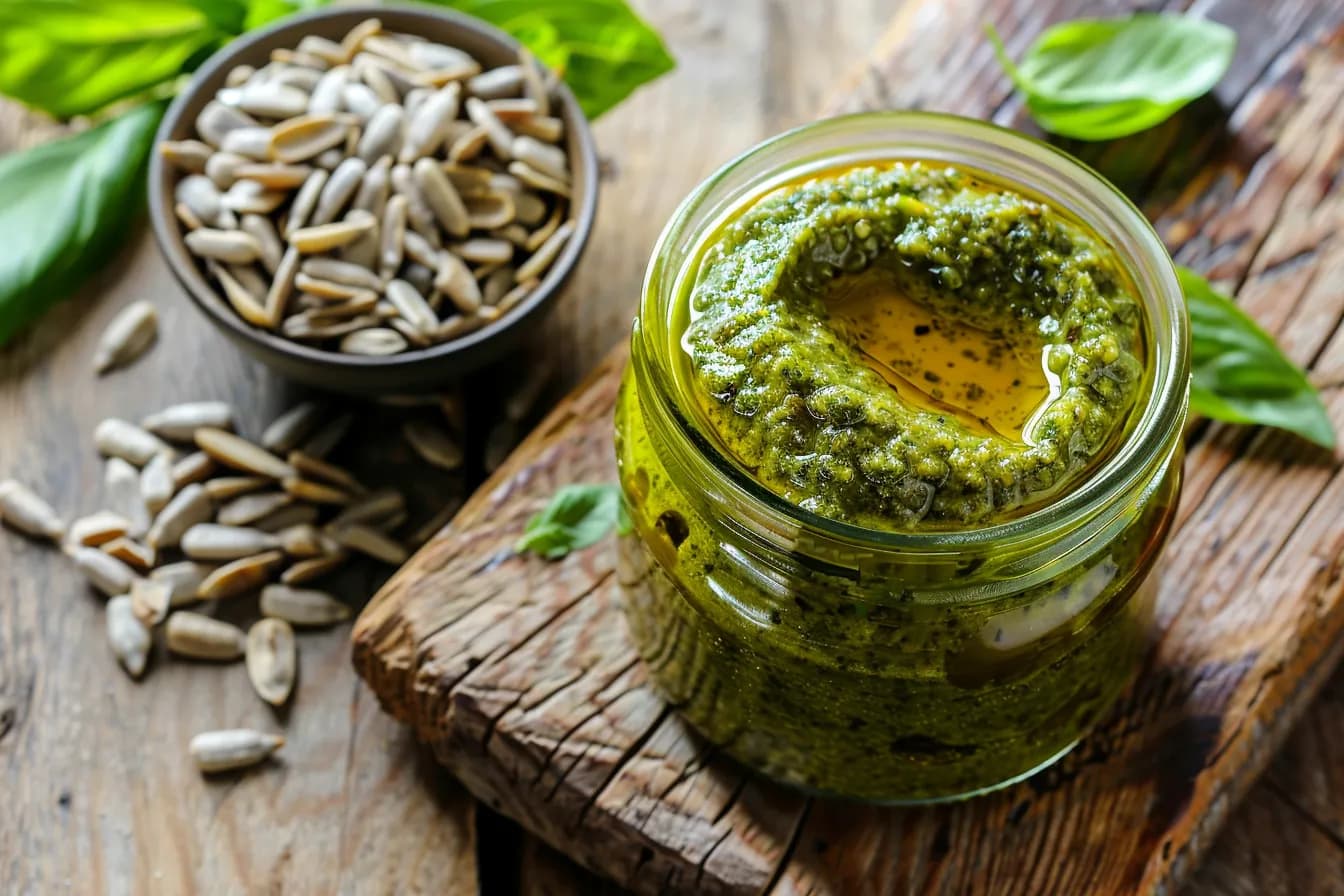
Nut-Free Pesto
Sunflower seeds instead of pine nuts are cheaper, schoolyard-friendly, and almost indistinguishable in taste.
- Preparation
- 15 min
- Cook/bake time
- 3 min
- Total
- 28 min
- Difficulty
- Easy
- Calories
- 288 kcal
- Servings
- 6 servings
- Prep
- 15 min
- Cooking & baking
- 3 min
- Resting
- 10 min
Only 18 min of that is hands-on – the rest takes care of itself.
Sunflower seeds instead of pine nuts are cheaper, schoolyard-friendly, and almost indistinguishable in taste. Pine nuts are botanically seeds and not in Annex II of the Food Information Regulation, but many daycares and schools exclude them anyway. Sunflower seeds solve the problem and bring the same creaminess.
Why this works
What makes a pesto creamy is the fat content of the seed and its ability to be finely grated. Sunflower seeds have around 50 percent fat, comparable to pine nuts, and no hard shell that wouldn't dissolve. The difference lies in the aroma. Sunflower seeds are more neutral and slightly earthier, which is why there are two tablespoons of lemon juice here instead of one. The acidity lifts the basil and balances the missing sweetness of the pine nuts. Everything else follows pesto physics. Mix briefly and in bursts so the mixture doesn't get above 50 degrees and become bitter, and fold in the oil by hand instead of mixing it in.
Step-by-step instructions
- 1
Toast the seeds and let them cool
Toast the sunflower seeds for two to three minutes in a dry pan until fragrant, and immediately pour them onto a cold plate. Complete cooling is mandatory. Warm seeds heat up the mixture, and above 50 degrees basil becomes bitter.
- 2
Prepare the basil
Wash the leaves and spin them really dry. Residual water dilutes the pesto and shortens its shelf life because it breaks through the protective oil layer.
- 3
Mix in bursts
Put the basil, cooled seeds, Parmesan, garlic, lemon juice, and salt in the blender and work in short bursts of two seconds each. Push down the sides in between. Two tablespoons of lemon juice sounds like a lot, but they balance the missing sweetness of the pine nuts.
- 4
Fold in the oil
Fold in the oil by hand with a spoon. If blended, good olive oil becomes bitter because the blade tears its oil cells. Pour into a jar and cover with a layer of oil.
Our best tips
- Two tablespoons of lemon instead of one. Sunflower seeds are more neutral than pine nuts, and the acidity replaces the missing sweetness.
- Let the seeds cool completely. They are the only warm ingredient, and above 50 degrees the basil becomes bitter.
- For daycare and school, check the Parmesan too. It is nut-free, but many facilities keep their own lists. Nutritional yeast is the safe alternative.
Tasty variations
Also without milk
Replace the Parmesan with four tablespoons of nutritional yeast and one teaspoon of light miso. This makes the pesto nut-free, dairy-free, and egg-free, covering three of the EU-14 at once.
With pumpkin seeds
Replace sunflower seeds with pumpkin seeds. The pesto becomes significantly greener and stronger in taste, and pumpkin seeds are also not tree nuts according to the EU list.
Nutrition facts
| Calories | 288 kcal |
|---|---|
| Protein | 6 g |
| Carbohydrates | 3 g |
| – of which sugar | 1 g |
| Fat | 29 g |
| Fiber | 1 g |
Where the 288 kcal come from
per serving
Calculated from the ingredients – how we do it
We add up reference values for every ingredient and divide by the number of servings. These assumptions are baked in:
- Reference values per 100 g – for the raw ingredient, exactly as listed.
- Tinned goods count at drained weight, bone-in meat at purchase weight: you eat about 70 per cent of a chicken thigh and leave the rest.
- Water evaporates as you cook. The energy stays in the pot, the weight does not – so the figure is per serving, not per 100 g of finished dish.
- Anything listed without a quantity – “salt and pepper” – is not counted.
A guide value, not a lab measurement: no two onions weigh the same, and fat content varies from pack to pack.
Frequently asked questions
Are pine nuts really not nuts?
Botanically no, they are seeds of pine trees and are not in Annex II of the Food Information Regulation, so they are not among the 14 allergens requiring labeling. Nevertheless, cross-reactions occur, and many facilities exclude them as a precaution. This recipe is exactly for these cases.
Can you taste the difference from classic pesto?
Side by side yes, individually hardly. Pine nuts are sweeter and more resinous, sunflower seeds more neutral and earthier. The extra lemon closes the gap almost completely, and the price difference is a good five times.
How long does it keep?
One week in a jar with a thumb-wide layer of oil on top, three months frozen in ice cube trays. One cube is exactly one serving of pasta and thaws in the hot pan in seconds.
Comments & ratings(0)
Sign in to rate and comment on this recipe.
You might also like
 Basic Recipes
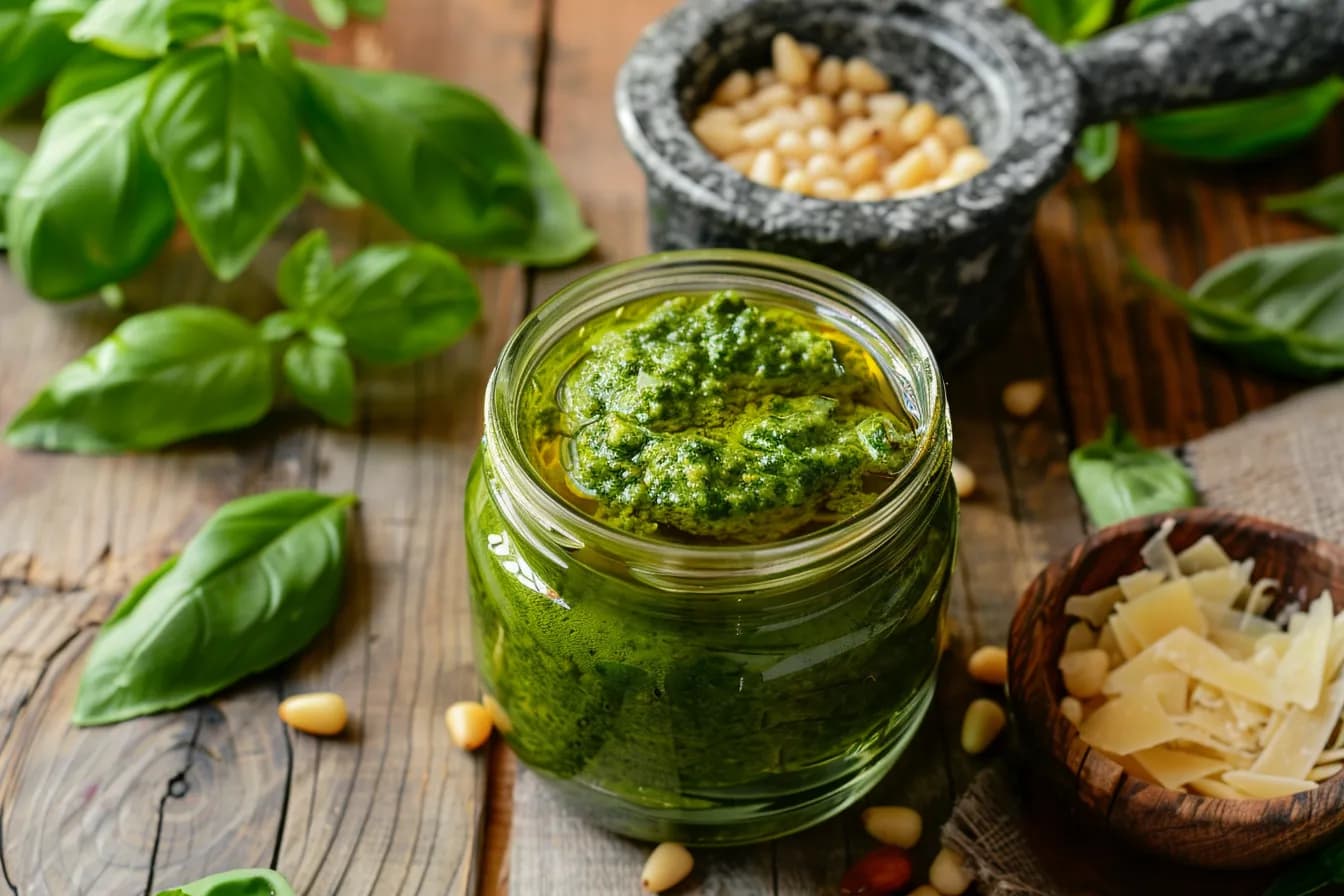
Make your own pesto, from whatever you have
Greens, fat, nuts, salt: pesto does not need basil, it just needs four roles filled.
 Basic Recipes
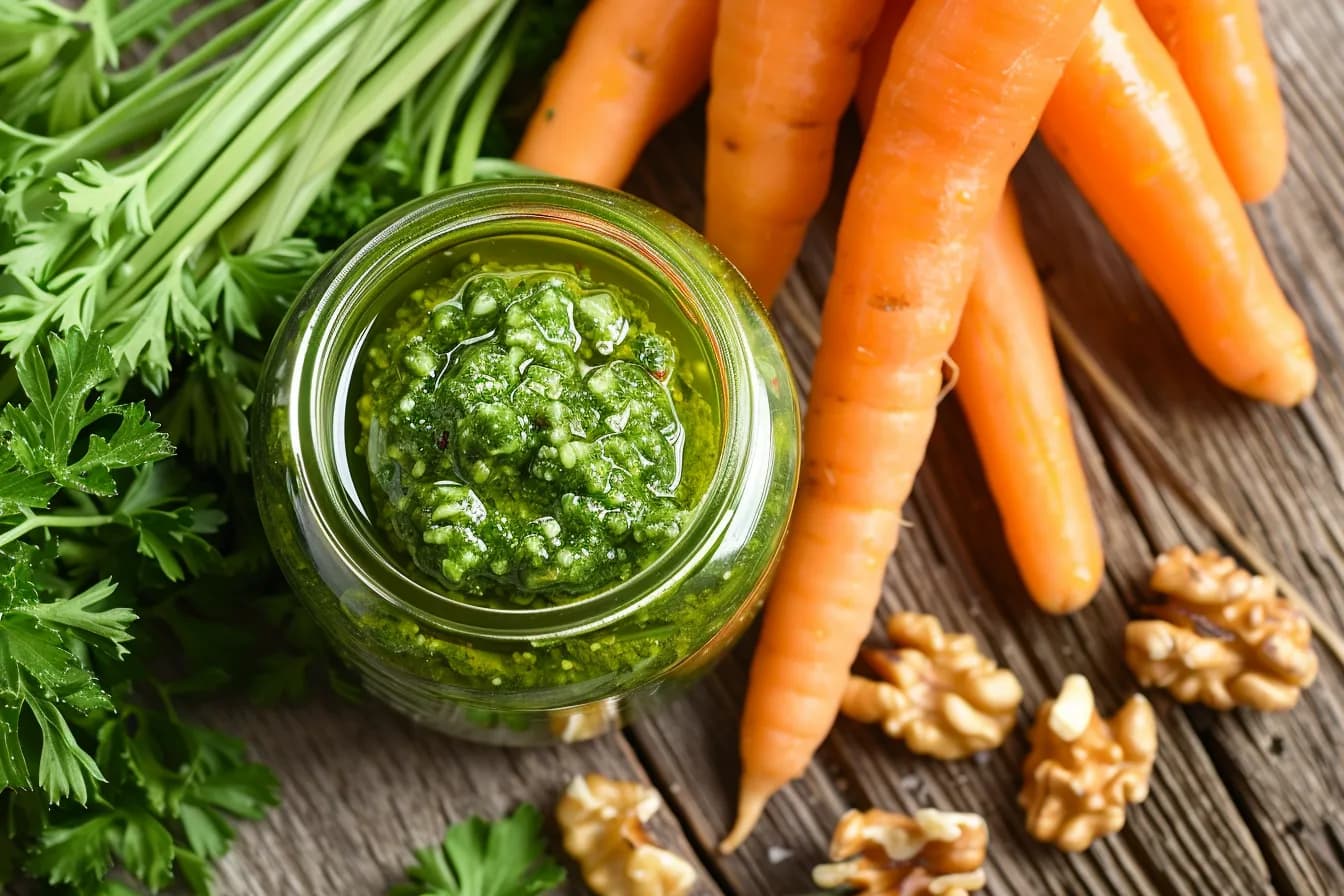
Carrot Top Pesto
The greens that get cut off at the store are edible, and they make a more robust pesto than basil.
 Basic Recipes
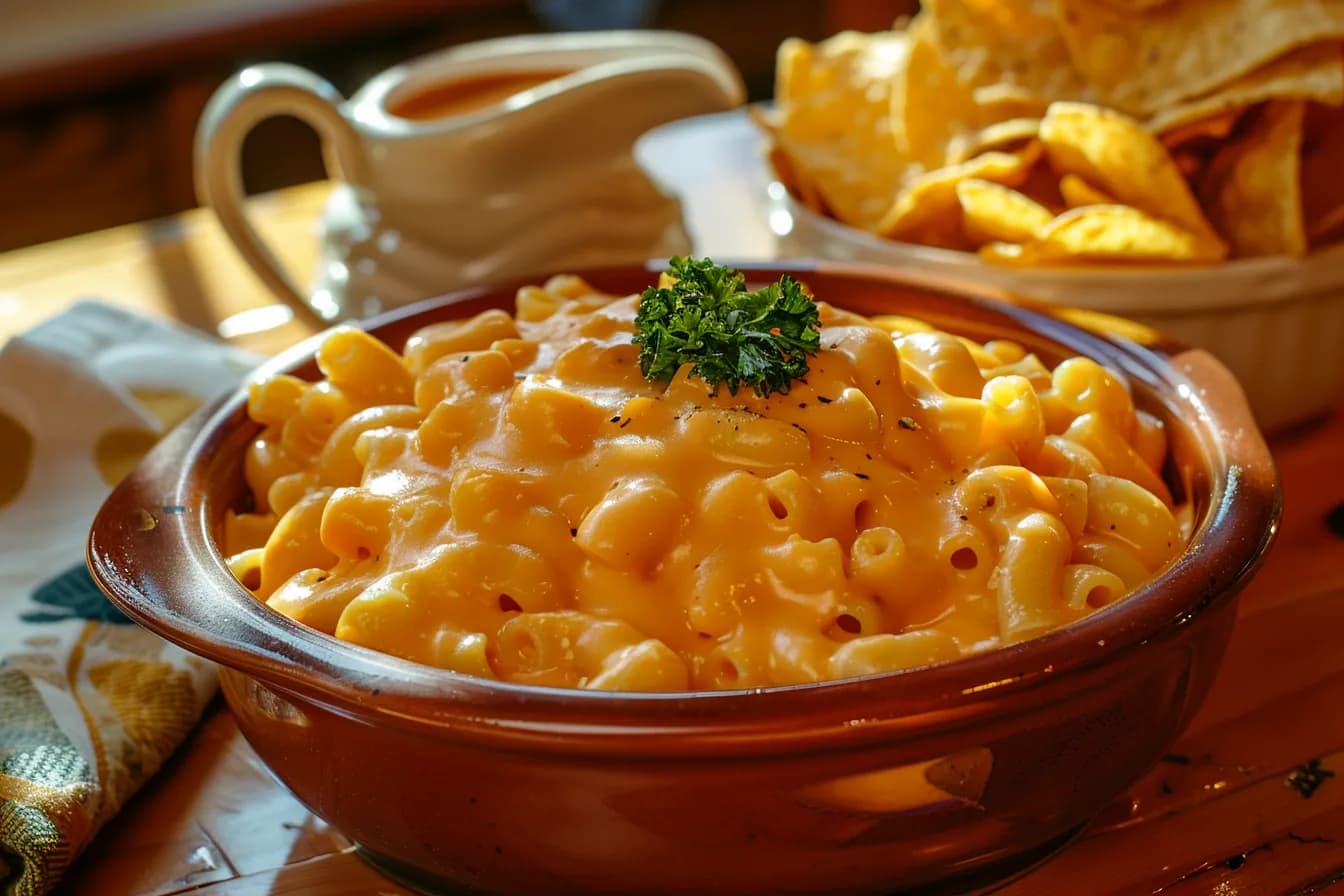
Lactose-Free Cheese Sauce
Potato and carrot combine with nutritional yeast to create a sauce that stretches and melts, completely without cheese.