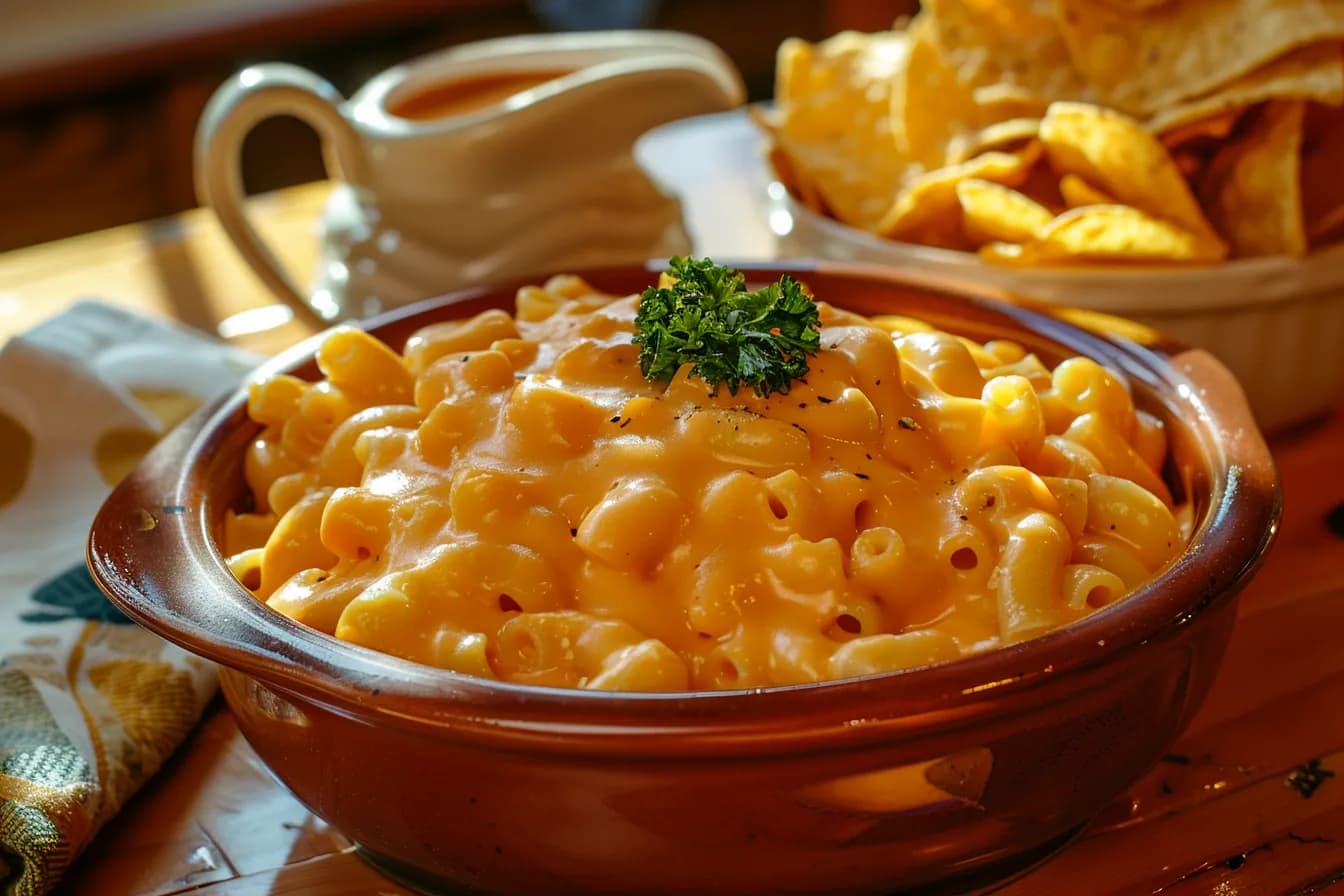
Lactose-Free Cheese Sauce
Potato and carrot combine with nutritional yeast to create a sauce that stretches and melts, completely without cheese.
- Preparation
- 10 min
- Cook/bake time
- 20 min
- Total
- 30 min
- Difficulty
- Easy
- Calories
- 169 kcal
- Servings
- 4
- Prep
- 10 min
- Cooking & baking
- 20 min
Potato and carrot combine with nutritional yeast to create a sauce that stretches and melts, completely without cheese. The trick is the potato starch. When freshly pureed, it becomes sticky and stringy, which is exactly what you expect from melted cheese. Add nutritional yeast for a savory base note and mustard for acidity.
Why this works
Cheese stretches because its milk protein forms long chains when melted. Potato starch can do something similar. When boiled potatoes are processed in a blender, the starch cells tear open and release long amylopectin chains. This is the exact same reaction that ruins mashed potatoes, but here it is highly desirable. That is why this sauce is blended and not mashed. The flavor comes from two other building blocks. Nutritional yeast contains a lot of free glutamic acid and nucleotides, providing the savory base note associated with cheese. Mustard provides the acidity that cheese gets from lactic acid fermentation. Without the acidity, the sauce tastes like vegetable puree, but with it, it comes surprisingly close to the original.
Step-by-step instructions
- 1
Boil the vegetables until soft
Boil the potatoes, carrots, and onion in a little salted water for fifteen minutes until everything is very soft. Soft really means soft here, as any piece that still has resistance will remain as a little grain in the sauce later.
- 2
Reserve the cooking water
Drain the vegetables and catch 250 ml of the cooking water. It already contains dissolved starch, which helps to thicken the sauce. Using fresh water here would be a wasted opportunity.
- 3
Blend until stringy
Put everything into the blender with 200 ml of the cooking water and blend for a full minute on the highest setting. The mixture will become visibly viscous and start to form strings. This is the torn potato starch, and for this sauce, that is exactly the goal.
- 4
Season and heat
Season to taste with salt, lemon, and mustard, then heat the sauce over low heat. Bring it to the desired consistency with the remaining cooking water. It thickens significantly as it cools and becomes almost solid in the fridge.
Our best tips
- Blend, do not mash. The torn potato starch is explicitly desired here, as it replaces the strings of melted cheese.
- Reserve the cooking water. It contains dissolved starch and thickens better than fresh water.
- Do not omit the mustard and lemon. Without acidity, the sauce tastes like vegetable puree, but with it, it comes surprisingly close to cheese.
Tasty variations
As a nacho dip
Blend with less water and stir in a chopped pickled jalapeño and a teaspoon of cumin. Thicker, spicier, and exactly the right consistency for dipping.
For mac and cheese
Mix the sauce with 300 g of cooked pasta, transfer to a baking dish, sprinkle with gluten-free breadcrumbs, and bake for fifteen minutes at 200 °C. The sauce will thicken further, so it is better to make it a little thinner.
Nutrition facts
| Calories | 169 kcal |
|---|---|
| Protein | 5 g |
| Carbohydrates | 17 g |
| – of which sugar | 3 g |
| Fat | 8 g |
| Fiber | 5 g |
Where the 169 kcal come from
per serving
Calculated from the ingredients – how we do it
We add up reference values for every ingredient and divide by the number of servings. These assumptions are baked in:
- Reference values per 100 g – for the raw ingredient, exactly as listed.
- Tinned goods count at drained weight, bone-in meat at purchase weight: you eat about 70 per cent of a chicken thigh and leave the rest.
- Water evaporates as you cook. The energy stays in the pot, the weight does not – so the figure is per serving, not per 100 g of finished dish.
- Anything listed without a quantity – “salt and pepper” – is not counted.
A guide value, not a lab measurement: no two onions weigh the same, and fat content varies from pack to pack.
Frequently asked questions
Does it really taste like cheese?
Not like cheddar, but surprisingly close to melted cheese sauce. What is missing is the fat component of real cheese and the aged flavors. If you are cooking lactose-free instead of vegan, you can stir in 50 g of lactose-free hard cheese. Then the difference is barely noticeable.
How long does the sauce keep?
Four days in the fridge. It becomes as firm as pudding because the starch continues to thicken. When reheating, stir it smooth with a splash of water or plant-based milk. Freezing does not work, as the starch separates when thawing and the sauce becomes grainy.
Is nutritional yeast the same as baker's yeast?
No. Nutritional yeast is inactivated yeast, meaning it is killed and dried. It does not leaven anything and has a savory, nutty flavor. Baker's yeast would be bitter here and would ferment. In stores, nutritional yeast is usually found with vegan products, not with baking ingredients.
Comments & ratings(0)
Sign in to rate and comment on this recipe.
You might also like
 Basic Recipes
Carrot Top Pesto
The greens that get cut off at the store are edible, and they make a more robust pesto than basil.
 Low Carb
Cauliflower Rice
A rice substitute made from cauliflower with a tenth of the carbohydrates, dry roasted instead of steamed, otherwise it turns to mush.
 Basic Recipes
Tomato Sauce
The one sauce that turns into pizza, pasta, lasagna, and casseroles. Four ingredients and no shortcuts when simmering.