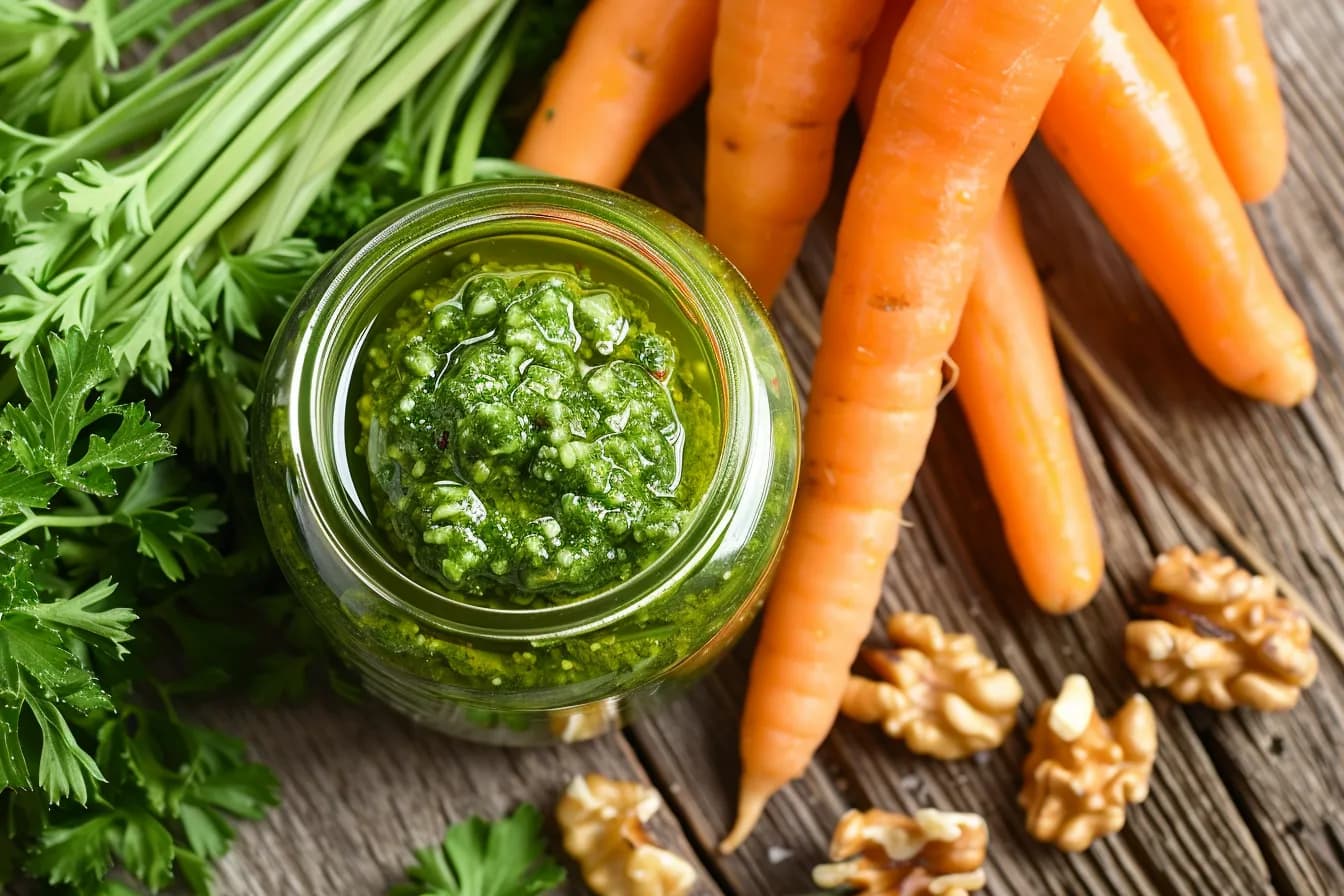
Carrot Top Pesto
The greens that get cut off at the store are edible, and they make a more robust pesto than basil.
- Preparation
- 15 min
- Cook/bake time
- 5 min
- Total
- 20 min
- Difficulty
- Easy
- Calories
- 267 kcal
- Servings
- 6 servings
- Prep
- 15 min
- Cooking & baking
- 5 min
The greens that get cut off at the store are edible, and they make a more robust pesto than basil. Carrot tops taste like parsley with a hint of carrot and come free with the bunch. A quick blanch removes their harsh bitterness, and after that they work just like any other herb.
Why this works
Carrot tops contain significantly more bitter compounds than basil, especially terpenes and polyphenols. Thirty seconds in boiling water extracts some of these and simultaneously deactivates the enzymes responsible for further bitterness development and darkening. This is why blanched greens stay vibrant, whereas raw ones turn olive brown within hours. The subsequent ice-cold shock stops the cooking process before the leaves become soft. What follows is normal pesto physics: short, pulsing blends so the mixture does not exceed 50 degrees, and folding in the oil by hand because the blade would otherwise release its bitter compounds.
Step-by-step instructions
- 1
Sort the greens
Pluck off only the tender leaves and discard the thick stems, as they are fibrous and will not blend well. A bunch of carrots yields about 80 g of usable greens, which is exactly one serving of pesto.
- 2
Blanch for thirty seconds
Place the greens in rolling boiling water for thirty seconds and immediately shock them in ice water. This extracts some of the bitter compounds and stops the enzymes that would otherwise turn the greens brown within hours.
- 3
Squeeze out thoroughly
Squeeze the greens really dry with your hands. You can easily get three tablespoons of water out of 80 g. Every milliliter of it dilutes the pesto and shortens its shelf life because water breaks through the protective oil layer.
- 4
Blend and fold in the oil
Toast the walnuts for two minutes in a dry pan and let them cool. Blend the greens, parsley, nuts, Parmesan, garlic, lemon juice and salt in short bursts. Finally, fold in the oil by hand and do not blend it. Good olive oil turns bitter under the blade.
Our best tips
- Use only the tender leaves and no stems. They are fibrous and will not break down even in the most powerful blender.
- Blanching is mandatory for carrot tops, unlike basil. Raw, it is significantly more bitter and turns brown within hours.
- Squeeze really dry after blanching. Residual water dilutes the pesto and reduces its shelf life from one week to two days.
Tasty variations
With radish or beetroot leaves
Both work exactly the same way and require the same blanching. Radish leaves are more peppery, while beetroot leaves are earthier and give the pesto a slightly reddish color.
As gremolata instead of pesto
Finely chop without oil and nuts, but with lemon zest and more garlic. It goes well over roasted vegetables and braised dishes and keeps for three days.
Nutrition facts
| Calories | 267 kcal |
|---|---|
| Protein | 5 g |
| Carbohydrates | 2 g |
| – of which sugar | 1 g |
| Fat | 27 g |
| Fiber | 1 g |
Where the 267 kcal come from
per serving
Calculated from the ingredients – how we do it
We add up reference values for every ingredient and divide by the number of servings. These assumptions are baked in:
- Reference values per 100 g – for the raw ingredient, exactly as listed.
- Tinned goods count at drained weight, bone-in meat at purchase weight: you eat about 70 per cent of a chicken thigh and leave the rest.
- Water evaporates as you cook. The energy stays in the pot, the weight does not – so the figure is per serving, not per 100 g of finished dish.
- Anything listed without a quantity – “salt and pepper” – is not counted.
A guide value, not a lab measurement: no two onions weigh the same, and fat content varies from pack to pack.
Frequently asked questions
Are carrot tops really edible?
Yes. The carrot belongs to the umbellifer family like parsley and celery, and its greens are related accordingly. It contains slightly more bitter compounds, hence the blanching. The only important thing is that it is fresh and not wilted. Yellow leaves should be discarded.
Why is my pesto still bitter?
Either stems were included, or it was blended too long and got too warm. Above 50 degrees, additional bitter compounds develop. A teaspoon of honey or a little more Parmesan balances out residual bitterness without being tasted.
How long does it keep?
One week in a jar with a thumb-width layer of oil on top, or three months frozen. Frozen in ice cube trays, one cube is exactly one serving of pasta, and carrot tops are only available when you buy carrots by the bunch anyway.
Comments & ratings(0)
Sign in to rate and comment on this recipe.
You might also like
 Basic Recipes
Make your own pesto, from whatever you have
Greens, fat, nuts, salt: pesto does not need basil, it just needs four roles filled.
 Basic Recipes
Lactose-Free Cheese Sauce
Potato and carrot combine with nutritional yeast to create a sauce that stretches and melts, completely without cheese.
 Basic Recipes
Tomato Sauce
The one sauce that turns into pizza, pasta, lasagna, and casseroles. Four ingredients and no shortcuts when simmering.