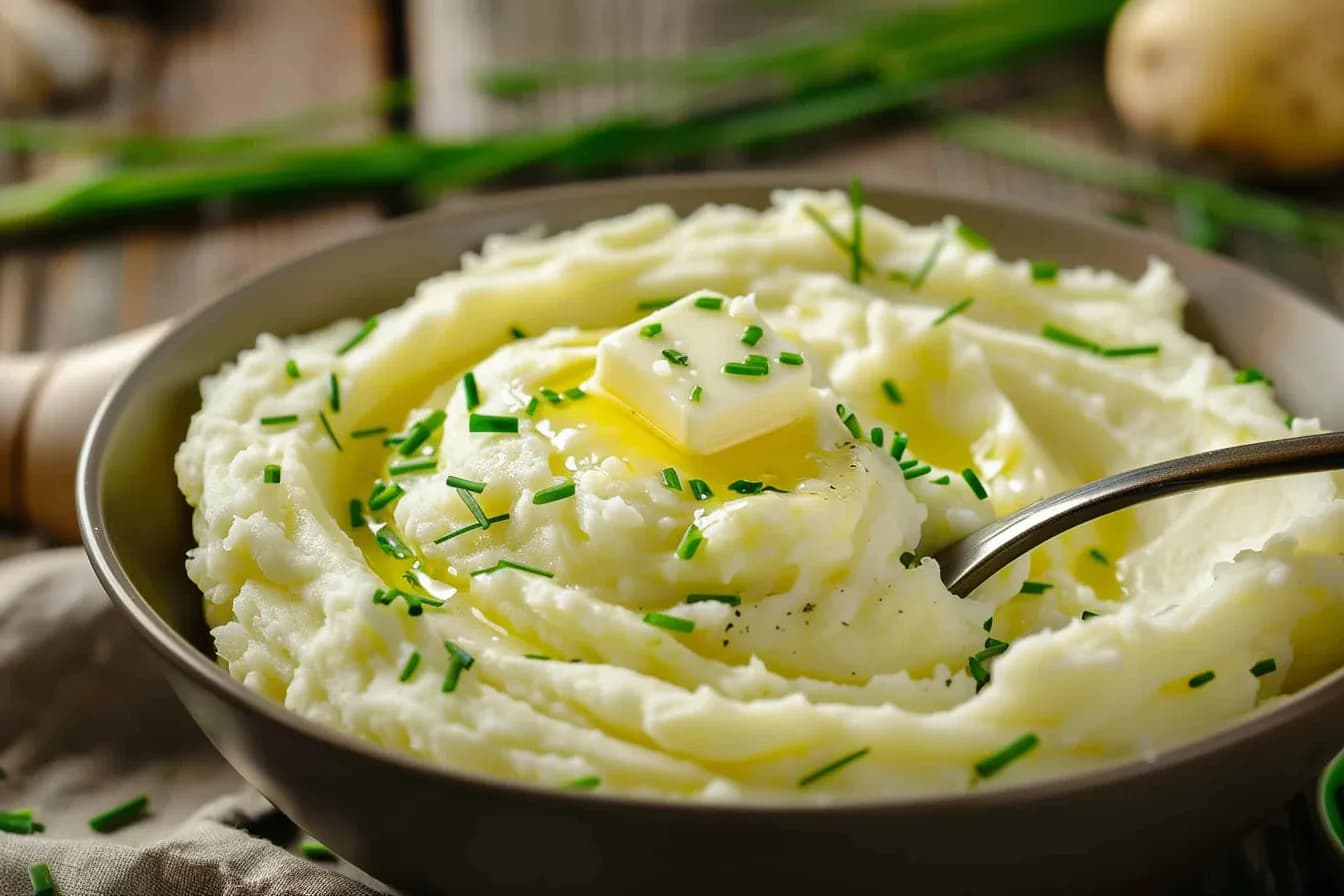
Creamy Mashed Potatoes
Buttery smooth mash made from floury potatoes, passed through a ricer and never a blender.
- Preparation
- 20 min
- Cook/bake time
- 30 min
- Total
- 50 min
- Difficulty
- Easy
- Calories
- 413 kcal
- Servings
- 6
- Prep
- 20 min
- Cooking & baking
- 30 min
Buttery smooth mash made from floury potatoes, passed through a ricer and never a blender. The order is crucial: first the warm butter, then the warm milk, because the fat coats the starch granules and keeps them apart. The other way around, creamy turns sticky within seconds.
Why this works
Potato starch sits in cells that swell during cooking. As long as these cells remain intact, the mash is creamy; if they are torn open, the starch escapes and the mixture becomes tough and gluey. That is exactly what a blender does, and that is why only a ricer or masher is used here. The order is the second lever: first the butter, then the milk. The fat coats the starch granules and keeps them apart. If the milk comes first, the starch swells in the water and clumps together. And both must be warm, because cold liquid immediately solidifies the starch and makes the mash dull.
Step-by-step instructions
- 1
Cut the potatoes evenly
Peel the potatoes and cut them into equally sized pieces of about four centimeters. Evenness is more important than small size: pieces of different sizes are never cooked at the same time, and overcooked potatoes absorb water that later ends up in the mash.
- 2
Cook in salted water
Place them in cold, well-salted water and boil them for twenty to twenty-five minutes, until a knife slides in without resistance. Starting cold is not a minor detail: this way the edge and center cook evenly, instead of the outside falling apart while the core is still hard.
- 3
Let steam off
Drain the potatoes and let them steam off uncovered in the hot pot for two to three minutes, until the surface looks floury and matte. Every gram of water that evaporates now is one you do not have to compensate for with butter later.
- 4
Rice, then butter
Press the potatoes while still hot through a ricer back into the pot. Fold in the butter in pieces until it is completely absorbed. The fat should coat the starch before liquid is added. Stir with a wooden spoon and not with a whisk.
- 5
Pour in milk and season
Heat the milk and cream until they steam, and pour them in in small portions while stirring, until the desired consistency is reached. Season with salt, white pepper and freshly grated nutmeg and sprinkle the chives on top. Serve immediately, mash does not like to wait.
Our best tips
- Only floury potatoes. Waxy ones keep their cell structure and result in a grainy, never creamy mash.
- Never the blender or immersion blender. Both tear open the starch cells, and the mash turns into paste.
- Always add butter and milk warm. Cold liquid makes the starch solidify immediately.
Tasty variations
With garlic and olive oil
Simmer four cloves of garlic in the milk, then remove them. Replace half of the butter with good olive oil.
Celery root mashed potatoes
Replace a third of the potatoes with celery root and cook them together. The mash becomes lighter and significantly more aromatic.
What is left over?
Boiled potatoes from yesterday are firmer than fresh ones, and that is exactly what makes them better in the pan.
Nutrition facts
| Calories | 413 kcal |
|---|---|
| Protein | 6 g |
| Carbohydrates | 32 g |
| – of which sugar | 4 g |
| Fat | 27 g |
| Fiber | 4 g |
Where the 413 kcal come from
per serving
Calculated from the ingredients – how we do it
We add up reference values for every ingredient and divide by the number of servings. These assumptions are baked in:
- Reference values per 100 g – for the raw ingredient, exactly as listed.
- Tinned goods count at drained weight, bone-in meat at purchase weight: you eat about 70 per cent of a chicken thigh and leave the rest.
- Water evaporates as you cook. The energy stays in the pot, the weight does not – so the figure is per serving, not per 100 g of finished dish.
- Anything listed without a quantity – “salt and pepper” – is not counted.
A guide value, not a lab measurement: no two onions weigh the same, and fat content varies from pack to pack.
Frequently asked questions
Why did my mash turn sticky?
Almost always the blender or stirring too vigorously. The torn starch cells release starch, and that cannot be taken back. From then on, only starting over helps.
Can I prepare mash in advance?
Yes, up to two days in the fridge. To reheat, stir over low heat with a splash of milk, not in the microwave, where it gets unevenly hot and dry.
Milk or cream?
Both together is the compromise between creaminess and lightness. Only cream quickly becomes heavy, only milk a bit flat. Those who like it particularly rich use cream and more butter.
Comments & ratings(0)
Sign in to rate and comment on this recipe.
You might also like
 Basic Recipes
Risotto
The basic technique for any risotto, along with the explanation of why cold butter is added at the end.
 Basic Recipes
Roasted Vegetables: Time & Temperature for Everything
Sixteen types of vegetables, each with a time and a temperature, so everything is ready at the same time.
 Dinner
How to Make a Casserole: The Modular Guide
Starch, vegetables, binder, cheese: the four layers that make up every casserole, individually selectable.