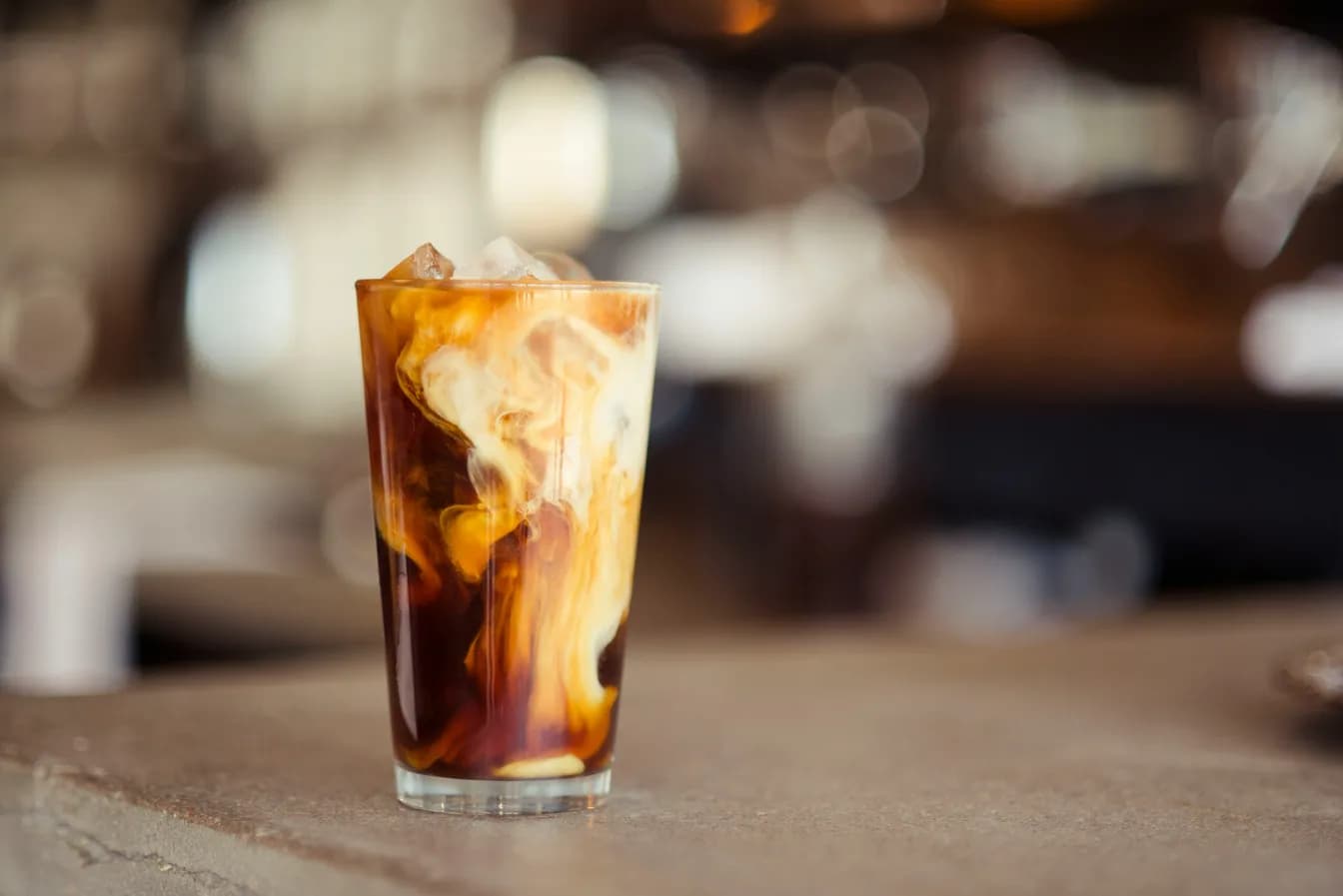
Cold Brew Coffee
Coffee that steeps cold for twelve hours instead of hot for two minutes, resulting in significantly less acidity and noticeably more sweetness.
- Preparation
- 20 min
- Cook/bake time
- –
- Total
- 12 hr 20 min
- Difficulty
- Easy
- Calories
- 1 kcal
- Servings
- 4 glasses
- Prep
- 20 min
- Resting
- 12 hr
Only 20 min of that is hands-on – the rest takes care of itself.
Coffee that steeps cold for twelve hours instead of hot for two minutes, resulting in significantly less acidity and noticeably more sweetness. Cold brew is not just chilled filter coffee, but a different process with a different result: without heat, certain acids and bitter compounds simply do not dissolve from the grounds. Once prepared, you have iced coffee in the fridge for a week.
Why this works
Extraction is temperature-dependent, and not uniformly so for all compounds. Chlorogenic acids and a large portion of the bitter roasted compounds need heat to dissolve. At room temperature, they mostly remain in the grounds, no matter how long you wait. Caffeine and the sweet sugar and caramel compounds, on the other hand, dissolve even when cold, just more slowly. This is exactly what creates the profile of cold brew: it contains measurably less acid than hot-brewed coffee, tastes rounder and sweeter as a result, and still delivers plenty of caffeine. The coarse grind is not a minor detail here: fine powder has so much surface area that bitter compounds will still be extracted over twelve hours, and it is almost impossible to separate from the water afterwards.
Step-by-step instructions
- 1
Grob mahlen
Mahl die Bohnen grob, wie für die French Press – die Körner sollen einzeln erkennbar bleiben. Feines Pulver gibt über die lange Ziehzeit doch Bitterstoffe ab und lässt sich am Ende kaum abseihen.
- 2
Ansetzen
Gib das Pulver in ein großes Glas und gieß das kalte Wasser darüber. Rühr einmal gründlich durch, bis kein trockenes Nest mehr oben schwimmt. Das Verhältnis ist 1:10, also 100 g auf einen Liter.
- 3
Zwölf Stunden ziehen
Verschließ das Gefäß und stell es in den Kühlschrank. Zwölf Stunden sind das Minimum, achtzehn das Maximum – danach werden auch kalt Bitterstoffe frei. Bei Zimmertemperatur geht es schneller, wird aber herber.
- 4
Abseihen
Gieß den Ansatz durch ein feines Sieb, ausgelegt mit einem Kaffeefilter oder Mulltuch. Lass ihn von allein durchlaufen und drück den Satz nicht aus. Beim Pressen treten genau die Bitterstoffe aus, die du zwölf Stunden lang vermieden hast.
- 5
Verdünnen und servieren
Das Konzentrat ist stark wie Espresso und wird nicht pur getrunken. Gieß es 1:1 mit Wasser oder Milch über reichlich Eis. Wer es milder mag, nimmt zwei Teile Wasser auf einen Teil Konzentrat.
Our best tips
- The concentrate is strong. For drinking, dilute it 1:1 with water or milk over ice, otherwise it is almost espresso strength.
- Lightly roasted beans yield fruity, acidic results, while dark roasts yield chocolatey ones. Unlike filter coffee, cold brew is very forgiving of dark roasts because hardly any bitter compounds are extracted anyway.
- Pour some of the finished cold brew into an ice cube tray and freeze it. These cubes will not water down the coffee in the glass, but rather strengthen it.
Tasty variations
Cold Brew Tonic
Pour 60 ml of concentrate over ice, top with 150 ml of tonic water, and add an orange zest. The bitterness of the quinine and the sweetness of the coffee go together surprisingly well.
Cold Brew with Oat Milk
Mix 1:1 with oat milk instead of water. Barista oat milk has a higher fat content and does not curdle in the cold, slightly acidic liquid.
Nutrition facts
| Calories | 1 kcal |
|---|---|
| Protein | 0 g |
| Carbohydrates | 0 g |
| – of which sugar | 0 g |
| Fat | 0 g |
| Fiber | 0 g |
Estimated, not calculated – why
Here some of the ingredients never reach the plate: most frying oil stays in the pan, and in a stock the solids are strained off. How much of it ends up in the food cannot be calculated – counting a litre of oil would quintuple the figure, leaving it out would describe a dish baked without fat. So this is an editorial estimate rather than a total that would look dependable without being so.
A guide value, not a lab measurement: no two onions weigh the same, and fat content varies from pack to pack.
Frequently asked questions
How many calories does cold brew have?
Black, practically none. It has about 1 to 2 kcal per glass, because the coffee grounds are strained out and do not end up in the drink. Anything above that comes from what is added: a splash of whole milk adds about 30 kcal, a teaspoon of sugar about 20.
How long does cold brew keep?
Strained and sealed in the refrigerator, about a week. Unstrained, it should not sit for more than eighteen hours, because bitter compounds will dissolve after that.
Is cold brew stronger than regular coffee?
The concentrate is, but the finished drink is not necessarily. Because of the 1:10 ratio, there is a lot of coffee in a little water. If you dilute it 1:1, you end up with roughly the caffeine amount of a strong filter coffee.
What is the difference to iced coffee?
Iced coffee is hot-brewed coffee that is cooled down. It retains the acids and bitter compounds of hot extraction. Cold brew steeps cold from the start and therefore tastes noticeably sweeter and smoother, with significantly less acidity.
Can I reuse the coffee grounds?
Not for making coffee, as they are depleted. In the garden, they work as an addition to compost, and dried, they can be used as a scrub.
Comments & ratings(0)
Sign in to rate and comment on this recipe.
You might also like
 Drinks
Iced Coffee
Ice-cold coffee that doesn't get watered down, thanks to coffee ice cubes and a cold-brewed base.
 Breakfast
Homemade Protein Shake
30 grams of protein from real food. This is a shake that keeps you full instead of leaving you hungry again after twenty minutes.
 Breakfast
Overnight Oats
Oats soaked overnight with yogurt and chia, just top them in the morning.