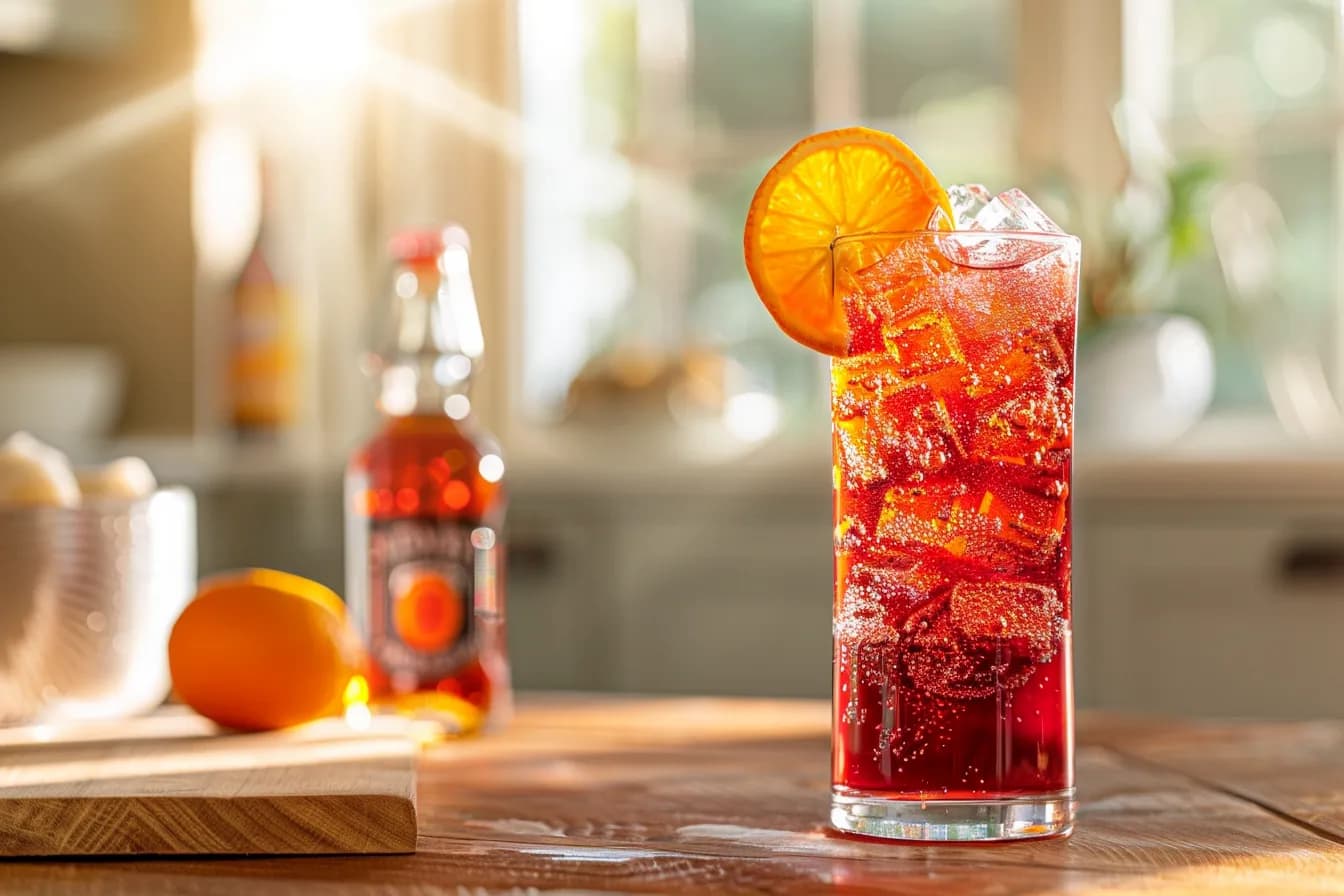
Campari Soda
Two ingredients, no sparkling wine, no discussion: the Italian aperitif in its shortest form.
- Preparation
- 3 min
- Cook/bake time
- –
- Total
- 3 min
- Difficulty
- Easy
- Calories
- 123 kcal
- Servings
- 1
Two ingredients, no sparkling wine, no discussion: the Italian aperitif in its shortest form. In Italy, it is a staple in every bar and is served in a small glass, not a large one. It is meant to wake up your palate before a meal, not to be sipped casually on the side. If you find Aperol too sweet, this is exactly what you need.
Why this works
At 25 percent alcohol, Campari is more than twice as strong as Aperol and brings significantly more bitterness to the table. Bitterness is the only basic taste that humans innately avoid, as it is an evolutionary warning signal for toxins, and that is exactly why an aperitif works. The slight irritation stimulates the production of saliva and gastric juices, making you hungry. The soda water has a precise job here that goes beyond simply diluting the drink. Carbonation activates receptors on the tongue that use the same pathways as mild pain stimuli, thereby distracting some of your attention away from the bitterness. Without carbonation, the same Campari mixed with still water tastes noticeably more bitter.
Step-by-step instructions
- 1
Glass and ice
Take a short tumbler and fill it two-thirds full with large ice cubes. The small glass is intentional. Campari Soda is not a long drink to be sipped for an hour, but a quick aperitif before a meal.
- 2
Campari over the ice
Pour the Campari directly over the cubes. It cools down immediately, and this is more important than it sounds. Cold significantly dampens the perception of bitterness, whereas a lukewarm Campari tastes much sharper.
- 3
Top with soda
Top up with ice-cold soda water by tilting the glass slightly and pouring it down the side. Do not stir. The soda mixes in sufficiently as it is poured, and any movement with a spoon costs carbonation, which is exactly the reason why the drink does not taste too bitter.
- 4
Express the zest
Hold the orange zest with the skin side down over the glass and snap it sharply so that the essential oils spray onto the surface as a fine mist. Then rub it along the rim of the glass and drop it in. Serve immediately.
Our best tips
- The ratio is a matter of taste and ranges from 1:2 to 1:3. If you are drinking Campari for the first time, start at 1:3 and work your way up.
- Use highly carbonated soda water, not still mineral water. The carbonation here is not just a fizzy effect, but the antidote to the bitterness.
- An orange slice is perfect for a mild introduction, while a lemon zest makes the drink sharper and drier. Both are common in Italy.
Tasty variations
Americano
30 ml each of Campari and sweet red vermouth, topped with soda. The vermouth adds sweetness and herbs, making the drink much more accessible.
Campari Tonic
Replace the soda water with tonic water. The quinine in the tonic brings a second, completely different bitterness. Together with the sugar in the tonic, this results in a more rounded drink.
Nutrition facts
| Calories | 123 kcal |
|---|---|
| Protein | 0 g |
| Carbohydrates | 13 g |
| – of which sugar | 13 g |
| Fat | 0 g |
| Fiber | 1 g |
Where the 123 kcal come from
per serving
Calculated from the ingredients – how we do it
We add up reference values for every ingredient and divide by the number of servings. These assumptions are baked in:
- Reference values per 100 g – for the raw ingredient, exactly as listed.
- Tinned goods count at drained weight, bone-in meat at purchase weight: you eat about 70 per cent of a chicken thigh and leave the rest.
- Water evaporates as you cook. The energy stays in the pot, the weight does not – so the figure is per serving, not per 100 g of finished dish.
- Anything listed without a quantity – “salt and pepper” – is not counted.
A guide value, not a lab measurement: no two onions weigh the same, and fat content varies from pack to pack.
Frequently asked questions
How many calories are in a Campari Soda?
About 125 kcal per glass. This puts it well below an Aperol Spritz with around 175 kcal, because soda water contributes no calories and there is no Prosecco involved.
What is the difference between Campari and Aperol?
Campari has 25 percent alcohol, while Aperol only has 11. Campari is significantly more bitter and less sweet, whereas Aperol is fruitier and more approachable. Both originally stem from the same tradition of Italian herbal bitters.
Can I make Campari Soda with tonic?
Yes, this is widely known as a Campari Tonic. However, the tonic brings sugar and a second bitter note from the quinine, making it a different drink rather than just a variation.
Does Campari still contain carmine?
No. The dye made from cochineal insects was gradually replaced by an artificial dye starting in 2006. This means Campari is also suitable for vegetarian and vegan diets.
Comments & ratings(0)
Sign in to rate and comment on this recipe.
You might also like
 Cocktails
Homemade Spritz
Bitter, sparkling wine, soda, three building blocks, and one recipe turns into all the Spritz variations on the Italian aperitivo menu.
 Cocktails
Negroni Sbagliato
The "mistaken" Negroni: Prosecco goes into the glass instead of gin, turning the heavy classic into an aperitif.
 Cocktails
Limoncello Spritz
The southern Italian answer to the Aperol Spritz: lemon liqueur, Prosecco, and a basil leaf.