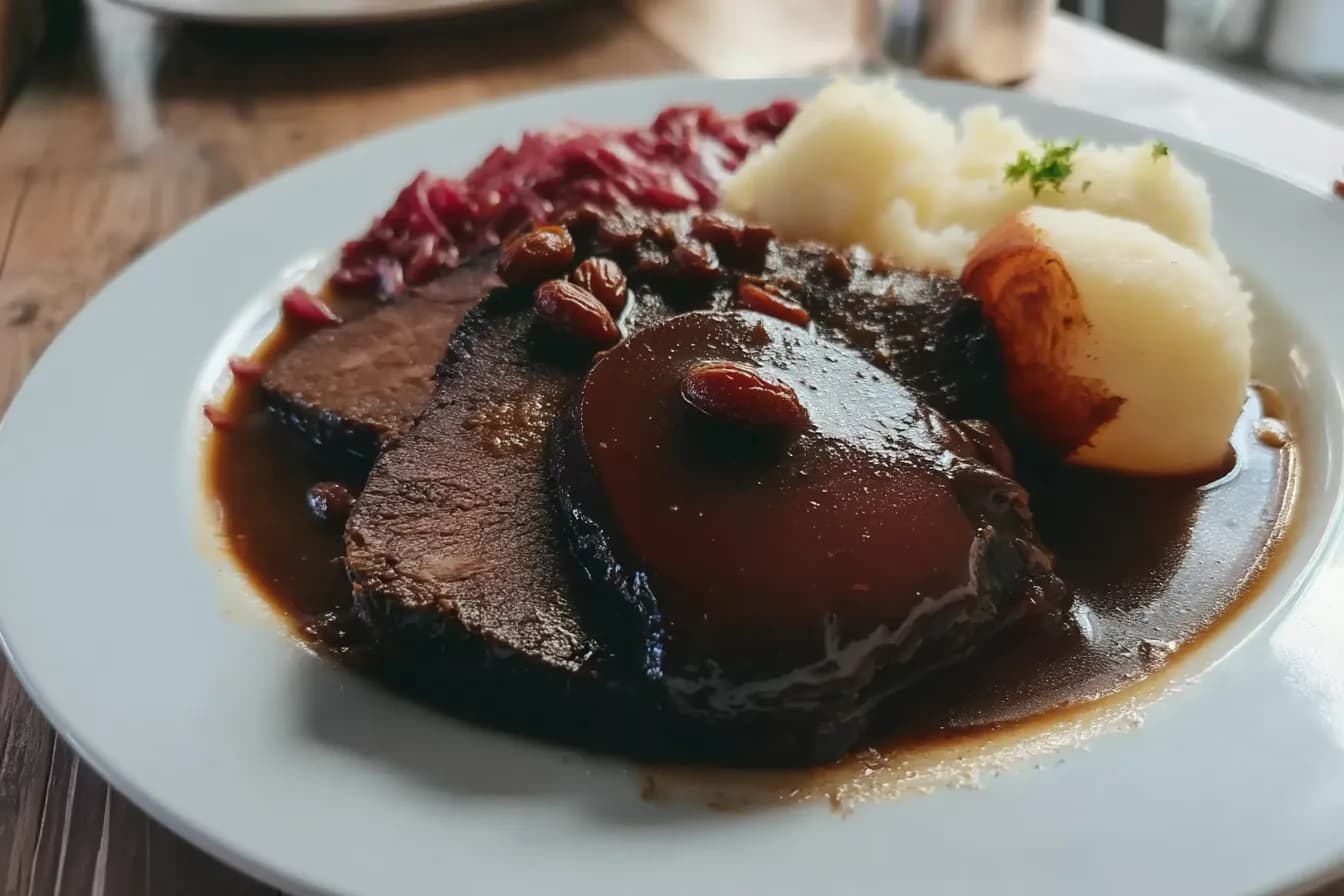
Rhenish Sauerbraten
Beef roast, marinated in vinegar for four days, and the sauce is thickened with raisins and gingerbread.
- Preparation
- 30 min
- Cook/bake time
- 3 hr
- Total
- 99 hr 30 min
- Difficulty
- Easy
- Calories
- 866 kcal
- Servings
- 6
- Prep
- 30 min
- Cooking & baking
- 3 hr
- Resting
- 96 hr
Only 3 hr 30 min of that is hands-on – the rest takes care of itself.
Beef roast, marinated in vinegar for four days, and the sauce is thickened with raisins and gingerbread. The Rhenish version differs from all others by its sweetness: raisins, sugar beet syrup, and crumbled Aachener Printen create a sweet-and-sour sauce that exists nowhere else. Four days of marinating is the minimum.
Why this works
The marinade works in two ways, and both take time. The acid denatures proteins on the surface of the meat and loosens the connective tissue, but only a few millimeters deep, which is why four days are necessary for the effect to be noticeable at all. More important is the second way: the low pH value increases the water-binding capacity of the meat, so it loses less juice when braising. This is exactly where the juiciness typical of Sauerbraten comes from despite the long cooking time. The sweetness in the Rhenish version is not a flavor detail, but a chemical balance: raisins, sugar beet syrup, and Printen bring so much sugar that the sharp acetic acid is buffered. The Printen also thicken the sauce; their starch and the spices they contain make the sauce thick without the need for flour.
Step-by-step instructions
- 1
Marinate for four days
Bring the vinegar, red wine, water, vegetables, and spices to a boil once and let everything cool completely. Place the meat in a container, pour the cold marinade over it until it is **completely covered**, and refrigerate for four days. Turn it once a day.
- 2
Dry and sear
Remove the meat, pat it very thoroughly dry, and save the marinade. Sear it in lard until dark all over. Wet meat does not brown, and for a roast that braises for two and a half hours, the roasted flavors are half the sauce.
- 3
Deglaze and braise
Briefly roast the marinade vegetables, pour in the strained marinade and the stock, and bring everything to a simmer. Braise covered over the lowest heat for two and a half hours until the meat is tender. It must not boil.
- 4
Thicken the sauce
Remove the meat and keep it warm. Strain the sauce, stir in the raisins, sugar beet syrup, and crumbled Printen, and let everything simmer for ten minutes. The Printen break down and thicken the sauce, so flour is not necessary.
- 5
Season and serve
Season with salt and pepper and adjust the ratio of sweet to sour: if it is too sour, add more sugar beet syrup; if it is too sweet, add a splash of marinade. Slice the meat against the grain. Serve classically with potato dumplings and applesauce.
Our best tips
- Four days is the minimum, five is better. The acid only works a few millimeters deep, and time is the only thing that brings it deeper.
- The meat must be completely covered by the marinade. Protruding parts will discolor and will not marinate.
- Aachener Printen are not a substitute product, but the classic thickener. Gingerbread also works; commercial sauce thickener strips the sauce of its character.
Tasty variations
Franconian Sauerbraten
Without raisins and Printen, but thickened with sour cream. Significantly more tart and the most common version outside the Rhineland.
With horse meat
The original Rhenish version was made with horse meat and is still offered this way in Cologne today. It is leaner and takes about thirty minutes less.
Nutrition facts
| Calories | 866 kcal |
|---|---|
| Protein | 56 g |
| Carbohydrates | 39 g |
| – of which sugar | 28 g |
| Fat | 46 g |
| Fiber | 3 g |
Where the 866 kcal come from
per serving
Calculated from the ingredients – how we do it
We add up reference values for every ingredient and divide by the number of servings. These assumptions are baked in:
- Reference values per 100 g – for the raw ingredient, exactly as listed.
- Tinned goods count at drained weight, bone-in meat at purchase weight: you eat about 70 per cent of a chicken thigh and leave the rest.
- Water evaporates as you cook. The energy stays in the pot, the weight does not – so the figure is per serving, not per 100 g of finished dish.
- Anything listed without a quantity – “salt and pepper” – is not counted.
A guide value, not a lab measurement: no two onions weigh the same, and fat content varies from pack to pack.
Frequently asked questions
How long does Sauerbraten need to marinate?
Four to five days. The acid only works a few millimeters deep into the meat, so shorter marinating times result in a braised dish with a sour sauce, but not a Sauerbraten.
How many calories does Rhenish Sauerbraten have?
Around 865 kcal per portion for six portions, without side dishes. The roast is generously calculated at 250 g of raw meat per portion; raisins, sugar beet syrup, and Printen together bring about 130 kcal per portion in the form of sugar.
What is the difference between Rhenish and Franconian Sauerbraten?
The sweetness. The Rhenish version is thickened with raisins, sugar beet syrup, and Printen and is distinctly sweet and sour; the Franconian version has no sweetness and is thickened with sour cream.
Can I reuse the marinade?
No. It has been in contact with raw meat for days and belongs in the sauce after straining and boiling, or it should be thrown away. Marinating a second piece of meat in it is not safe.
Comments & ratings(0)
Sign in to rate and comment on this recipe.
You might also like
 Dinner
Kale with Pinkel Sausage
A Northern German winter classic, and the kale needs frost or a long cooking time, not both.
 Dinner
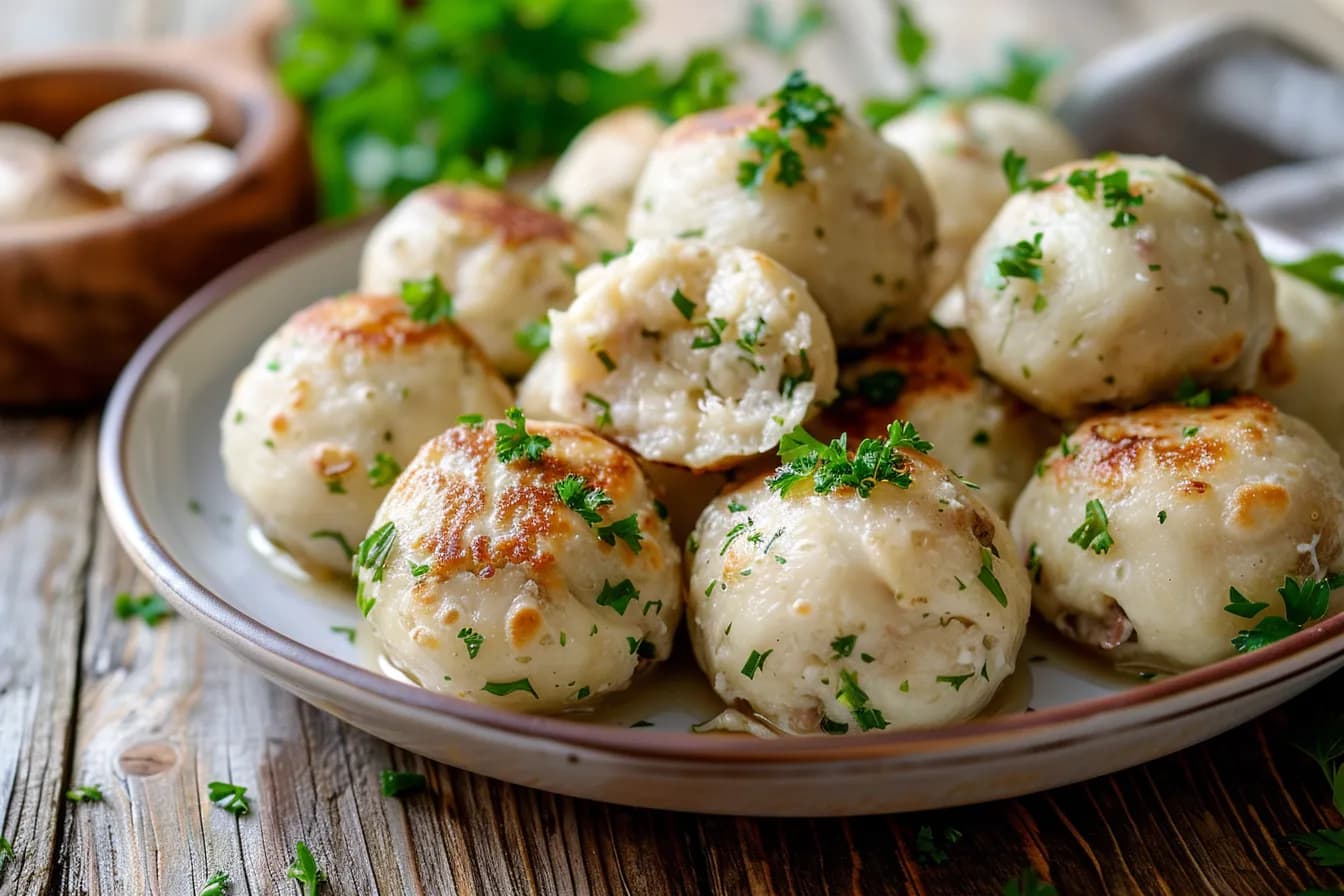
German Bread Dumplings
Let them soak for twenty minutes, then stop kneading. Bread dumplings fall apart because of how they are handled, not because of the recipe.
 Dinner
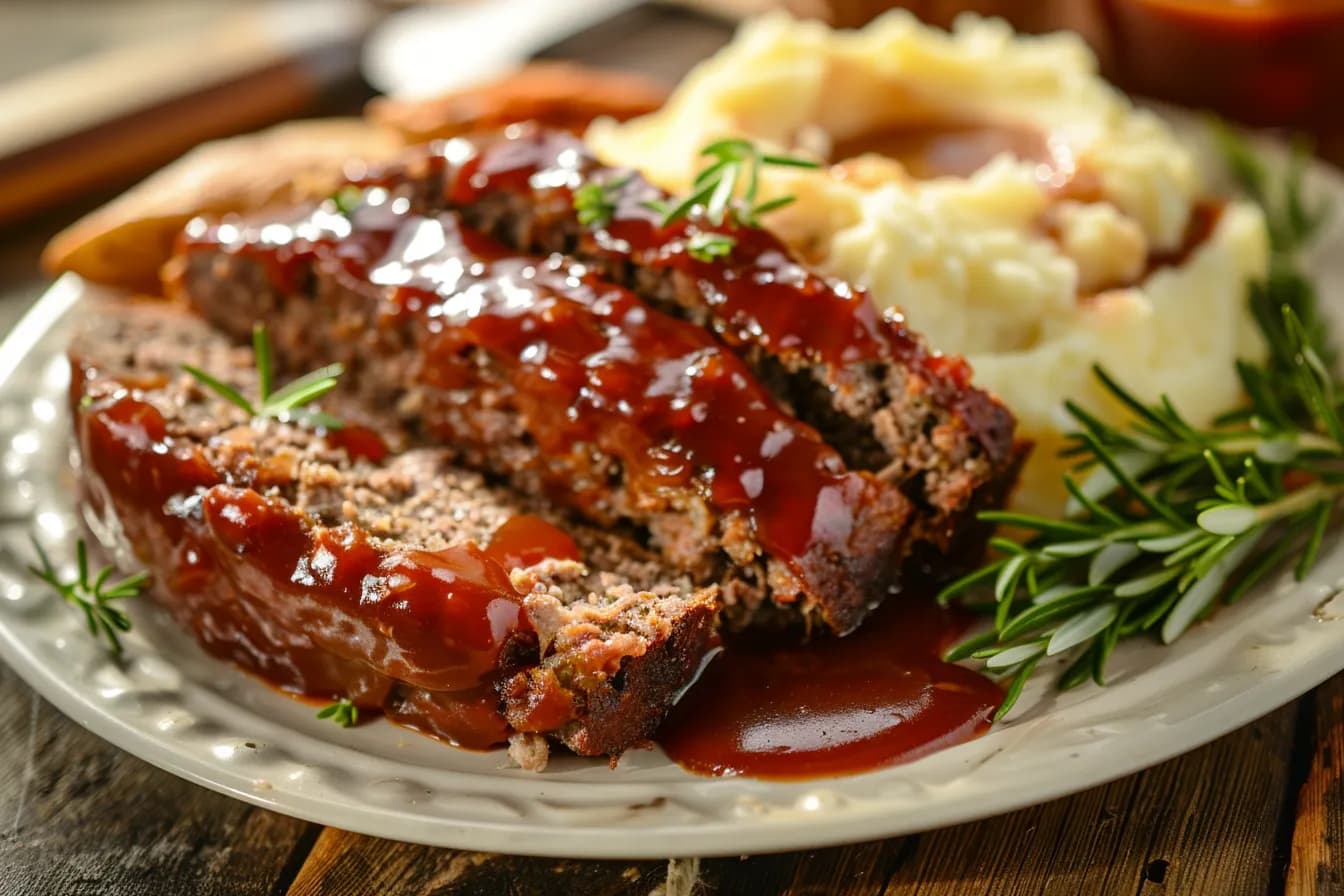
Meatloaf with Mashed Potatoes
Juicy meatloaf with a glazed ketchup crust, served with creamy mashed potatoes and gravy.