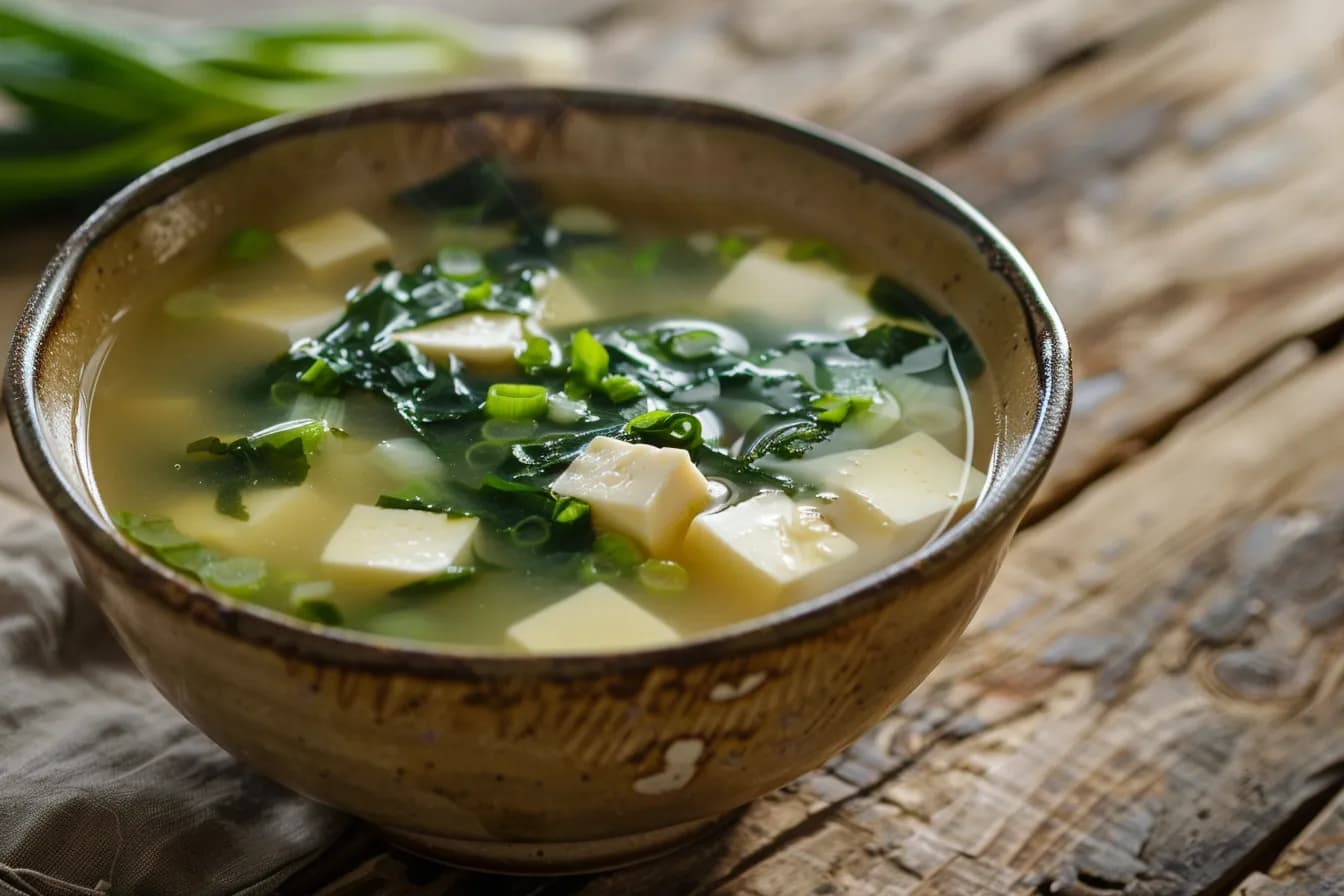
Miso Soup with Tofu
The clear, umami-rich five minutes of everyday Japanese cooking, featuring tofu and wakame.
- Preparation
- 10 min
- Cook/bake time
- 10 min
- Total
- 20 min
- Difficulty
- Easy
- Calories
- 89 kcal
- Servings
- 4
- Prep
- 10 min
- Cooking & baking
- 10 min
The clear, umami-rich five minutes of everyday Japanese cooking, featuring tofu and wakame. The crucial point is that miso must never boil, because heat destroys its delicate aroma and live cultures. This is a soup that accompanies almost every meal in Japan and is still ready in minutes.
Why this works
Miso is a fermented food. Its aroma comes from volatile compounds that are the first to escape during cooking. What remains tastes merely salty. Dashi also cannot tolerate a rolling boil, as kombu releases bitter substances above 60 °C, and katsuobushi becomes fishy when boiled vigorously. The entire soup is therefore an exercise in never reaching the boiling point.
Step-by-step instructions
- 1
Soak the wakame
Place the dried wakame in a bowl of cold water and let them soak for five minutes. They multiply their volume surprisingly well, so one teaspoon per person is truly enough. Drain them afterwards and squeeze them out gently.
- 2
Heat the dashi
Heat the dashi broth in a pot until it is steaming slightly but not quite boiling. If you are making dashi yourself, steep a piece of kombu seaweed in cold water for thirty minutes and then heat it slowly, removing it just before boiling, and let bonito flakes steep for two minutes.
- 3
Add tofu and wakame
Add the tofu cubes and the drained wakame to the hot broth and let them steep for two minutes so they are warmed through. Stir very gently with a spoon, because silken tofu is very delicate and will otherwise break apart into flakes.
- 4
Stir in the miso
Now remove the pot from the heat. Place the miso paste in a small bowl or a ladle and stir it smooth with a few spoons of the hot broth until there are no more lumps. Only then do you stir it into the pot. This order is important, because miso stirred in directly never distributes evenly.
- 5
Serve
Quickly distribute the soup among four bowls and sprinkle the spring onion rings on top. Miso soup is traditionally drunk immediately and not kept warm, because reheating it causes it to lose a significant amount of aroma and become flat in taste.
Our best tips
- Miso must never boil. Always remove from the heat, stir it in, and serve immediately.
- No dashi on hand? Instant dashi powder from the Asian supermarket is a perfectly legitimate substitute and absolutely common in Japan.
- Light Shiro Miso is mild and sweet, while dark Aka Miso is significantly stronger. For beginners, the light one is the safe choice.
Tasty variations
Vegan
Make the dashi with only kombu and omit the bonito flakes, letting a few dried shiitake mushrooms steep along with it.
More filling
Add a handful of cooked udon noodles and baby spinach to the bowl, turning the side dish into a full meal.
Nutrition facts
| Calories | 89 kcal |
|---|---|
| Protein | 8 g |
| Carbohydrates | 8 g |
| – of which sugar | 3 g |
| Fat | 3 g |
| Fiber | 1 g |
Where the 89 kcal come from
per serving
Calculated from the ingredients – how we do it
We add up reference values for every ingredient and divide by the number of servings. These assumptions are baked in:
- Reference values per 100 g – for the raw ingredient, exactly as listed.
- Tinned goods count at drained weight, bone-in meat at purchase weight: you eat about 70 per cent of a chicken thigh and leave the rest.
- Water evaporates as you cook. The energy stays in the pot, the weight does not – so the figure is per serving, not per 100 g of finished dish.
- Anything listed without a quantity – “salt and pepper” – is not counted.
A guide value, not a lab measurement: no two onions weigh the same, and fat content varies from pack to pack.
Frequently asked questions
What exactly is dashi?
A light Japanese basic broth made from kombu seaweed and dried bonito flakes. It provides the umami foundation and is the base in almost every Japanese dish.
Can I use vegetable broth instead of dashi?
In an emergency, yes, but the character changes significantly. A mild, unseasoned vegetable broth is better than a strong one with many herbs.
How long does miso keep?
Once opened, it keeps in the fridge for a year without any problems. It is fermented and therefore very shelf-stable, though the color may just become a little darker over time.
Comments & ratings(0)
Sign in to rate and comment on this recipe.
You might also like
 Breakfast
Skyr Bowl
Icelandic Skyr with berries, nuts and honey: 25 grams of protein in a bowl that is ready in four minutes.
 Low Carb
Cauliflower Rice
A rice substitute made from cauliflower with a tenth of the carbohydrates, dry roasted instead of steamed, otherwise it turns to mush.
 Breakfast
Eggs in Tomato Sauce for One
Half a can of tomatoes, two eggs, a small pan: Shakshuka in a single portion.