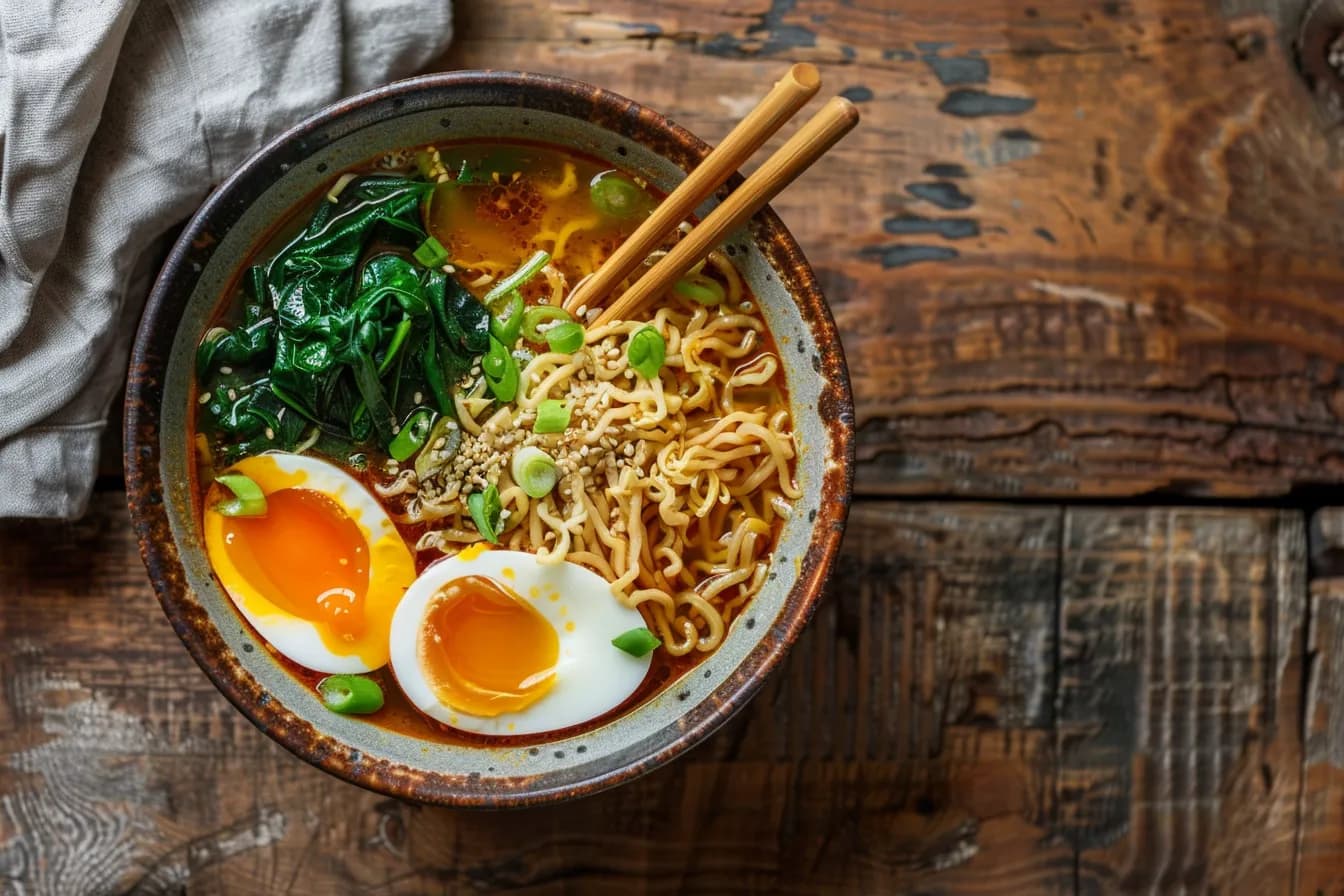
Instant Ramen Upgrade
The noodles stay, the little packet gets tossed out. Four ingredients turn this into a real bowl of food.
- Preparation
- 5 min
- Cook/bake time
- 12 min
- Total
- 17 min
- Difficulty
- Easy
- Calories
- 467 kcal
- Servings
- 1
- Prep
- 5 min
- Cooking & baking
- 12 min
The noodles stay, the little packet gets tossed out. Four ingredients turn this into a real bowl of food. Instant ramen has good noodles with bad broth. If you build the broth yourself and add an egg, some greens, and a little fat, you will have something on the table in ten minutes that has nothing to do with instant soup.
Why this works
The seasoning packet of instant noodles consists almost entirely of salt and flavor enhancers. It delivers intensity but no depth. Depth comes from three sources that can be built up in minutes: miso brings fermented soy protein and therefore glutamate, sautéed garlic and ginger provide roasted aromas, and a spoonful of fat carries the fat-soluble flavor compounds to the tongue in the first place. This is why a fat-free broth always tastes flat, no matter how well seasoned it is. The soft-boiled egg is the fourth building block. Its liquid yolk emulsifies into the hot broth when cut open and makes it creamy, playing the same role that bone marrow boiled for hours plays in a classic ramen broth.
Step-by-step instructions
- 1
Boil the egg
Slip the egg into boiling water and cook it for exactly seven minutes, then immediately transfer it to cold water. The yolk will then be firm on the outside and creamy in the middle, and exactly this creamy yolk makes the broth rich later on.
- 2
Sauté the flavor base
Heat the sesame oil in a pot and sauté the garlic and ginger for thirty seconds until fragrant. Do not cook it any longer: grated garlic burns quickly, and you can taste burnt garlic throughout the whole bowl.
- 3
Prepare the broth
Pour in the broth, stir in the miso and soy sauce, and let everything get hot once without boiling. Miso contains live cultures and flavor compounds that are lost during a rolling boil, so getting it hot is perfectly sufficient.
- 4
Noodles and greens
Add the noodle block to the broth and let it steep for two to three minutes until it loosens. Add the spinach and half of the scallions in the last half minute. Pour into a bowl, top with the halved egg, and sprinkle the rest of the scallions over it.
Our best tips
- Really leave out the seasoning packet. It is just salt with flavor enhancers and works against everything you have just built.
- Never boil the miso. Above 80 degrees it loses its aroma and live cultures, so stir it in when the broth is hot but calm.
- A teaspoon of fat is mandatory. Without fat, any broth remains flat because the interesting flavor compounds are fat-soluble and will not reach your tongue.
Tasty variations
With ground meat
Sear 100 g of ground meat over high heat before adding the garlic and ginger, and season with a teaspoon of chili oil. This goes in the direction of Tantanmen and turns the soup into a complete meal.
Vegan
Use vegetable broth, replace the egg with pan-fried smoked tofu, and additionally let a dried shiitake steep in the broth. It provides the glutamate that otherwise comes from the egg.
Nutrition facts
| Calories | 467 kcal |
|---|---|
| Protein | 19 g |
| Carbohydrates | 73 g |
| – of which sugar | 4 g |
| Fat | 11 g |
| Fiber | 4 g |
Where the 467 kcal come from
per serving
Calculated from the ingredients – how we do it
We add up reference values for every ingredient and divide by the number of servings. These assumptions are baked in:
- Reference values per 100 g – for the raw ingredient, exactly as listed.
- Tinned goods count at drained weight, bone-in meat at purchase weight: you eat about 70 per cent of a chicken thigh and leave the rest.
- Water evaporates as you cook. The energy stays in the pot, the weight does not – so the figure is per serving, not per 100 g of finished dish.
- Anything listed without a quantity – “salt and pepper” – is not counted.
A guide value, not a lab measurement: no two onions weigh the same, and fat content varies from pack to pack.
Frequently asked questions
Which instant noodles are suitable?
Air-dried ones are best instead of fried ones, as they have more bite and less of their own flavor. You can recognize them by the fat content on the package: under 5 g per 100 g means air-dried. Fried ones work too, but they need a more robust broth.
Can I prepare the broth in advance?
You can prepare the broth up to three days in the fridge, but add the noodles and egg only when serving. Noodles left sitting in the broth will soak it up and turn to mush by the next day, and then you will be missing both.
Why seven minutes for the egg?
At seven minutes, the egg white is completely firm and the yolk is still creamy and liquid. From eight minutes on, the yolk begins to set, and from ten minutes it is crumbly and no longer thickens the broth. The difference really lies in this single minute.
Comments & ratings(0)
Sign in to rate and comment on this recipe.
You might also like
 Dinner
Frozen Vegetable Soup
Frozen vegetables go straight into the pot frozen. Thawing them only costs time and flavor.
 Dinner
Miso Butter Noodles
Two ingredients emulsify with pasta water into a sauce that tastes like it took hours to make.
 Dinner
15-Minute Gnocchi Skillet
Refrigerated gnocchi go uncooked into the pan, and they become crispy on the outside.