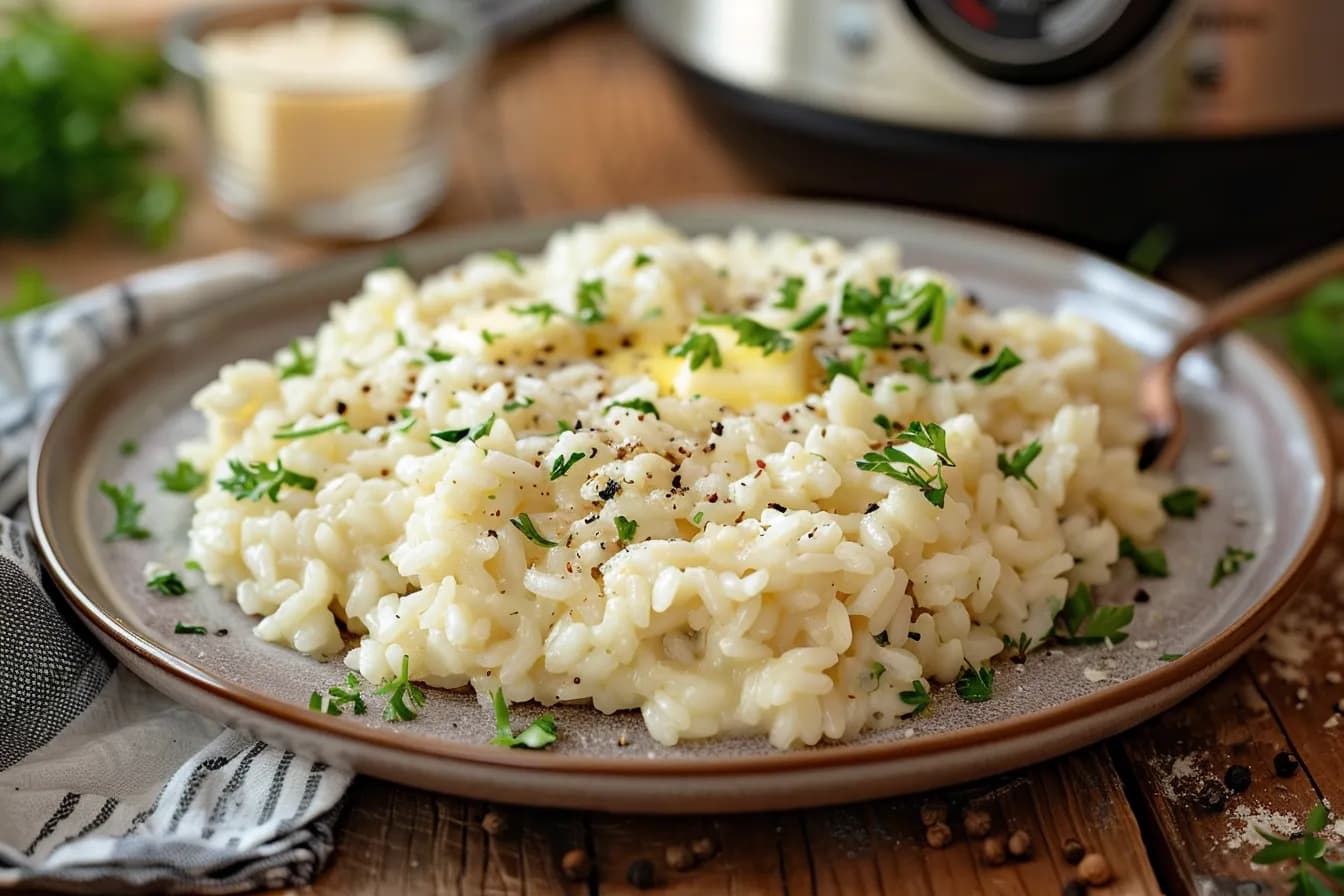
Pressure Cooker Risotto
Six minutes under pressure instead of twenty minutes of stirring, and it still turns out creamy.
- Preparation
- 10 min
- Cook/bake time
- 25 min
- Total
- 35 min
- Difficulty
- Easy
- Calories
- 563 kcal
- Servings
- 4
- Prep
- 10 min
- Cooking & baking
- 25 min
Six minutes under pressure instead of twenty minutes of stirring, and it still turns out creamy. Stirring risotto has a purpose: it rubs starch off the grains. Under pressure, the movement of the boiling liquid takes over this job, and the result differs less than purists might believe.
Why this works
The creaminess of a risotto comes from amylopectin, a starch found primarily in short-grain rice like Arborio or Carnaroli. It dissolves from the surface of the grain during cooking and binds the liquid. The constant stirring in the classic method accelerates this through friction. Under pressure, the vigorously circulating liquid does the same thing. The crucial factor instead is the ratio: 1 to 2.5 rather than the usual 1 to 3.5, because nothing evaporates in a closed pot. Toasting the rice before adding liquid remains mandatory: this slightly seals the outer layer of the grain so that it absorbs liquid slowly and remains al dente, rather than disintegrating into mush in six minutes.
Step-by-step instructions
- 1
Sweat the onion
Set the pot to the sauté function and sweat the onion in oil for four minutes until translucent, without letting it take on color. It must be very finely diced. In a risotto, you should taste it, but not bite into it.
- 2
Toast the rice
Add the rice and toast it for two minutes while stirring, until the edges of the grains become translucent and the center remains white. This step is indispensable even under pressure: it seals the surface of the grain so that it absorbs liquid slowly instead of falling apart in six minutes.
- 3
Reduce the wine and add liquid
Pour in the wine and let it evaporate completely, scraping up any browned bits from the bottom. Then pour in the hot broth and stir once. The ratio is tighter than with classic risotto because nothing evaporates in a closed pot.
- 4
Six minutes under pressure
Close the lid, set the valve to pressure, and cook on high for six minutes. Then immediately release the pressure manually. With a natural release, the rice would continue cooking for another ten minutes and become mushy.
- 5
Mantecare: butter and Parmesan
Vigorously stir in the cold cubed butter and the Parmesan until the risotto is glossy and flows slowly when you tilt the pot. No machine can take over this step. This is where the emulsion of fat, starch, and liquid is created, which is what makes a risotto.
Our best tips
- Release the pressure manually right away. With a natural release, the rice continues to cook for ten minutes, and al dente turns into mush.
- Use cold butter for the mantecare. It melts slowly enough for an emulsion to form. Melted butter separates, and the risotto becomes oily.
- Use less liquid than for classic risotto. 1 to 2.5 instead of 1 to 3.5, because nothing evaporates in a closed pot.
Tasty variations
With mushrooms
Sear 300 g of mushrooms separately beforehand and fold them in only during the mantecare. If cooked along with the rice, they release water and dilute the risotto, and their roasted flavors would be lost anyway.
With pumpkin
Add 300 g of diced pumpkin to the pot right along with the rice. They partially break down under pressure and color the risotto orange. Here, cooking them together is exceptionally desirable.
Nutrition facts
| Calories | 563 kcal |
|---|---|
| Protein | 13 g |
| Carbohydrates | 67 g |
| – of which sugar | 3 g |
| Fat | 24 g |
| Fiber | 2 g |
Where the 563 kcal come from
per serving
Calculated from the ingredients – how we do it
We add up reference values for every ingredient and divide by the number of servings. These assumptions are baked in:
- Reference values per 100 g – for the raw ingredient, exactly as listed.
- Tinned goods count at drained weight, bone-in meat at purchase weight: you eat about 70 per cent of a chicken thigh and leave the rest.
- Water evaporates as you cook. The energy stays in the pot, the weight does not – so the figure is per serving, not per 100 g of finished dish.
- Anything listed without a quantity – “salt and pepper” – is not counted.
A guide value, not a lab measurement: no two onions weigh the same, and fat content varies from pack to pack.
Frequently asked questions
Can you taste the difference compared to stirred risotto?
Side by side, yes, but individually, hardly. Classic risotto has a slightly more even binding because the starch is released steadily over twenty minutes. However, the time difference amounts to a good fifteen minutes of active stirring, and that is a strong argument.
Which rice works?
Arborio and Carnaroli. Carnaroli is a bit more robust and forgives an extra minute, while Arborio becomes creamier. What does not work: long-grain rice or parboiled. They contain too little amylopectin and result in rice with broth instead of risotto.
My risotto turned out too thick.
Stir in hot broth by the spoonful until it flows slowly when you tilt the pot. That is the correct consistency. Risotto continues to thicken even off the stove, so it is better to serve it slightly too liquid than too firm.
Comments & ratings(0)
Sign in to rate and comment on this recipe.
You might also like
 Pizza
PizzaNeapolitan Pizza Margherita
Airy crust, thin base, San Marzano tomatoes and Fior di Latte, Neapolitan pizza from the home oven.
 Basic Recipes
Risotto
The basic technique for any risotto, along with the explanation of why cold butter is added at the end.
 Dinner
Risotto alla Milanese
Saffron risotto from Milan, golden yellow, with beef marrow, and the classic accompaniment to ossobuco.