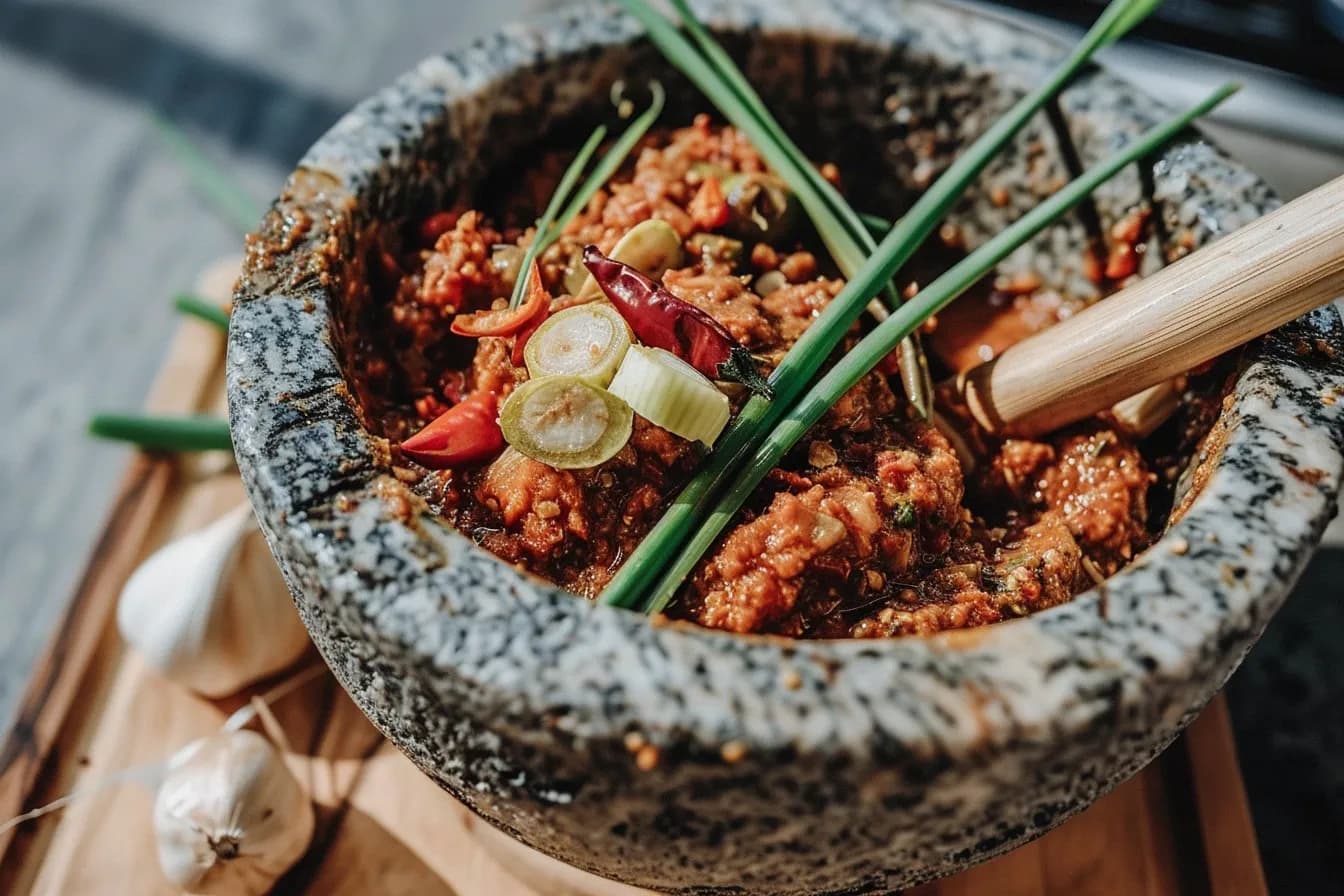
Homemade Thai Curry Paste
Red and green curry paste made from fresh ingredients, and the difference compared to the jar is greater than with any other ingredient.
- Preparation
- 30 min
- Cook/bake time
- 5 min
- Total
- 35 min
- Difficulty
- Easy
- Calories
- 67 kcal
- Servings
- 8 servings
- Prep
- 30 min
- Cooking & baking
- 5 min
Red and green curry paste made from fresh ingredients, and the difference compared to the jar is greater than with any other ingredient. Store-bought paste is pasteurized, and in the process, exactly what makes fresh lemongrass, galangal, and lime leaves special disappears: the volatile oils. Twenty minutes of pounding in a mortar does not replace them, it brings them back.
Why this works
There is a real difference between pounding in a mortar and blending, and it is not based on romance. A blender cuts at high speed and generates friction heat, which drives out exactly the volatile essential oils that matter. A mortar, on the other hand, crushes the cell walls slowly and cold, so that the oils remain in the paste and combine with the other ingredients. The order in the mortar follows the same logic: first the hard, dry components like spice seeds and lemongrass, because they need time, and finally the soft ones like shallots and garlic, which break down immediately. Toasting the seeds beforehand is the third building block, as heat releases flavor compounds in coriander and cumin that are bound in the raw seed.
Step-by-step instructions
- 1
Toast the spices
Toast the coriander seeds, cumin, and peppercorns dry in a pan for two minutes until fragrant, and let them cool. The heat releases flavor compounds that are bound in the raw seed, and untoasted, the paste tastes thin, no matter how good the fresh ingredients are.
- 2
Pound the dry ingredients first
Finely pound the toasted spices in a mortar, then add the soaked chilies and salt and continue working until a coarse paste forms. Salt is also a tool here: the crystals act as an abrasive and significantly speed up the crushing process.
- 3
Add the fibrous ingredients
Work in the lemongrass, galangal, lime leaves, and lime zest one after the other. These are the tough components, and they take the most time, so this step is only finished when no more fibers can be seen. Push the edges of the mortar down in between.
- 4
Soft ingredients at the end
Finally, work in the shallots and garlic. They break down almost on their own and, if added earlier, would make the paste so wet that the hard components would swim around in it instead of being ground up. Finally, stir in the oil, as it preserves and carries the fat-soluble flavors.
Our best tips
- Wear gloves when processing the chilies. Capsaicin is fat-soluble and can hardly be washed off with water, and anyone who touches their eye afterwards will notice it very clearly.
- If you do not have a mortar, use a blender, but add two tablespoons of oil and blend in short intervals. The oil distributes the friction heat and protects the volatile oils somewhat.
- Freeze the paste in portions in an ice cube tray. One cube corresponds to about one tablespoon and thus one curry pan for two people.
Tasty variations
Green curry paste
Replace the dried red chilies with 15 fresh green Thai chilies and add a bunch of coriander roots. Significantly spicier and fresher, and in Thailand the spiciest of the three classic pastes.
Massaman paste
Additionally toast a cinnamon stick, four cardamom pods, and three cloves. Yields the warm, mild paste for Massaman curry.
Nutrition facts
| Calories | 67 kcal |
|---|---|
| Protein | 2 g |
| Carbohydrates | 8 g |
| – of which sugar | 2 g |
| Fat | 3 g |
| Fiber | 3 g |
Where the 67 kcal come from
per serving
Calculated from the ingredients – how we do it
We add up reference values for every ingredient and divide by the number of servings. These assumptions are baked in:
- Reference values per 100 g – for the raw ingredient, exactly as listed.
- Tinned goods count at drained weight, bone-in meat at purchase weight: you eat about 70 per cent of a chicken thigh and leave the rest.
- Water evaporates as you cook. The energy stays in the pot, the weight does not – so the figure is per serving, not per 100 g of finished dish.
- Anything listed without a quantity – “salt and pepper” – is not counted.
A guide value, not a lab measurement: no two onions weigh the same, and fat content varies from pack to pack.
Frequently asked questions
How many calories does curry paste have?
Around 65 kcal per portion of about two tablespoons. In a finished curry, this hardly matters, as the calories there come almost entirely from the coconut milk.
Is the effort worth it compared to store-bought paste?
With hardly any ingredient as much as here. Store-bought paste is pasteurized, and in the process, exactly the volatile oils of lemongrass, galangal, and lime leaf are lost that make the difference. The leap is greater than with any other convenience product in Thai cuisine.
Mortar or blender?
Mortar, if possible. A blender generates friction heat and drives out the essential oils. If using a blender, then with additional oil and in short intervals so that it does not run hot.
How long does the paste keep?
In a jar covered with a layer of oil for two weeks in the refrigerator. Frozen in portions for three months without significant loss of flavor, which is the more practical way.
Comments & ratings(0)
Sign in to rate and comment on this recipe.
You might also like
 Low Carb
Cauliflower Rice
A rice substitute made from cauliflower with a tenth of the carbohydrates, dry roasted instead of steamed, otherwise it turns to mush.
 Basic Recipes
Tomato Sauce
The one sauce that turns into pizza, pasta, lasagna, and casseroles. Four ingredients and no shortcuts when simmering.
 Basic Recipes
Roasted Vegetables: Time & Temperature for Everything
Sixteen types of vegetables, each with a time and a temperature, so everything is ready at the same time.