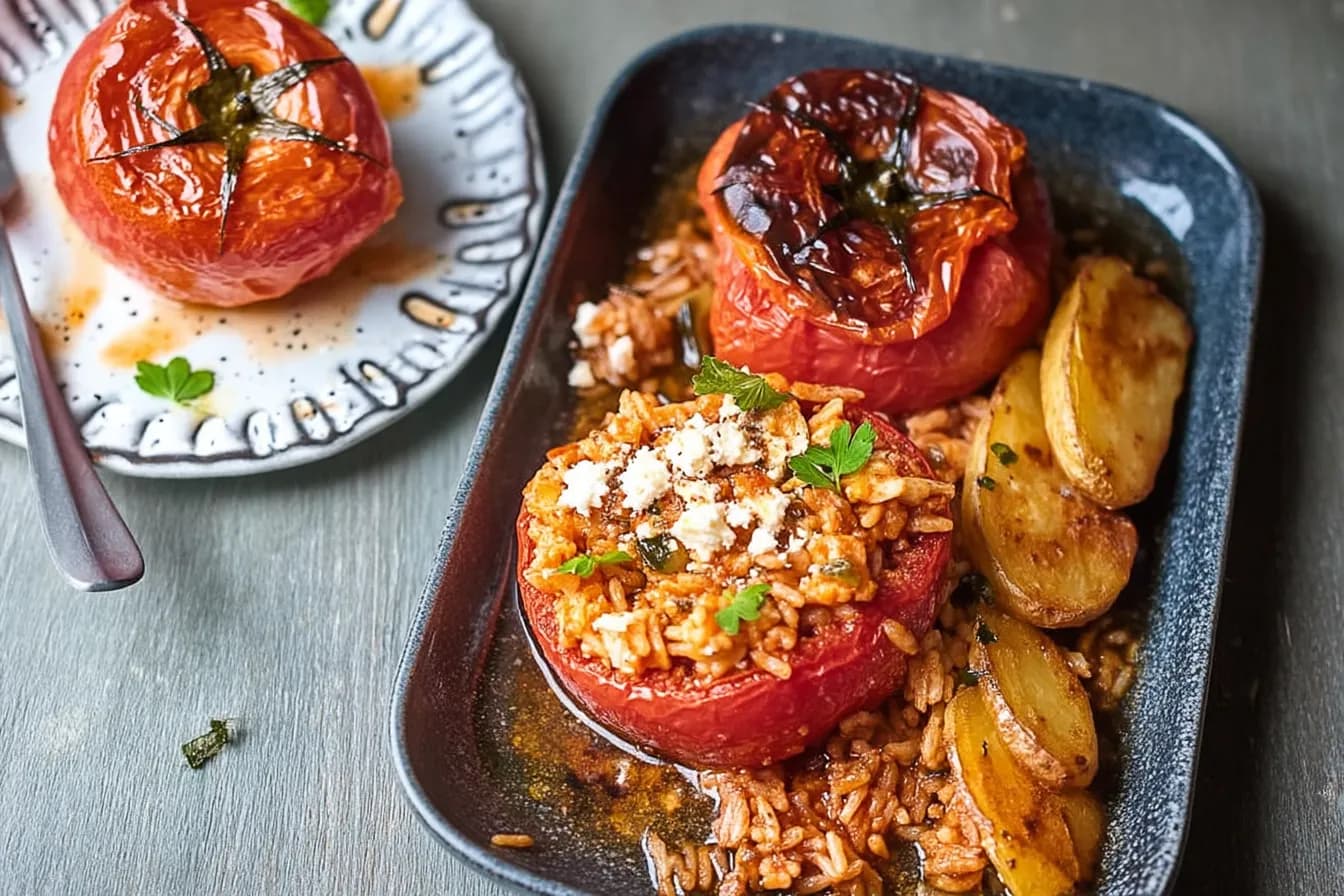
Gemista
Stuffed tomatoes and bell peppers baked in the oven, and the rice is added raw, not pre-cooked.
- Preparation
- 45 min
- Cook/bake time
- 1 hr 15 min
- Total
- 2 hr 30 min
- Difficulty
- Easy
- Calories
- 431 kcal
- Servings
- 6
- Prep
- 45 min
- Cooking & baking
- 1 hr 15 min
- Resting
- 30 min
Only 2 hr of that is hands-on – the rest takes care of itself.
Stuffed tomatoes and bell peppers baked in the oven, and the rice is added raw, not pre-cooked. It cooks in the vegetable juice released by the tomatoes, absorbing exactly the flavor that would otherwise be left behind in the pan. Pre-cooked rice can no longer do this and becomes mushy.
Why this works
The raw rice is the core of this recipe. During baking, the hollowed-out tomatoes and the bell pepper walls release significant amounts of juice, flavored liquid full of dissolved sugars, acids, and glutamate. Raw rice absorbs exactly this liquid and cooks in it; pre-cooked rice is already saturated, cannot absorb anything else, and falls apart instead. That is why the filling is only filled to two-thirds: rice expands to two and a half times its size when cooking, and an overfilled vegetable bursts open. The second building block is the potato wedges between the vegetables. They are not just a side dish, but prevent tomatoes and bell peppers from tipping over in the pan, and they absorb the juice that runs down, so nothing burns.
Step-by-step instructions
- 1
Hollow out the vegetables
Cut the tops off the tomatoes and bell peppers and save them. Hollow out the tomatoes with a spoon and collect the pulp, it goes into the filling. For the bell peppers, only remove the seeds and white membranes. The walls must not be pierced.
- 2
Mix the filling
Roughly puree the tomato pulp and mix it with raw rice, onions, garlic, parsley, mint, half of the olive oil, sugar, salt, and pepper. The rice remains raw, it cooks in the vegetable juice and absorbs the flavor that would otherwise be lost.
- 3
Fill only to two-thirds
Salt the vegetables inside and fill them only to two-thirds with the rice mixture. Rice expands to two and a half times its size, fully filled vegetables burst open in the oven. Put the tops back on.
- 4
Into the pan with potatoes
Place the vegetables closely together in a baking dish and distribute the potato wedges in the gaps. They support the vegetables and catch the leaking juice. Pour water and the remaining olive oil over them and salt the potatoes.
- 5
Bake for 75 minutes
Cover the dish with foil for the first 45 minutes and bake at 180 °C, then open for another 30 minutes until the vegetables collapse and the surface takes on color. Serve lukewarm, in Greece, Gemista often stand for an hour before they come to the table.
Our best tips
- The rice remains raw. Pre-cooked rice can no longer absorb the vegetable juice and falls apart, this is the most common mistake with this dish.
- Fill only to two-thirds. Rice expands greatly during cooking, and burst vegetables lose their filling into the pan.
- Serve lukewarm, not hot. Gemista belong to the Greek category "ladera", olive oil dishes that are eaten at room temperature and then taste significantly rounder.
Tasty variations
With ground meat
Mix 300 g of ground beef into the rice filling. Just as common in Greece as the vegetarian version, then it is no longer a "ladera".
With zucchini and eggplants
Additionally fill two hollowed-out zucchini and one eggplant. They release less juice, therefore add 100 ml more water to the pan.
Nutrition facts
| Calories | 431 kcal |
|---|---|
| Protein | 7 g |
| Carbohydrates | 55 g |
| – of which sugar | 11 g |
| Fat | 19 g |
| Fiber | 7 g |
Where the 431 kcal come from
per serving
Calculated from the ingredients – how we do it
We add up reference values for every ingredient and divide by the number of servings. These assumptions are baked in:
- Reference values per 100 g – for the raw ingredient, exactly as listed.
- Tinned goods count at drained weight, bone-in meat at purchase weight: you eat about 70 per cent of a chicken thigh and leave the rest.
- Water evaporates as you cook. The energy stays in the pot, the weight does not – so the figure is per serving, not per 100 g of finished dish.
- Anything listed without a quantity – “salt and pepper” – is not counted.
A guide value, not a lab measurement: no two onions weigh the same, and fat content varies from pack to pack.
Frequently asked questions
Why raw rice?
Because it should absorb the vegetable juice that escapes during baking, flavored liquid full of dissolved sugars and acids. Pre-cooked rice is already saturated, cannot absorb anything else, and becomes mushy.
How many calories do Gemista have?
Around 430 kcal per serving for six servings, with potatoes. The olive oil contributes the largest part with about 180 kcal per serving, however, it is the eponymous component of "ladera" dishes.
Why do my tomatoes burst open?
They were filled too full. Rice expands to two and a half times its size during cooking, two-thirds filling height is the limit.
Why serve lukewarm?
Gemista belong to the "ladera", the Greek olive oil dishes that are traditionally eaten at room temperature. Hot temperature masks the herb and olive oil flavors.
Comments & ratings(0)
Sign in to rate and comment on this recipe.
You might also like
 Vegetarian
Ratatouille
Provençal summer vegetables, each variety seared individually and then gently braised together.
 Vegetarian
Crispy Zucchini Fritters
From 800 g zucchini comes a good 200 ml of water, and that is exactly the difference between crispy and mushy.
 Basic Recipes
Roasted Vegetables: Time & Temperature for Everything
Sixteen types of vegetables, each with a time and a temperature, so everything is ready at the same time.