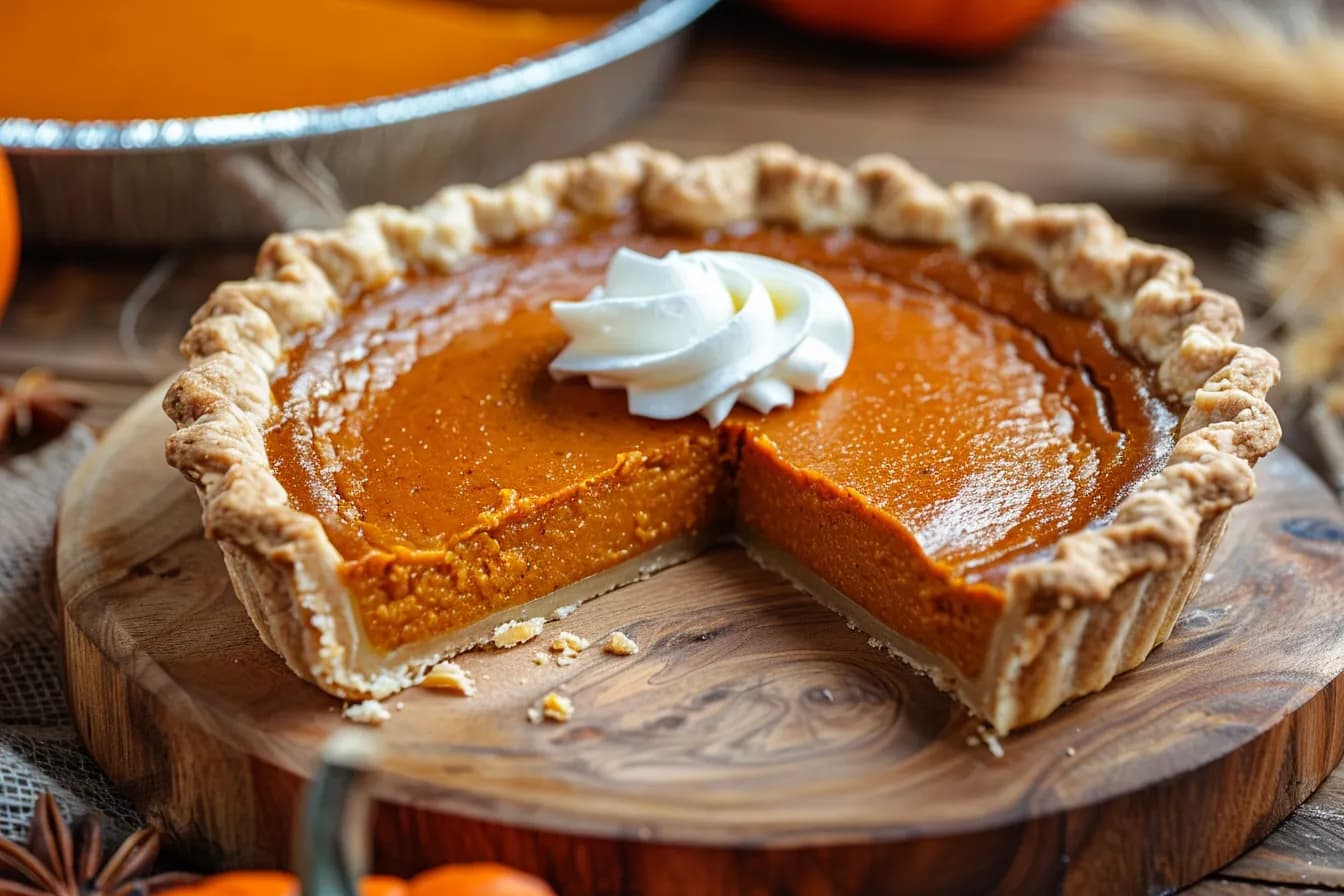
Pumpkin Pie
American pumpkin pie with cinnamon, ginger, and cloves in a blind-baked shortcrust pastry base.
- Preparation
- 30 min
- Cook/bake time
- 1 hr 10 min
- Total
- 5 hr 40 min
- Difficulty
- Medium
- Calories
- 333 kcal
- Servings
- 12 slices
- Prep
- 30 min
- Cooking & baking
- 1 hr 10 min
- Resting
- 4 hr
Only 1 hr 40 min of that is hands-on – the rest takes care of itself.
American pumpkin pie with cinnamon, ginger, and cloves in a blind-baked shortcrust pastry base. The filling is an egg custard and sets between 80 and 85 degrees, if baked beyond that, it cracks. That is why the pie comes out of the oven while the center still jiggles.
Why this works
The filling is an egg custard, and eggs set between 80 and 85 °C. If you bake beyond that, the proteins contract further, squeeze out water, and the surface cracks, which is why the pie comes out of the oven when the center still jiggles by two centimeters, and finishes cooking with the residual heat. The base is blind-baked beforehand because a liquid filling would otherwise soak it from the inside before it can even set. And homemade pumpkin puree belongs in the pan first: without the water evaporating, the filling remains thin and will never become sliceable.
Step-by-step instructions
- 1
Mix and chill the dough
Knead the flour, sugar, salt, and cold butter only until pea-sized crumbs form, and then add ice water by the spoonful until the dough just holds together. Visible pieces of butter are desirable, they make the base flaky. Wrap it in plastic wrap and chill it for one hour.
- 2
Blind bake the base
Roll out the dough, line a 26 cm pie dish with it, and prick the base several times with a fork. Cover it with parchment paper, fill it with legumes as weights, and bake it at 200 °C top/bottom heat for fifteen minutes. Remove the weights and paper and bake it for another five minutes until it looks dry.
- 3
Reduce the pumpkin puree
Roast the puree in a wide pan over medium heat for five to eight minutes while stirring, until it is visibly darker and significantly thicker and sticks to the spoon. For canned puree, three minutes are enough. This step determines whether the pie can be sliced.
- 4
Mix and bake the filling
Mix the cooled puree with sugar, eggs, cream, all the spices, vanilla, and salt to a smooth mass and pour it into the pre-baked base. Bake the pie at 160 °C top/bottom heat for thirty-five to forty minutes. It is done when the edge is set and the center still jiggles like jelly when the baking sheet is shaken.
- 5
Cool completely
Let the pie cool at room temperature for at least three hours, during this time the center finishes setting. Only then put it in the refrigerator if you want to serve it cold. Never cut it warm, the filling is not yet sliceable then. Serve it with whipped cream.
Our best tips
- Reduce the pumpkin puree beforehand. Without this step, the filling remains thin, no matter how long you bake.
- Out of the oven while the center still jiggles. A fully baked pumpkin pie inevitably cracks when cooling.
- Hokkaido can be processed with the skin and is particularly aromatic. Halloween pumpkins are watery and unsuitable for this.
Tasty variations
With maple syrup
Replace the brown sugar with 120 ml of maple syrup and reduce the cream to 200 ml. The filling becomes slightly darker and less sweet.
Cookie crust
Mix 200 g of butter cookies with 90 g of melted butter, press into the dish, and pre-bake for ten minutes. Saves the shortcrust pastry and the chilling time.
Nutrition facts
| Calories | 333 kcal |
|---|---|
| Protein | 5 g |
| Carbohydrates | 30 g |
| – of which sugar | 16 g |
| Fat | 22 g |
| Fiber | 2 g |
Where the 333 kcal come from
per serving
Calculated from the ingredients – how we do it
We add up reference values for every ingredient and divide by the number of servings. These assumptions are baked in:
- Reference values per 100 g – for the raw ingredient, exactly as listed.
- Tinned goods count at drained weight, bone-in meat at purchase weight: you eat about 70 per cent of a chicken thigh and leave the rest.
- Water evaporates as you cook. The energy stays in the pot, the weight does not – so the figure is per serving, not per 100 g of finished dish.
- Anything listed without a quantity – “salt and pepper” – is not counted.
A guide value, not a lab measurement: no two onions weigh the same, and fat content varies from pack to pack.
Frequently asked questions
Why did my pie crack in the middle?
It was in the oven too long. Above 85 °C, the proteins squeeze out water and the surface cracks. Take it out as long as the center jiggles, a crack does not change the taste, cream covers it reliably.
Homemade or store-bought puree?
Both work. Homemade is more aromatic but contains more water and must absolutely be reduced. Canned puree is already concentrated and only needs a short time in the pan.
Why is the base soft?
It was not blind-baked or not baked long enough. The filling is liquid when poured in and soaks in immediately if the base has not dried through beforehand.
Comments & ratings(0)
Sign in to rate and comment on this recipe.
You might also like
 Cakes & Pastries
Apple Pie
American apple pie with a flaky lattice crust and a cinnamon-spiced apple filling.
 Desserts
Sticky Toffee Pudding
Date cake with hot caramel sauce, and the dates are soaked in baking soda water beforehand, not plain water.
 Cakes & Pastries
Zucchini Brownies
A whole zucchini in the batter, and nobody notices it: instead, they stay moist for three days.