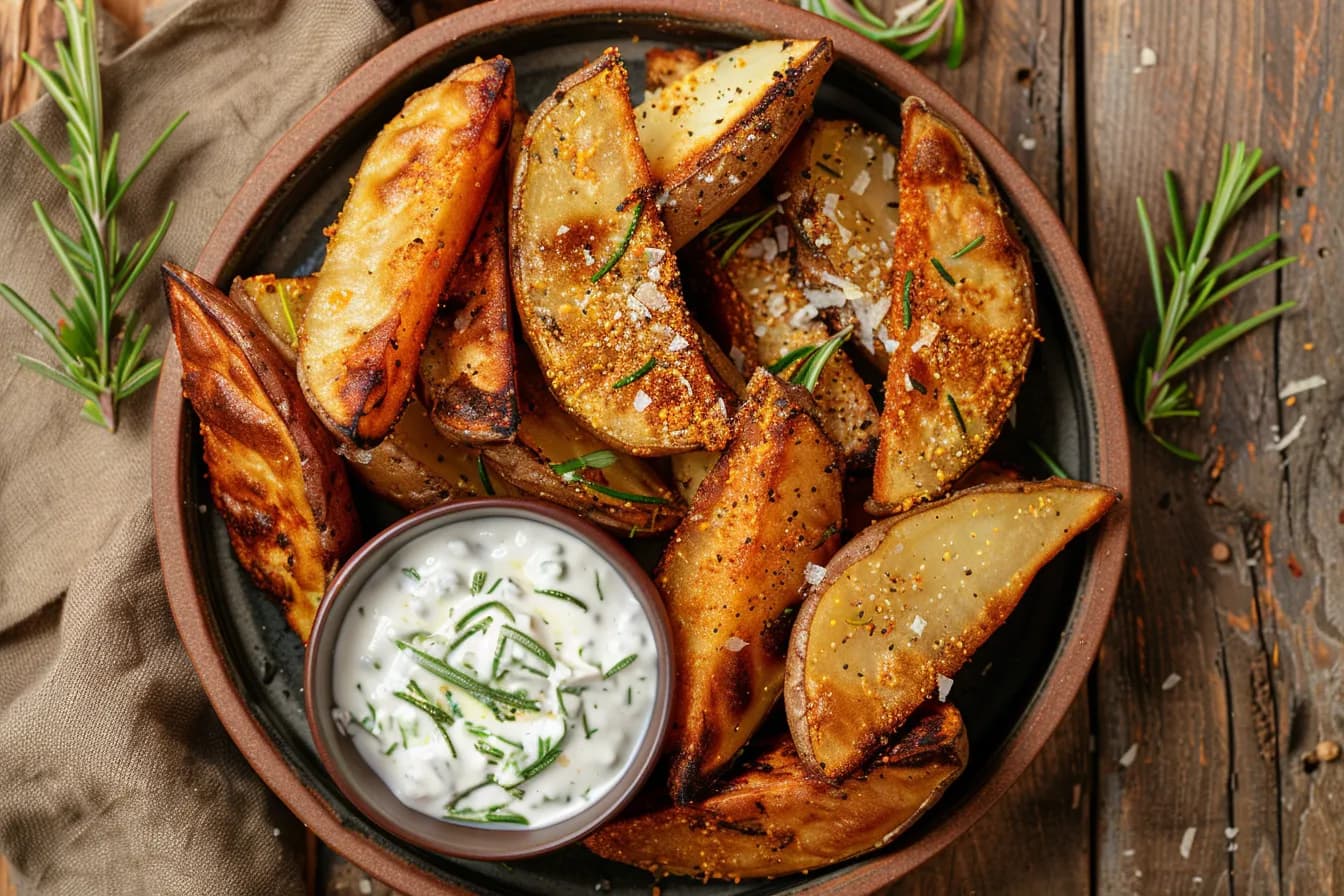
Air Fryer Parmesan Potato Wedges
Leave the skin on, add the Parmesan in the last five minutes, and it will get crispy instead of black.
- Preparation
- 12 min
- Cook/bake time
- 22 min
- Total
- 34 min
- Difficulty
- Easy
- Calories
- 350 kcal
- Servings
- 3
- Prep
- 12 min
- Cooking & baking
- 22 min
Leave the skin on, add the Parmesan in the last five minutes, and it will get crispy instead of black. Potato wedges are the more forgiving sister of french fries: thicker, with the skin on, and no soaking required. What they need is space in the basket and a clear sequence for the cheese.
Why this works
Unlike thin fries, the surface starch on wedges is not a problem but an advantage. It gelatinizes into a thin, glassy layer that dries out and becomes crispy as it cooks further, which is why they are not soaked here, just patted dry. The Parmesan follows a different logic. Its milk proteins and lactose brown much earlier than potato starch, and in the airflow of an air fryer, they burn in a few minutes. Applied five minutes before the end, it melts, binds to the surface, and becomes crispy. If added from the beginning, it would be bitter and black long before the potato is cooked.
Step-by-step instructions
- 1
Cut the wedges
Wash the potatoes well and cut them lengthwise into eighths so that each wedge retains a side of skin. The skin is intentional here: it holds the wedge together and gets crispy itself.
- 2
Pat dry and season
Pat the wedges dry and toss them with oil, paprika, rosemary, garlic powder, and salt. Unlike thin fries, there is no soaking here, as the surface starch is an advantage at this thickness and turns into a crust.
- 3
Seventeen minutes at 190 °C
Distribute the wedges cut-side down in the basket, in no more than two layers. Cook for seventeen minutes at 190 °C, shaking once halfway through. They should now be golden brown and soft inside.
- 4
Parmesan in the last five minutes
Sprinkle the Parmesan over them and cook for another five minutes at 190 °C. The cheese melts, binds to the surface, and becomes crispy. If added from the beginning, it would have turned black long ago, as milk protein browns much earlier than potato starch.
Our best tips
- Leave the skin on. It holds the wedge together, gets crispy itself, and saves you the peeler.
- Add Parmesan only in the last five minutes. Its milk protein browns much earlier than potato starch and burns in the airflow.
- Use finely grated Parmesan, not shaved. Shavings fly around in the airflow and land on the heating element.
Tasty variations
With herb dip
Mix 150 g of yogurt with a grated garlic clove, lemon juice, and chopped chives. The acidity is the counterpoint to the salty Parmesan and turns the side dish into a meal.
Without cheese, with lemon salt
Mix the zest of an untreated lemon with coarse salt and sprinkle it over the finished wedges. Significantly lighter and without dairy products, and the acidity is otherwise really missing.
Nutrition facts
| Calories | 350 kcal |
|---|---|
| Protein | 12 g |
| Carbohydrates | 41 g |
| – of which sugar | 2 g |
| Fat | 13 g |
| Fiber | 6 g |
Where the 350 kcal come from
per serving
Calculated from the ingredients – how we do it
We add up reference values for every ingredient and divide by the number of servings. These assumptions are baked in:
- Reference values per 100 g – for the raw ingredient, exactly as listed.
- Tinned goods count at drained weight, bone-in meat at purchase weight: you eat about 70 per cent of a chicken thigh and leave the rest.
- Water evaporates as you cook. The energy stays in the pot, the weight does not – so the figure is per serving, not per 100 g of finished dish.
- Anything listed without a quantity – “salt and pepper” – is not counted.
A guide value, not a lab measurement: no two onions weigh the same, and fat content varies from pack to pack.
Frequently asked questions
Which potatoes are suitable?
Waxy ones, because they keep their shape and the wedge does not fall apart. All-purpose potatoes also work and become a bit fluffier inside. Floury potatoes fall apart at the edges and are the wrong choice here, as they are meant for mashed potatoes.
Can I reheat the wedges?
Yes, and the air fryer is the best appliance for this: four minutes at 190 °C, and they are crispy again. In the microwave they become soft, and in the oven it takes longer than the original cooking.
Why are my wedges sticking together?
Too little oil or layered too densely. Two layers are the maximum, and every wedge should visibly shine. After shaking halfway through, they usually separate. If not, it was too much for one batch.
Comments & ratings(0)
Sign in to rate and comment on this recipe.
You might also like
 Air Fryer
Air Fryer French Fries
One tablespoon of oil for one kilo of potatoes, and the rest is soaking and the right sequence.
 Dinner
Microwave Sweet Potato
Eight minutes instead of fifty, and with thirty seconds in a pan it still gets roasted flavors.
 Air Fryer
Air Fryer Chicken Thighs
Twenty-two minutes to skin that crackles, without an oven, without a deep fryer, and without splatters.