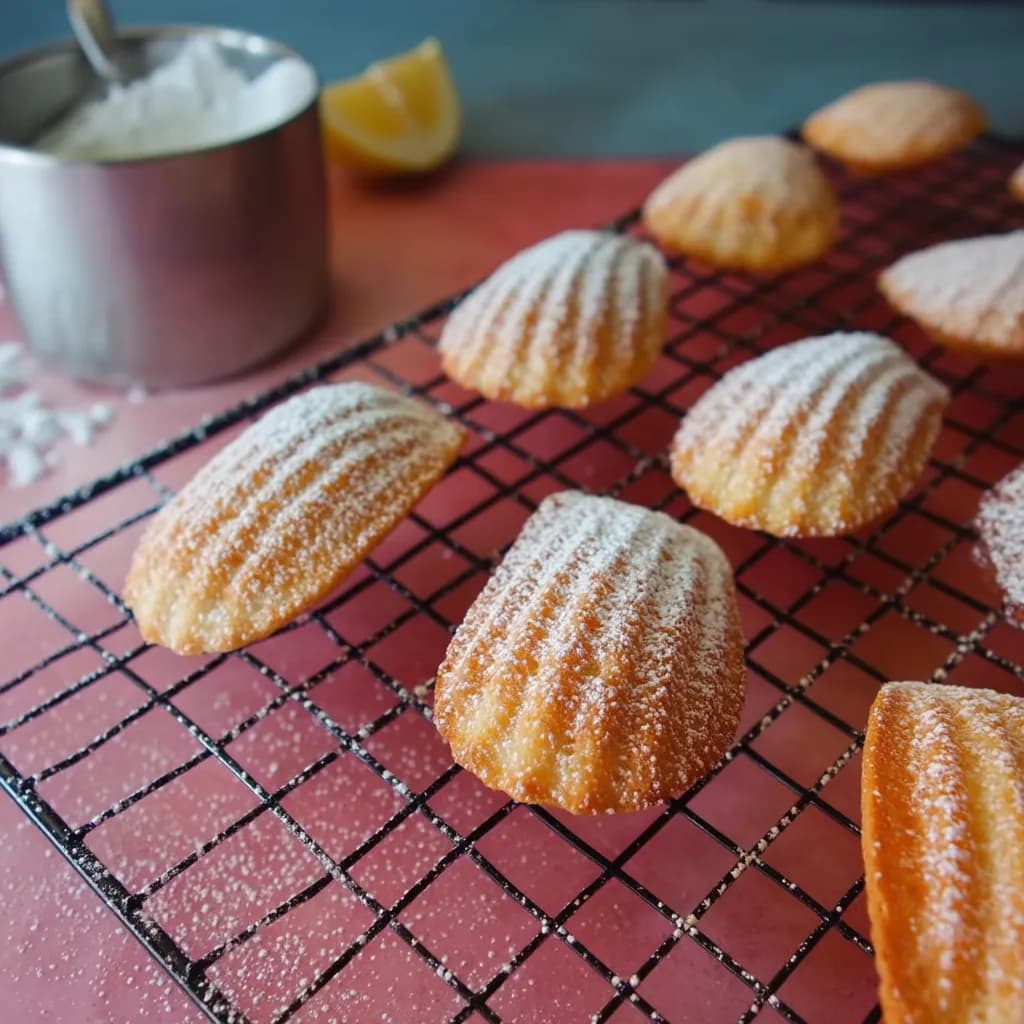
Madeleines
Shell-shaped little cakes with the characteristic bump, and the cold shock that creates it.
- Preparation
- 20 min
- Cook/bake time
- 18 min
- Total
- 2 hr 38 min
- Difficulty
- Medium
- Calories
- 96 kcal
- Servings
- 20 pieces
- Prep
- 20 min
- Cooking & baking
- 18 min
- Resting
- 2 hr
Only 38 min of that is hands-on – the rest takes care of itself.
Shell-shaped little cakes with the characteristic bump, and the cold shock that creates it. The bump is no accident and no sign of skill, but the result of a temperature difference: ice-cold batter, very hot oven. Without the resting time in the fridge, madeleines stay flat.
Why this works
The bump is created by a temperature gradient, not by baking powder alone. When ice-cold batter goes into a 220 degree oven, the edge cooks immediately and forms a solid shell, while the center is still cold and liquid. There, the baking powder only becomes active with a delay, and because the edge is already solid, the resulting steam can only escape upwards, which becomes the bulge. Without the cooling time, the batter has the same temperature everywhere, rises evenly and stays flat. For the same reason, the mold must also be cold: a pre-warmed mold takes away the temperature advantage of the batter center. The brown butter is the second building block and purely for taste. When browning, nutty flavor compounds are created from milk protein and milk sugar, which make a madeleine a madeleine in the first place.
Step-by-step instructions
- 1
Brown the butter
Melt the butter and let it simmer until it smells nutty and brown flakes form on the bottom. Take it off the heat immediately, as there are only a few seconds between nut-brown and burnt. Let it cool until it is lukewarm.
- 2
Mix the batter
Beat eggs, sugar, honey and salt for three minutes until light and frothy. Sift flour and baking powder over it and fold both in, then the cooled brown butter. Do not mix too long, as too much developed gluten makes the little cakes tough instead of tender.
- 3
Chill for at least two hours
Cover the batter and put it in the fridge for at least two hours, preferably overnight. This is the step that decides the bump: without the temperature difference between cold batter and hot oven, madeleines stay flat.
- 4
Fill the cold mold
Butter the madeleine mold and chill it briefly. Fill a heaped teaspoon amount of cold batter into each indentation, only three-quarters full, as the batter spreads during baking. Do not smooth it out, the heat will do that.
- 5
Bake at 220 °C
Bake the madeleines at 220 °C for eight to ten minutes, until the edges are golden brown and the bump has risen. Turn them out of the mold immediately, as they will stick once cooled. They taste best on the day of baking and become significantly drier on the second day.
Our best tips
- Cold batter, cold mold, hot oven. All three together create the bump; if one is missing, it will not appear.
- Only fill three-quarters full. The batter spreads in the heat, and overflowing madeleines cannot be removed cleanly from the mold later.
- Madeleines are a day-of pastry. On the second day they are dry, then dunked in tea, which brought Marcel Proust to a whole novel.
Tasty variations
With chocolate base
Dip the cooled madeleines with the shell side into melted dark chocolate. The most common variation in French bakeries.
With orange and rosemary
Replace lemon zest with orange zest and fold in a teaspoon of very finely chopped rosemary. Unusual, but surprisingly harmonious.
Nutrition facts
| Calories | 96 kcal |
|---|---|
| Protein | 1 g |
| Carbohydrates | 10 g |
| – of which sugar | 6 g |
| Fat | 6 g |
| Fiber | 0 g |
Where the 96 kcal come from
per serving
Calculated from the ingredients – how we do it
We add up reference values for every ingredient and divide by the number of servings. These assumptions are baked in:
- Reference values per 100 g – for the raw ingredient, exactly as listed.
- Tinned goods count at drained weight, bone-in meat at purchase weight: you eat about 70 per cent of a chicken thigh and leave the rest.
- Water evaporates as you cook. The energy stays in the pot, the weight does not – so the figure is per serving, not per 100 g of finished dish.
- Anything listed without a quantity – “salt and pepper” – is not counted.
A guide value, not a lab measurement: no two onions weigh the same, and fat content varies from pack to pack.
Frequently asked questions
Why do my madeleines not get a bump?
The batter was not cold enough or the oven not hot enough. The bump is created by the temperature difference: the edge cooks immediately, the cold center rises with a delay and can only escape upwards. Two hours of cooling time is the minimum.
How many calories does a madeleine have?
Around 96 kcal per piece for twenty pieces. Butter and sugar make up the majority. A madeleine is a small pastry, and the portion size is part of the concept.
Do I need a madeleine mold?
For the shell shape, yes. The batter also works in a mini muffin tin, but then the characteristic ribbing is missing, and the baking time increases by about two minutes.
How long do madeleines keep?
They are decidedly a day-of pastry. On the second day they are noticeably drier, after three days only enjoyable dunked. Frozen they keep for a month and can be refreshed in the oven.
Comments & ratings(0)
Sign in to rate and comment on this recipe.
You might also like
 Cakes & Pastries
Galette des Rois
French King Cake made of puff pastry and almond cream, with a figurine inside and a crown on top.
 Cakes & Pastries
Tarte Tatin
Upside-down apple tart with caramel, the most famous kitchen accident in France, repeated on purpose.
 Leftover Cooking
Leftover Egg Whites 3 Ways
Meringue, financiers or an omelet, depending on how many egg whites are in the jar.