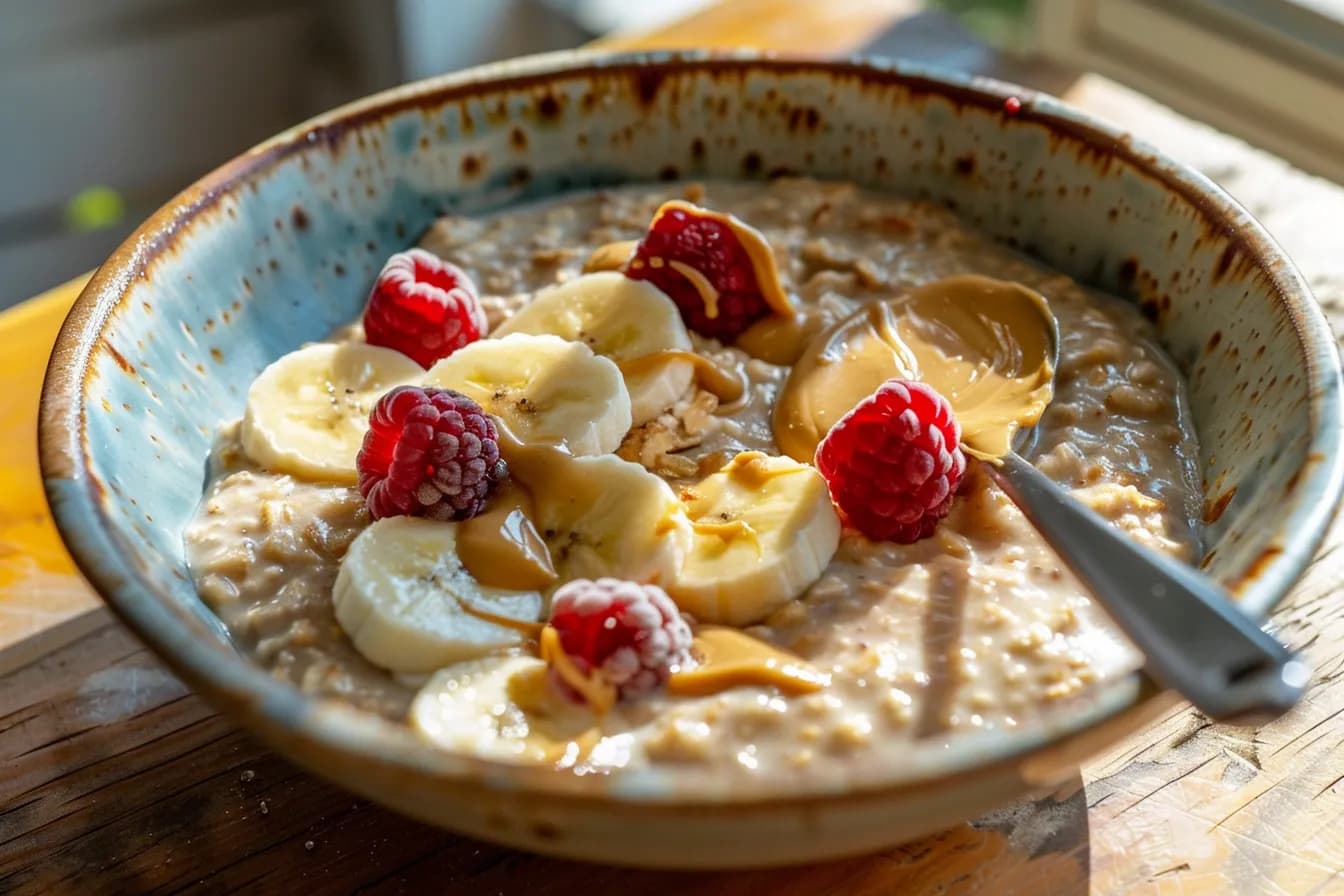
High-Protein Porridge
Porridge with 25 grams of protein without the protein powder clumping, the timing is crucial.
- Preparation
- 5 min
- Cook/bake time
- 8 min
- Total
- 13 min
- Difficulty
- Easy
- Calories
- 644 kcal
- Servings
- 1
- Prep
- 5 min
- Cooking & baking
- 8 min
Porridge with 25 grams of protein without the protein powder clumping, the timing is crucial. If you stir whey protein into the boiling pot, you get lumps and a grainy texture because the proteins coagulate when heated. Taken off the heat and stirred in, the same porridge remains creamy.
Why this works
Whey proteins denature from about 70 degrees, their folded structures unfold and interlock with each other to form solid lumps. This is exactly what happens when protein powder is added to boiling porridge, and it cannot be reversed. If, on the other hand, the powder is only stirred in after the stove, the mass remains below this threshold, and the proteins are distributed individually in the liquid. The porridge itself becomes creamy through something else: beta-glucans, soluble dietary fibers from the oats, emerge during cooking and bind ten times their weight in water. That is why oats are so filling, the same beta-glucans slow down gastric emptying and dampen the rise in blood sugar.
Step-by-step instructions
- 1
Boil the oats
Put the rolled oats, milk and the pinch of salt in a small pot and bring everything to a simmer while stirring. The salt is not optional, without it porridge tastes flat and mealy even with plenty of sweetness.
- 2
Let swell for five minutes
Let the porridge simmer gently over low heat for five minutes and stir occasionally. During this time, the beta-glucans emerge from the oats and bind the liquid, which is where the creaminess comes from, not from the amount of milk.
- 3
Off the heat, then the powder
Take the pot off the heat and let it stand for one minute. Only then stir in the protein powder and almond butter. This is the step where the recipe stands or falls: in boiling porridge, the whey protein immediately coagulates into lumps.
- 4
Serve
Pour the porridge into a bowl and distribute the berries and chia seeds over it. If it has become too thick, stir in a dash of cold milk, it will continue to thicken as it stands anyway.
Our best tips
- Never put protein powder in the boiling pot. A one-minute cooling time is enough to get below the coagulation threshold and saves the entire texture.
- The pinch of salt is not a detail in porridge, but the difference between boring and well-rounded. Even with the sweet version.
- Old-fashioned rolled oats take about three minutes longer than quick ones, but give significantly more bite. Instant oats disintegrate into mush and bind less.
Tasty variations
Overnight variation
Mix everything cold, including the powder, and put it in the fridge overnight. Without heat there is no coagulation problem, and the beta-glucans also emerge cold, just more slowly.
Without protein powder
Stir in 150 g of low-fat quark after cooking. Around 20 g of protein, a significantly more natural taste and the same rule: only after the stove.
Nutrition facts
| Calories | 644 kcal |
|---|---|
| Protein | 42 g |
| Carbohydrates | 62 g |
| – of which sugar | 22 g |
| Fat | 24 g |
| Fiber | 13 g |
Where the 644 kcal come from
per serving
Calculated from the ingredients – how we do it
We add up reference values for every ingredient and divide by the number of servings. These assumptions are baked in:
- Reference values per 100 g – for the raw ingredient, exactly as listed.
- Tinned goods count at drained weight, bone-in meat at purchase weight: you eat about 70 per cent of a chicken thigh and leave the rest.
- Water evaporates as you cook. The energy stays in the pot, the weight does not – so the figure is per serving, not per 100 g of finished dish.
- Anything listed without a quantity – “salt and pepper” – is not counted.
A guide value, not a lab measurement: no two onions weigh the same, and fat content varies from pack to pack.
Frequently asked questions
How many calories does high-protein porridge have?
Around 645 kcal with about 42 g of protein. That is a large portion, with 40 g of rolled oats instead of 60 and without almond butter you end up at around 470 kcal and still 38 g of protein.
Why does my protein powder clump?
Because it was added to the boiling mass. Whey proteins coagulate into solid lumps from about 70 degrees. Take the pot off the heat, wait a minute, then stir in.
Which protein powder is suitable?
Neutral or vanilla whey-based. Plant-based powders bind more water and make the porridge firmer, then plan for about 50 ml more milk. The calculated protein value assumes an 80 percent share.
Can I prepare porridge in advance?
Yes, two days in the fridge. It becomes very firm in the process; stir in a good dash of milk when reheating. Cold as an overnight variation it works just as well.
Comments & ratings(0)
Sign in to rate and comment on this recipe.
You might also like
 Breakfast
Low-Fat Quark Pancakes
Fluffy pancakes with 30 grams of protein per serving, without protein powder, made only from quark, egg, and rolled oats.
 Breakfast
Skyr Bowl
Icelandic Skyr with berries, nuts and honey: 25 grams of protein in a bowl that is ready in four minutes.
 Breakfast
Homemade Protein Shake
30 grams of protein from real food. This is a shake that keeps you full instead of leaving you hungry again after twenty minutes.