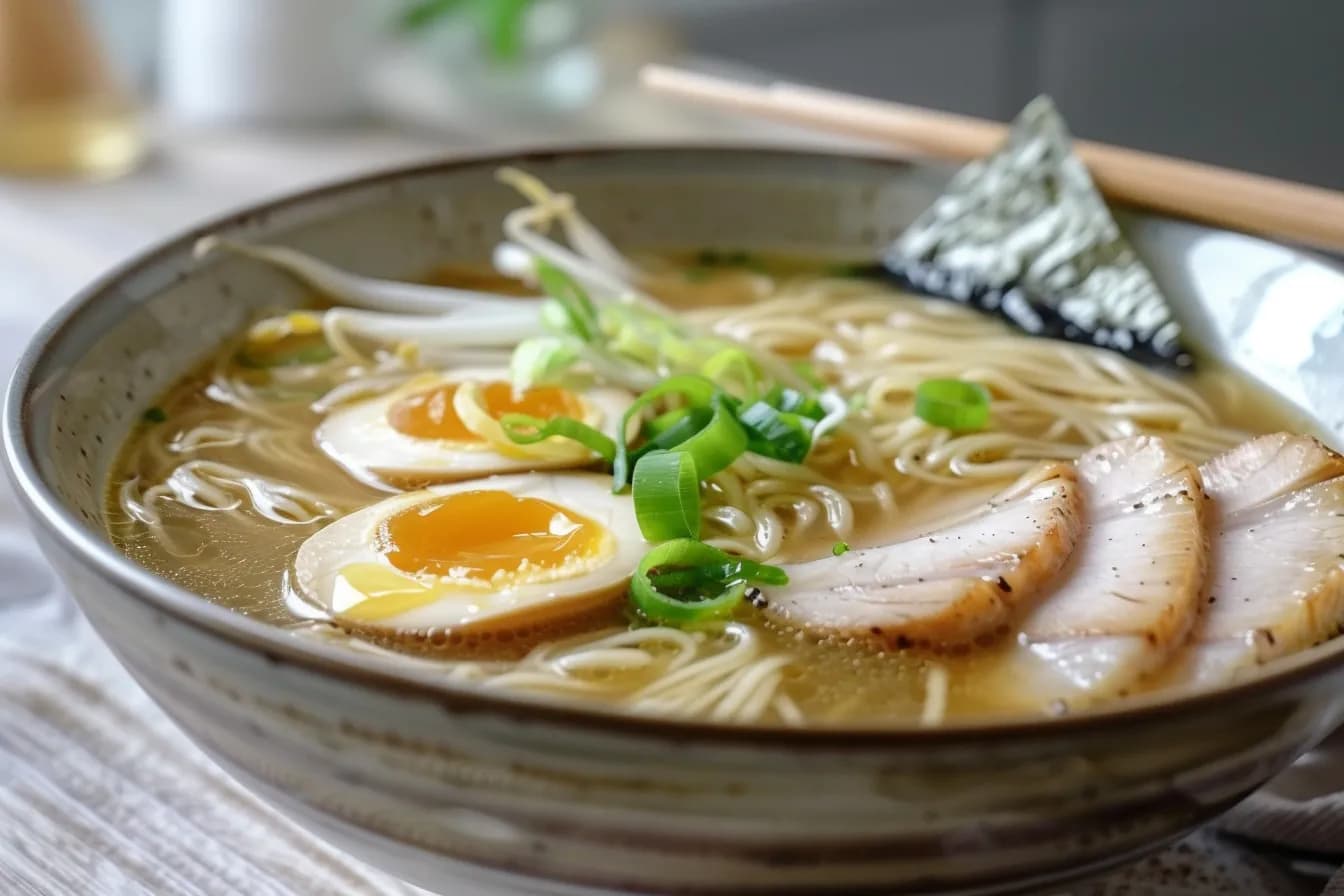
Shoyu Ramen
Clear soy sauce ramen with a marinated egg, the ramen bowl where you learn the craft.
- Preparation
- 20 min
- Cook/bake time
- 45 min
- Total
- 5 hr 5 min
- Difficulty
- Advanced
- Calories
- 823 kcal
- Servings
- 2
- Prep
- 20 min
- Cooking & baking
- 45 min
- Resting
- 4 hr
Only 1 hr 5 min of that is hands-on – the rest takes care of itself.
Clear soy sauce ramen with a marinated egg, the ramen bowl where you learn the craft. A good ramen consists of three parts built separately: broth, tare, and aroma oil. Once you understand this, you no longer need a recipe, just time.
Why this works
Ramen is a modular system of three components, and each has exactly one job. The broth provides body and texture, but intentionally little salt; it is the carrier. The tare, a concentrated seasoning base of soy sauce and mirin, provides all the salt and the main flavor, and is added by the spoonful to the empty bowl. The aroma oil on top forms a thin film on the surface, keeps the soup hot, and carries fat-soluble aromas to the nose. This separation is not a ritual, but practice: because the tare is dosed separately, the same broth can be used for different types of ramen and the saltiness can be hit exactly per bowl. If you salt the whole broth instead, every correction is final.
Step-by-step instructions
- 1
Marinate the eggs
Boil the eggs for exactly six minutes and immediately shock them in ice water. Peel them and place them in the mixture of soy sauce, mirin, and water for at least four hours, preferably overnight. Do not leave them for more than a day, otherwise the egg white will become rubbery and overly salty.
- 2
Flavor the broth
Heat the stock with the kombu to 70 degrees and let it steep for twenty minutes without letting it boil. Boiled kombu releases bitter substances and a slimy note. Remove the kombu, briefly bring the broth to a simmer, remove it from the heat, and sprinkle in the katsuobushi. Let it steep for two minutes, then strain.
- 3
Mix the tare
Stir together the soy sauce, mirin, rice vinegar, and sugar. This small amount carries all the salt for the bowl. The broth itself intentionally remains mild so that the seasoning can be adjusted per bowl at the end.
- 4
Cook the noodles
Cook the ramen noodles in plenty of water for one minute less than indicated and shake them off thoroughly. Every drop of cooking water that gets into the bowl dilutes the broth and makes it cloudy. Ramen chefs shake the noodles out almost demonstratively for this reason.
- 5
Build the bowl
Put two tablespoons of tare and one teaspoon of sesame oil into each pre-warmed bowl, pour the hot broth over it, and stir once. Then add the noodles, pork belly, halved eggs, scallions, and nori. Serve immediately, ramen waits for no one.
Our best tips
- Never boil kombu. At 60 to 70 degrees it releases its glutamate, but when boiled it also releases bitter substances and alginates that make the broth slimy.
- Six minutes for the egg is right for size M, for size L it is more like six and a half. The goal is a liquid core that stays in place when halved instead of running out.
- Pre-warm the bowls. Ramen cools down noticeably within two minutes in a cold ceramic bowl, and the aroma oil on the surface cannot replace this heat.
Tasty variations
Miso Ramen
Replace the tare with three tablespoons of light miso paste and one spoon of mirin. Significantly more robust and the right choice on cold days.
Vegetarian
Replace the chicken stock with vegetable broth, omit the katsuobushi, and extend the kombu steeping time to 40 minutes. Serve with fried shiitake mushrooms instead of pork belly.
Nutrition facts
| Calories | 823 kcal |
|---|---|
| Protein | 49 g |
| Carbohydrates | 88 g |
| – of which sugar | 5 g |
| Fat | 28 g |
| Fiber | 3 g |
Where the 823 kcal come from
per serving
Calculated from the ingredients – how we do it
We add up reference values for every ingredient and divide by the number of servings. These assumptions are baked in:
- Reference values per 100 g – for the raw ingredient, exactly as listed.
- Tinned goods count at drained weight, bone-in meat at purchase weight: you eat about 70 per cent of a chicken thigh and leave the rest.
- Water evaporates as you cook. The energy stays in the pot, the weight does not – so the figure is per serving, not per 100 g of finished dish.
- Anything listed without a quantity – “salt and pepper” – is not counted.
A guide value, not a lab measurement: no two onions weigh the same, and fat content varies from pack to pack.
Frequently asked questions
How many calories does Shoyu Ramen have?
Around 825 kcal per serving. The pork belly contributes about 285 kcal and can be replaced with lean chicken breast, which lowers the serving to around 640 kcal.
What is tare?
The concentrated seasoning base that goes into the empty bowl before the broth is poured in. It provides all the salt and the character of the ramen: shoyu tare based on soy sauce, shio tare based on salt, miso tare based on miso.
Can I use store-bought broth?
Yes, this is explicitly intended here. The effort is in the kombu, katsuobushi, and tare, which turn a store-bought stock into a ramen broth. A pork bone broth from scratch is a twelve-hour project and a different recipe.
Why is my broth cloudy?
Usually noodle water that got into the bowl. Really shake out the noodles thoroughly after cooking. Second reason: boiling kombu, which releases alginates.
Comments & ratings(0)
Sign in to rate and comment on this recipe.
You might also like
 Dinner
Tantanmen
Japanese ramen with sesame paste and chili oil, the Japanese answer to Sichuan dan dan noodles.
 Dinner
Maultaschen
Swabian dumplings with sausage meat and spinach, and the dough needs plenty of egg to hold the filling.
 Soups & Stews
Chicken Noodle Soup
Clear chicken broth with tender meat, noodles and lots of vegetables, the ultimate comfort food.