Pastéis de Nata
Portuguese custard tarts with puff pastry, baked in an oven as hot as it can go.
- Preparation
- 25 min
- Cook/bake time
- 30 min
- Total
- 1 hr 55 min
- Difficulty
- Medium
- Calories
- 205 kcal
- Servings
- 12 pieces
- Prep
- 25 min
- Cooking & baking
- 30 min
- Resting
- 1 hr
Only 55 min of that is hands-on – the rest takes care of itself.
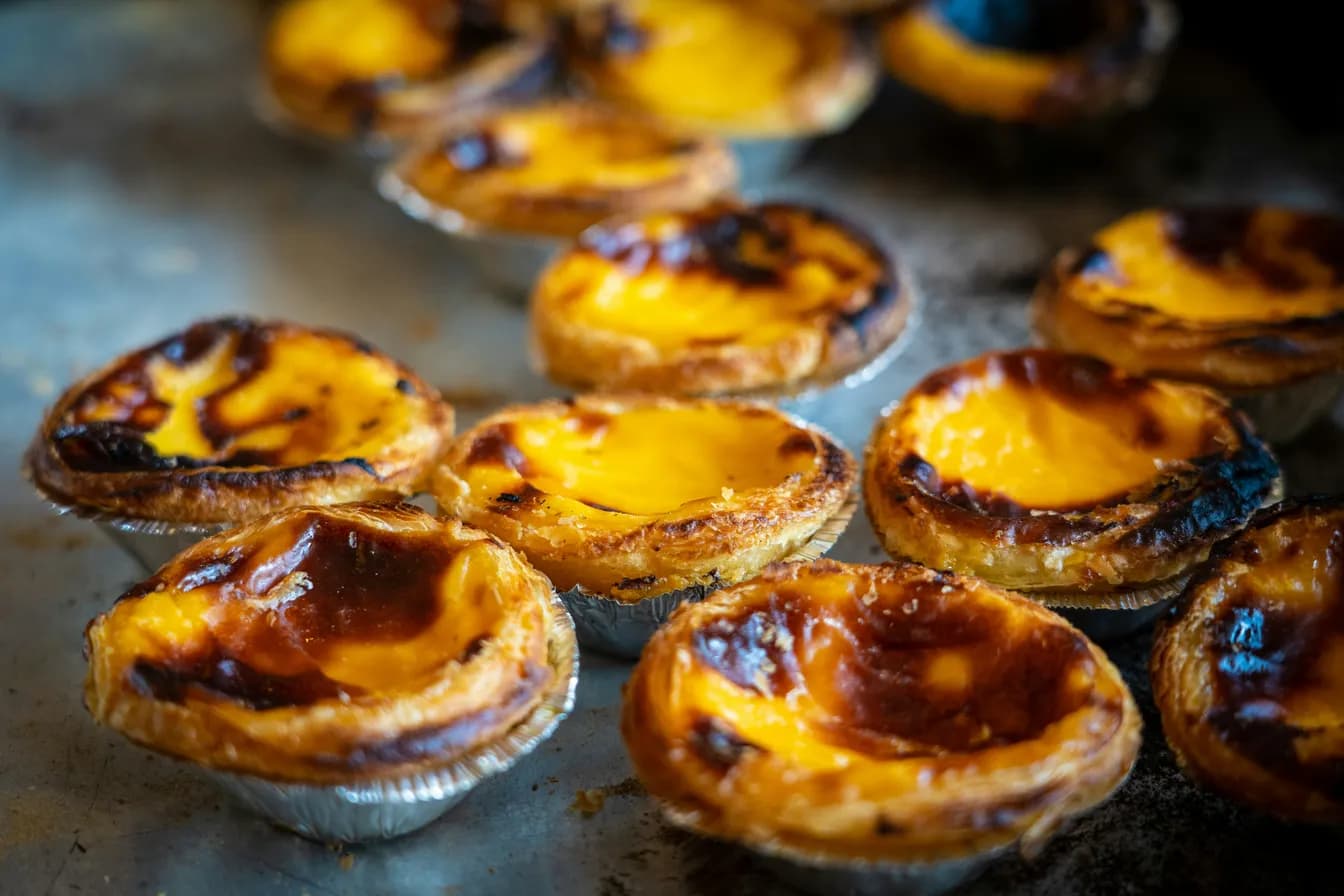
Portuguese custard tarts with puff pastry, baked in an oven as hot as it can go. The black blisters on the surface are not a mishap but the hallmark. They only form at over 250 degrees when the sugar in the custard caramelizes in spots before the custard sets. A home oven can just about manage this.
Why this works
The characteristic black blisters are the result of a race between two processes. The egg custard sets at around 80 degrees, while the sugar in it only caramelizes from 160 degrees. At moderate oven heat, the setting wins, and the custard becomes firm and remains pale yellow. Only at over 250 degrees is the surface hot enough quickly enough for caramelization to start in spots before the custard is fully set, resulting in the dark spots. Therefore, the oven temperature here is not a recommendation but a requirement. Below 240 degrees, you get a good custard tart, but not a Pastel de Nata. The second component is the rolled-up puff pastry. The spiral stands vertically in the tin, and the layers flake outwards during baking, creating the typical shell-shaped casing, which flatly laid dough cannot do.
Step-by-step instructions
- 1
Boil the sugar syrup
Boil the sugar and water with the cinnamon stick and lemon peel to exactly 100 degrees, then let the syrup cool. Remove the cinnamon stick and peel. The syrup gives the custard its sweetness and at the same time the liquid, which is why the sugar is not simply stirred in.
- 2
Milk and flour base
Mix the flour with a little cold milk until lump-free, pour in the remaining milk and cook everything while stirring to a thick cream. Remove from the heat and slowly stir in the lukewarm syrup, then the egg yolks. The syrup and egg yolks must not go into the boiling mixture, otherwise they will curdle.
- 3
Roll and cut the dough
Roll the puff pastry tightly from the long side into a roll and cut it into twelve equally thick slices. The spiral is crucial. It ensures that the layers flake outwards during baking and form the shell-shaped casing.
- 4
Press into the tin
Place one slice with the cut surface facing down into a greased muffin cup and press it up with a wet thumb from the center outwards to form a thin cup. The edge should protrude slightly over the cup. Chill for one hour.
- 5
Bake at 260 °C
Preheat the oven to the highest setting, at least 250 degrees. Fill the pastry cups three-quarters full with custard and bake them for twelve to fifteen minutes until the surface throws dark blisters. They should really get black spots, which is the difference to a standard custard tart. Serve lukewarm dusted with cinnamon.
Our best tips
- The oven must be at maximum. Below 240 degrees, the custard sets before it can caramelize, and the black blisters will not appear.
- Pastéis de Nata are a day-of pastry. After a few hours, moisture from the custard seeps into the dough and the shell becomes soft, which is why in Lisbon there are always only small batches on the shelf.
- The syrup must be cooled before it is added to the egg yolks. Hot sugar syrup cooks them immediately and the custard becomes grainy.
Tasty variations
With vanilla instead of cinnamon
Replace the lemon peel and cinnamon stick with a scraped vanilla pod. Not classic, but quite common in Portuguese cafes.
Finish with top heat
If the oven cannot reach 250 degrees, finish baking under the broiler for the last three minutes. This comes closest to creating the blisters.
What is left over?
This recipe only uses the yolks. The whites keep for three days in the fridge and freeze well – nobody has to throw them out.
Nutrition facts
| Calories | 205 kcal |
|---|---|
| Protein | 4 g |
| Carbohydrates | 27 g |
| – of which sugar | 18 g |
| Fat | 9 g |
| Fiber | 1 g |
Where the 205 kcal come from
per serving
Calculated from the ingredients – how we do it
We add up reference values for every ingredient and divide by the number of servings. These assumptions are baked in:
- Reference values per 100 g – for the raw ingredient, exactly as listed.
- Tinned goods count at drained weight, bone-in meat at purchase weight: you eat about 70 per cent of a chicken thigh and leave the rest.
- Water evaporates as you cook. The energy stays in the pot, the weight does not – so the figure is per serving, not per 100 g of finished dish.
- Anything listed without a quantity – “salt and pepper” – is not counted.
A guide value, not a lab measurement: no two onions weigh the same, and fat content varies from pack to pack.
Frequently asked questions
Why are my Pastéis not getting black spots?
The oven was too cool. The custard sets at 80 degrees, the sugar only caramelizes from 160, and only at over 250 degrees top heat does the caramelization win the race. If necessary, use the broiler for the last few minutes.
How many calories does a Pastel de Nata have?
Around 205 kcal per piece for twelve pieces. Puff pastry and sugar make up the majority. The tarts are small, and that is part of the concept.
Can I prepare them in advance?
The custard yes, for one day in the fridge. The baked tarts, however, no. After a few hours, moisture seeps into the dough and the shell loses its crispness.
Do I need a special tin?
No, a muffin tin works. In Portugal, flatter, conical molds are used, which result in a thinner shell. The difference is noticeable but small.
Comments & ratings(0)
Sign in to rate and comment on this recipe.
You might also like
 Cakes & Pastries
Chocolate Muffins
Dark, moist muffins with a domed top and melted chocolate chunks.
 Cakes & Pastries
Zucchini Brownies
A whole zucchini in the batter, and nobody notices it: instead, they stay moist for three days.
 Desserts
Peach Crumble with Oat Streusel
One kilo of peaches, one baking dish, forty minutes, and streusel that still crunches the next day.