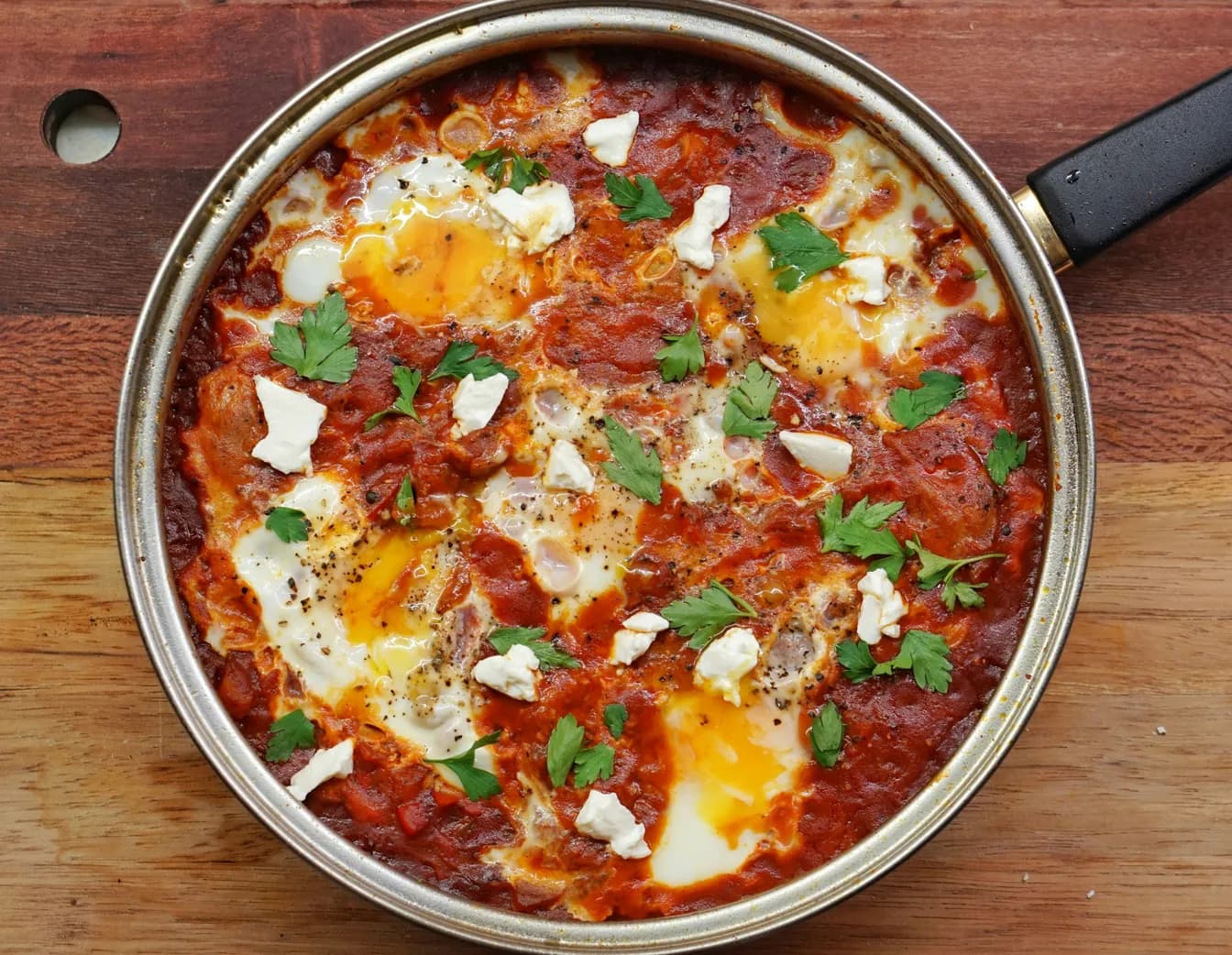
Menemen
Turkish scrambled eggs with tomatoes and green peppers, and the eggs are just stirred in, not cooked through.
- Preparation
- 15 min
- Cook/bake time
- 25 min
- Total
- 40 min
- Difficulty
- Easy
- Calories
- 530 kcal
- Servings
- 2
- Prep
- 15 min
- Cooking & baking
- 25 min
Turkish scrambled eggs with tomatoes and green peppers, and the eggs are just stirred in, not cooked through. The difference to shakshuka is exactly that: there the eggs remain whole and set in wells, here they are pulled through the vegetables with a fork and remain creamy. In Turkey, menemen is a breakfast, not a dinner.
Why this works
The difference between creamy and dry scrambled eggs lies solely in the temperature at which the egg proteins coagulate. Between 62 and 65 degrees they form a loose network that traps liquid, which is the creamy state. From 70 degrees this network contracts and squeezes out the water, making scrambled eggs grainy and dry. For menemen, the heat is therefore reduced before the eggs are added, and the pot is taken off the stove early at the end, as the residual heat continues to cook. The tomatoes play an unexpected supporting role here: their water content keeps the pan temperature low as long as liquid is still evaporating, thereby buffering the heat. That is why they must be boiled down beforehand until the mixture is thick, as tomatoes that are too watery would dilute the egg instead of supporting it.
Step-by-step instructions
- 1
Sweat peppers and onions
Sweat onions and pepper strips in olive oil over medium heat for eight minutes until soft. Turkish pointed peppers are thinner-walled and sweeter than bell peppers, so if not available, use green pointed peppers or light bell peppers.
- 2
Boil down tomatoes
Add the peeled, diced tomatoes with paprika powder and Pul Biber and let everything boil down uncovered for eight to ten minutes until the mixture is thick and there is no more water. Tomatoes that are too moist will water down the egg later.
- 3
Reduce heat
Turn the heat down to the lowest setting and wait a minute. This is the step you skip and then regret: poured into a hot pan, the egg sets immediately, and menemen becomes scrambled eggs with tomatoes.
- 4
Stir in eggs
Pour the beaten eggs over the vegetables and pull them through slowly with a spatula, do not stir, but pull. Take the pan off the heat as soon as the mixture still looks slightly shiny and moist, as the residual heat will finish cooking it.
- 5
Serve
Sprinkle feta and parsley over it and season with salt and pepper. Menemen comes to the table in the pan, accompanied by white bread for dipping, as in Turkey it is a breakfast dish that is shared.
Our best tips
- Turn the heat down before the eggs go in. There are only a few degrees between creamy and grainy, and nothing can be undone.
- Take the pan off the heat earlier than it looks right. Residual heat continues to cook for another half minute, so whoever waits until it looks done has overcooked it.
- Pul Biber is the Turkish chili flake standard: fruity and mild, not burning hot. Normal chili flakes are significantly hotter, so use half.
Tasty variations
With Sucuk
Render 150 g of sliced sucuk beforehand and sweat the vegetables in its fat. In Turkey, this is the most common addition.
Without stirring
Place the eggs whole in wells and let them set covered. Then it is closer to shakshuka than to menemen, which is good, but a different dish.
Nutrition facts
| Calories | 530 kcal |
|---|---|
| Protein | 25 g |
| Carbohydrates | 22 g |
| – of which sugar | 18 g |
| Fat | 37 g |
| Fiber | 7 g |
Where the 530 kcal come from
per serving
Calculated from the ingredients – how we do it
We add up reference values for every ingredient and divide by the number of servings. These assumptions are baked in:
- Reference values per 100 g – for the raw ingredient, exactly as listed.
- Tinned goods count at drained weight, bone-in meat at purchase weight: you eat about 70 per cent of a chicken thigh and leave the rest.
- Water evaporates as you cook. The energy stays in the pot, the weight does not – so the figure is per serving, not per 100 g of finished dish.
- Anything listed without a quantity – “salt and pepper” – is not counted.
A guide value, not a lab measurement: no two onions weigh the same, and fat content varies from pack to pack.
Frequently asked questions
What is the difference to shakshuka?
In menemen, the eggs are beaten and pulled through the vegetables, while in shakshuka they remain whole and set in wells. Then there is the seasoning: menemen remains mild with paprika, while shakshuka brings cumin and harissa.
How many calories does menemen have?
Around 530 kcal per portion with feta. Without feta it is about 400 kcal, as the olive oil also contributes significantly with around 130 kcal per portion.
Why does my menemen get grainy?
The pan was too hot when the eggs went in. Egg proteins form a creamy network between 62 and 65 degrees and squeeze out water from 70 degrees. Reduce heat and take off the stove early.
Which peppers belong in it?
Turkish pointed peppers, thin-walled and mildly sweet. In the Turkish supermarket they are usually simply called sivri biber. Alternatively, green pointed peppers, as bell peppers are thicker-walled and need a few minutes longer.
Comments & ratings(0)
Sign in to rate and comment on this recipe.
You might also like
 Lunch
LunchGrilled Cheese Sandwich
Golden brown toasted bread with a stringy cheese core, ready in ten minutes.
 Breakfast
Shakshuka
Eggs poached in a spicy tomato and bell pepper sauce, eaten straight from the pan with bread.
 Dinner
Spanish Tortilla
Thick Spanish potato and egg omelet with a soft, slightly runny center.